Highlight
- Preoperative analgesic education did not significantly reduce postoperative opioid consumption following hip arthroplasty or laparoscopic-assisted abdominal surgery.
- There were no significant differences in postoperative pain scores or patient satisfaction with analgesia between patients receiving analgesic education versus generic surgical information.
- The findings suggest that brief educational interventions alone may be insufficient to optimize postoperative opioid use and pain management.
- Further research is warranted to explore more intensive or multimodal patient education strategies to improve pain outcomes while minimizing opioid reliance.
Study Background
Effective management of postoperative pain is a cornerstone of surgical recovery, influencing patient comfort, satisfaction, and functional outcomes. Opioids remain a mainstay of postoperative analgesia, yet their use carries inherent risks including tolerance development, dependence, and potential for misuse or addiction. This is particularly concerning given the ongoing opioid epidemic worldwide. Consequently, healthcare providers and systems are actively seeking avenues to reduce opioid consumption without compromising pain control. Preoperative patient education aimed at informing patients about analgesic options, appropriate opioid use, and expectations for postoperative pain may offer a nonpharmacologic strategy to mitigate opioid dependence post-surgery. Prior data on the effectiveness of such education have been mixed, and rigorous randomized clinical trials are needed to evaluate their impact on opioid consumption, pain experience, and patient satisfaction. The current study addresses this clinical gap by assessing whether a preoperative analgesic educational video influences postoperative opioid use and patient-reported outcomes in two common surgical populations.
Study Design
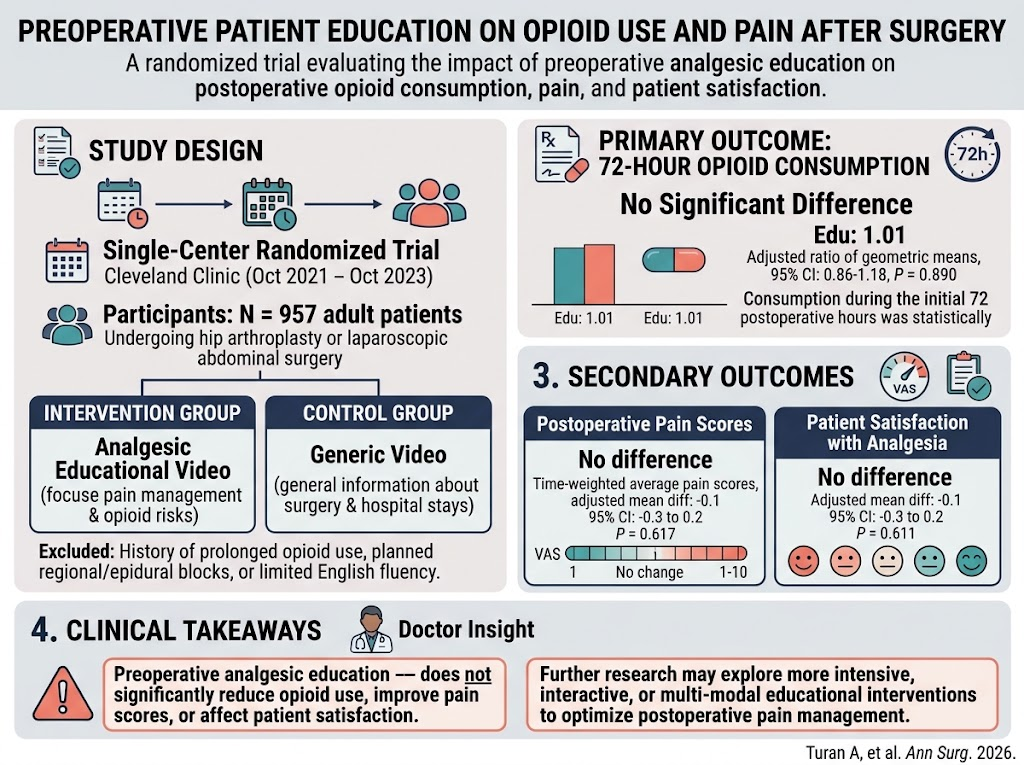
This was a prospective, single-center randomized controlled trial conducted at the Cleveland Clinic Main Campus over a two-year period (October 2021 to October 2023). Eligible participants were adults undergoing hip arthroplasty or laparoscopic-assisted abdominal surgery, with the American Society of Anesthesiologists (ASA) physical status classification between 1 and 4. Key exclusion criteria included histories of prolonged opioid use, planned use of regional blocks or epidural analgesia, and limited English language proficiency.
Participants were randomized 1:1 to receive either a targeted analgesic educational video or a generic educational video concerning surgical and hospitalization information prior to surgery. The analgesic education video focused on opioid use, risks, alternative pain management strategies, and realistic pain expectations after surgery.
The primary outcome measure was total opioid consumption during the first 72 hours after surgery, assessed quantitatively. Secondary outcomes included the time-weighted average of postoperative pain scores and patient satisfaction measured via validated scales related to analgesia efficacy.
Key Findings
A total of 957 patients were analyzed. The primary outcome showed no statistically significant difference in opioid consumption between the analgesic education group and the control group, with an adjusted ratio of geometric means of 1.01 (95% confidence interval [CI] 0.86 to 1.18, P = 0.890). This indicates that preoperative analgesic education neither reduced nor increased opioid use in the immediate postoperative period.
Similarly, no significant differences were observed for secondary outcomes. The adjusted mean difference in time-weighted average pain scores was -0.1 (95% CI -0.3 to 0.2, P = 0.617), indicating that pain intensity perceived by patients was comparable regardless of the educational intervention received.
Patient satisfaction with analgesia also did not differ meaningfully, with an adjusted mean difference of -0.1 (95% CI -0.3 to 0.2, P = 0.611). These findings suggest that the brief preoperative educational intervention did not enhance patients’ satisfaction with their postoperative analgesic care.
No notable safety concerns or adverse events related to the intervention were reported.
Expert Commentary
The results of this well-designed randomized controlled trial challenge the assumption that brief preoperative educational videos alone can significantly influence opioid consumption or enhance postoperative pain experience. Several potential explanations may account for these findings. First, the complexity of pain perception and opioid use behavior often requires multifaceted interventions beyond education, including psychological support, multimodal analgesia, and tailored prescribing practices.
Second, the scope and depth of the educational content and mode of delivery may have been insufficient to alter deeply ingrained patient expectations or habits regarding pain and opioids. The exclusion of patients with prolonged opioid use limits generalizability to a population at higher risk of opioid dependence. Furthermore, cultural and individual patient factors influencing opioid perception and reporting may not be adequately addressed by standardized video content.
Prior literature has shown mixed results with educational approaches, with some studies advocating for multimodal strategies combining education with enhanced prescribing protocols and psychosocial interventions to effect meaningful change.
Limitations include the single-center design, potential language and cultural homogeneity, and lack of longer-term follow-up to assess persistent opioid use or chronic pain outcomes. Nonetheless, this trial contributes valuable evidence disfavoring reliance on brief educational videos as a sole strategy to modify postoperative opioid utilization.
Conclusion
This randomized trial demonstrates that preoperative analgesic education in the form of a standardized video does not produce clinically meaningful reductions in postoperative opioid consumption, nor does it improve immediate postoperative pain scores or patient satisfaction with analgesia in adult patients undergoing hip arthroplasty or laparoscopic-assisted abdominal surgery. These results underscore the need for more comprehensive and intensive approaches to patient education, possibly integrated into multimodal pain management protocols, to safely optimize postoperative pain control and minimize opioid-related risks. Future studies should explore tailored educational interventions, incorporate behavioral and pharmacologic strategies, and evaluate long-term outcomes to better guide clinical practice and policy development in postoperative analgesia management.
Funding and Clinical Trials Registration
The study was conducted at the Cleveland Clinic with no specific funding source reported in the publication. Trial registration details were not explicitly provided in the abstract or citation.
References
Turan A, Karras T, Medellin S, Kharabe A, Ekrami E, Wang J, Yalcin EK, Cummings K, Shah K, Ruetzler K, Sessler DI; Collaborative Patient Education Trial Group. Preoperative Patient Education on Opioid Use and Pain After Surgery: A Randomized Trial. Ann Surg. 2026 Oct 1;284(4):744-750. doi: 10.1097/SLA.0000000000006717. Epub 2025 Apr 14. PMID: 40223603.