Highlight
This study elucidates the multifactorial hospital configurations that enable successful adoption of Enhanced Recovery Programs (ERPs) post-surgery, emphasizing that implementation success depends on complex combinations of organizational readiness, resource allocation, and staff engagement tailored to hospital characteristics.
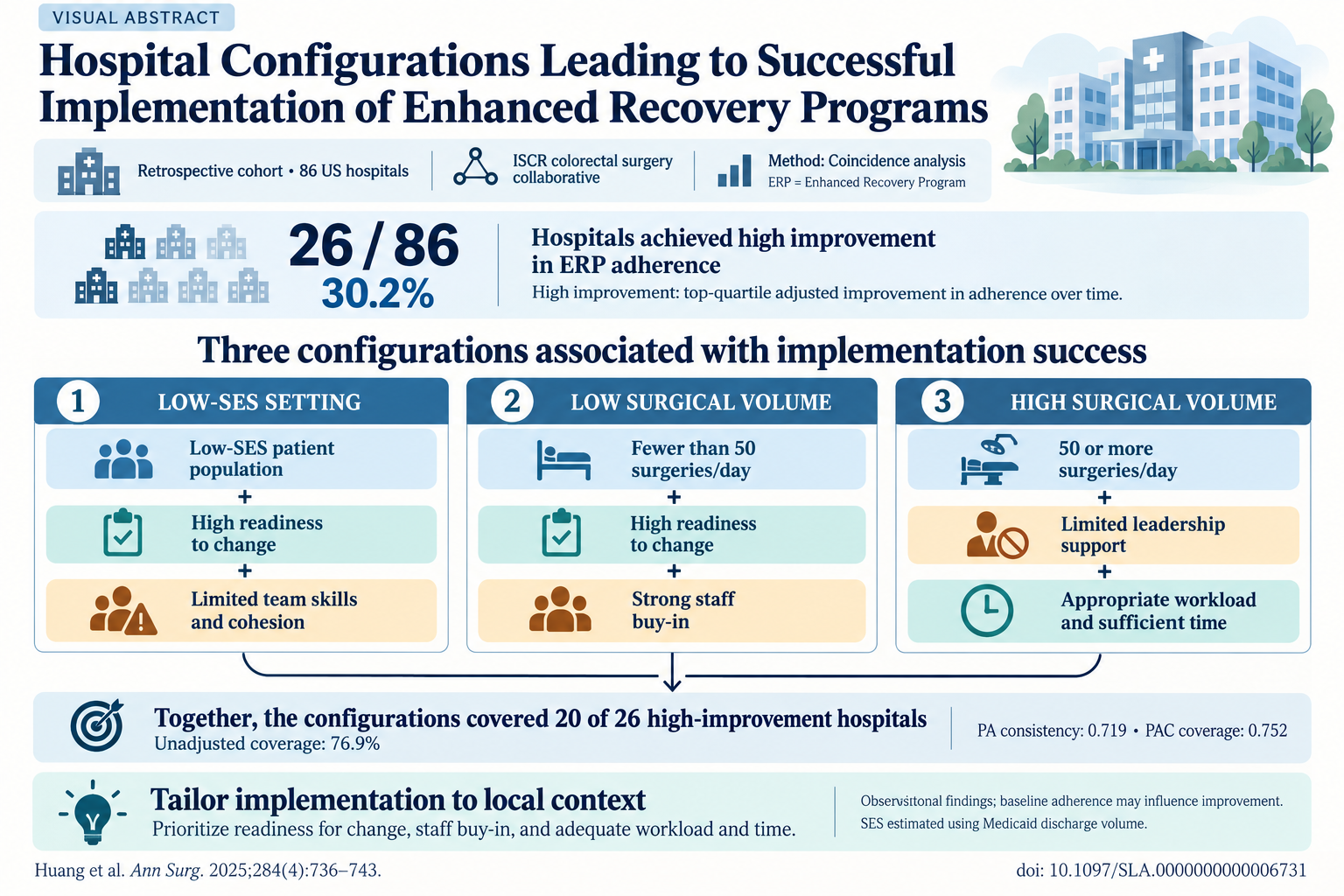
Three distinct contextual scenarios identified include: (1) socioeconomically challenged hospitals with readiness but lacking team cohesion; (2) low surgical volume centers with strong buy-in and readiness; and (3) high-volume hospitals compensating for lack of leadership support with appropriate workload and time allocation.
Study Background
Enhanced Recovery Programs (ERPs), a set of evidence-based perioperative care protocols, have been shown to improve surgical outcomes by reducing complications, shortening hospital stays, and accelerating patient recovery. Despite their proven efficacy, widespread and effective implementation of ERPs in hospitals remains a challenge. The heterogeneous success of ERP adoption suggests that local hospital environments, resources, and implementation strategies critically influence outcomes.
Understanding these contextual and process factors is essential for tailoring interventions and maximizing quality improvement in surgical care nationally. This study addresses the clinical imperative by analyzing the unique hospital configurations that underpin successful ERP implementation.
Study Design
This investigation utilized data from a national surgical collaborative encompassing 86 hospitals. Success was operationalized as being in the top quartile for improvement in ERP adherence rates over time, i.e., demonstrating significant uptake of ERP practices.
The researchers examined multiple explanatory variables grouped into three domains: implementation resources (knowledge of ERP evidence, leadership support, team skills and cohesion, stakeholder buy-in, workload/time management), organizational readiness to change, and hospital characteristics (teaching status, bed size, surgical volume, and socioeconomic status of patient populations).
A mathematical method known as coincidence analysis was employed to identify configurations of conditions that are both necessary and sufficient for successful ERP implementation. Model fit was assessed with prevalence-adjusted consistency and contrapositive coverage metrics to ensure robustness against outcome prevalence bias.
Key Findings
Out of 86 hospitals, 26 (30.2%) successfully improved ERP adherence substantially. The analysis revealed three principal, context-dependent pathways explaining over 70% of successful implementations:
- Scenario 1: Hospitals serving low socioeconomic status populations that were organizationally ready for change but suffered from insufficient team skills and cohesion. Despite this deficiency, the readiness to change was a strong enabling factor.
- Scenario 2: Low surgical volume hospitals combining readiness for change with strong staff and stakeholder buy-in. This combination created a conducive environment for ERP adoption despite smaller operative throughput.
- Scenario 3: High surgical volume hospitals lacking formal leadership support, yet compensating with appropriate workload allocation and sufficient time dedicated to rolling out ERP protocols.
These findings underscore that no single condition guarantees ERP success; instead, distinct synergistic configurations of organizational and contextual factors can result in effective implementation.
Crucially, organizational readiness to change emerged as a consistent cornerstone across all scenarios, signaling its paramount importance. Strong staff buy-in and adequate time and workload management likewise featured prominently, whereas traditional markers such as teaching status or bed size were not independently influential.
Expert Commentary
This study offers critical insights into the implementation science of surgical quality improvement. By leveraging coincidence analysis, the authors have moved beyond simplistic univariate predictors to map the complex interplay of hospital-level determinants.
The three scenarios identified reflect plausible real-world adaptations. For instance, socioeconomically disadvantaged hospitals may leverage high motivation for change to overcome team cohesion challenges, while high-volume centers may rely on operational adjustments to offset leadership gaps. These nuanced findings can guide tailored strategies according to hospital profile.
Limitations include the observational design inherent to collaborative data and potential residual confounding by unmeasured cultural or financial factors. The generalizability to other care improvement initiatives beyond ERPs warrants further study.
Conclusion
The successful implementation of Enhanced Recovery Programs is multifactorial and context-specific. Hospitals achieve ERP success through diverse but identifiable combinations of readiness to change, stakeholder engagement, and pragmatic workload/time support. Recognizing hospital heterogeneity and aligning interventions to specific contextual profiles can enhance surgical quality improvement efforts nationwide.
This research emphasizes the need for flexible, tailored implementation frameworks rather than one-size-fits-all solutions, offering a valuable roadmap to optimize ERP adoption and improve patient outcomes.
Reference
Huang R, Remer SL, Knapp LK, Cohen ME, Rosen MA, Hall BL, Wick EC, Ko CY. Hospital Configurations Leading to Successful Implementation of Enhanced Recovery Programs. Ann Surg. 2026 Oct 1;284(4):736-743. doi: 10.1097/SLA.0000000000006731. Epub 2025 Apr 16. PMID: 40235443; PMCID: PMC12354056.