Highlight
- Peripheral parenteral nutrition (PPN) after colorectal surgery reduces early postoperative inflammatory response as measured by procalcitonin levels.
- PPN improves short-term nitrogen balance, indicating a mitigation of postoperative catabolism compared to standard dextrose-saline infusion.
- The use of PPN is safe with no significant increase in overall or major postoperative complications.
Study Background
Major colorectal surgery induces significant metabolic stress and an inflammatory response, leading to postoperative catabolism and delayed functional recovery. These physiological perturbations impair protein synthesis and increase muscle breakdown, adversely affecting wound healing, immune competence, and overall recovery trajectory. Nutritional support in the early postoperative period is crucial to counteract these effects; however, the optimal mode and timing of nutritional intervention remain under investigation. Peripheral parenteral nutrition offers a minimally invasive method to deliver essential macronutrients postoperatively but lacks robust clinical trial evidence in colorectal surgery populations. This study addresses this gap by evaluating whether early postoperative peripheral parenteral nutrition modulates inflammatory markers and improves short-term nutritional status in patients undergoing colorectal resection.
Study Design
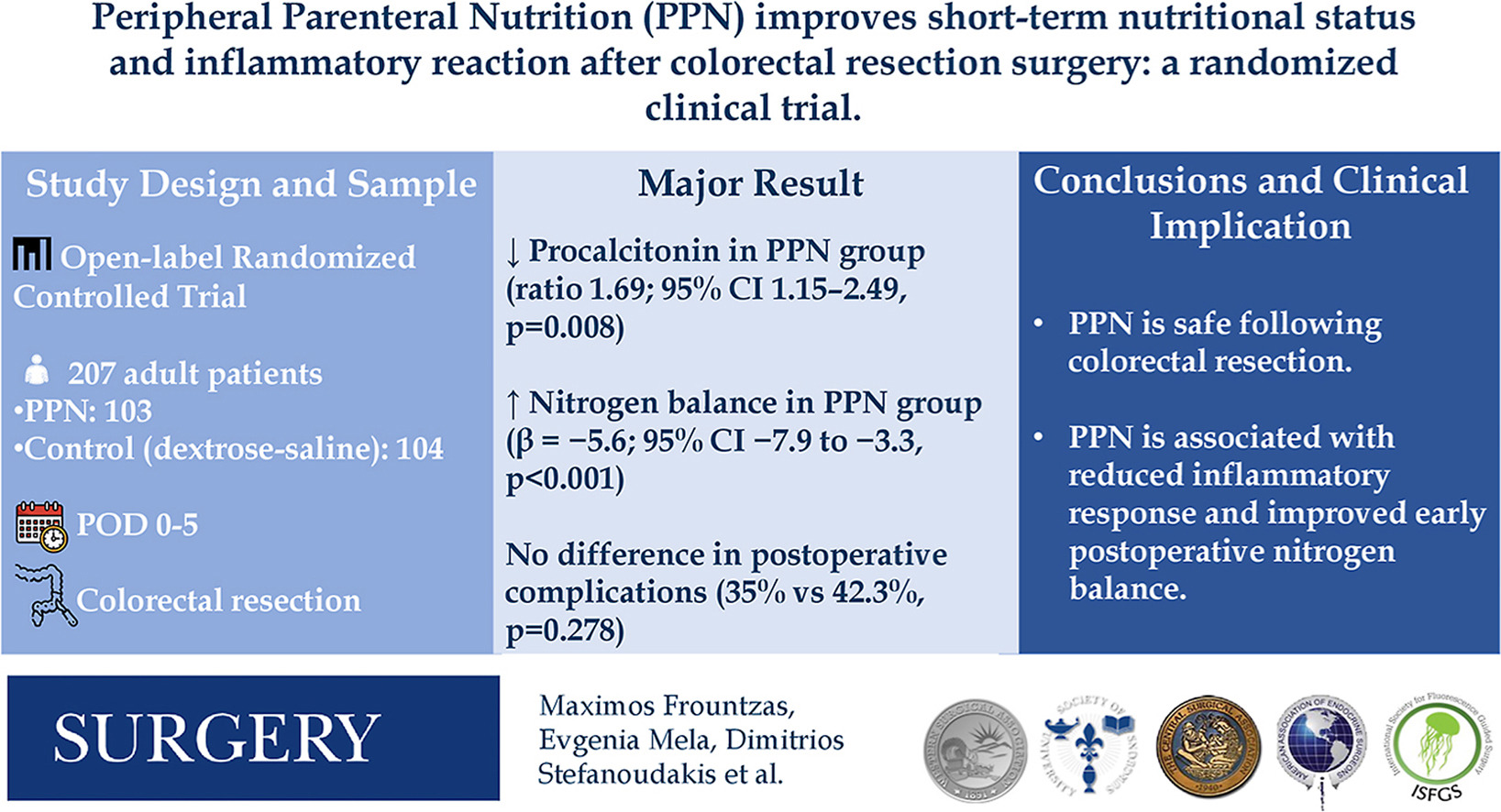
This was an open-label, randomized controlled superiority trial (NCT06737211) conducted among adult patients undergoing either elective or emergency colorectal resection. Participants were randomized 1:1 to receive either peripheral parenteral nutrition (PPN) or 5% dextrose-normal saline with identical electrolyte supplementation over the first five postoperative days. The PPN regimen included macronutrients appropriate for nutritional repletion delivered via peripheral venous access. The primary endpoints included postoperative complications assessed by the Clavien-Dindo classification, inflammatory markers such as procalcitonin levels, and nutritional parameters including nitrogen balance. A modified intention-to-treat analysis was employed to preserve the integrity of randomization while accounting for protocol deviations.
Key Findings
A total of 207 patients were analyzed, with 103 in the PPN arm and 104 in the control group. Baseline demographic and operative characteristics were well matched, mitigating selection bias. Postoperative complication rates did not differ significantly between the groups: 35% in the PPN group versus 42.3% in controls (P = .278), and major complications (Clavien-Dindo ≥3) were also similar (25% vs 28.9%, P = .696), supporting the safety of PPN.
Inflammatory response, assessed via procalcitonin—a biomarker reflecting systemic inflammation and bacterial infection—was significantly attenuated in the PPN group. On postoperative day 3, patients receiving dextrose-saline had a 69% higher median procalcitonin level than those receiving PPN (ratio of medians 1.69; 95% CI, 1.15-2.49; P = .008), suggesting a moderated inflammatory milieu with nutritional support.
From a nutritional standpoint, nitrogen balance, an index of protein metabolism reflecting net body protein gain or loss, was significantly more favorable in the PPN group. The beta coefficient of -5.6 (95% CI, -7.9 to -3.3; P < .001) indicated that patients in the control group experienced a more negative nitrogen balance, thus greater catabolism, compared to those receiving PPN. This improved nitrogen retention in the PPN arm translates into better preservation of lean body mass and potentially improved recovery.
These biochemical and nutritional advantages did not translate into a higher complication rate or adverse safety signal, highlighting PPN as a well-tolerated intervention.
Expert Commentary
This study provides compelling evidence to support the adoption of early peripheral parenteral nutrition after colorectal resection. The attenuation of procalcitonin suggests that targeted nutritional supplementation may modulate systemic inflammatory responses, potentially via reduced metabolic stress and immune support mechanisms. Improved nitrogen balance aligns with preclinical models demonstrating that adequate protein supply prevents muscle wasting and supports anabolism.
However, limitations include the open-label design, which could introduce performance bias, although objective biomarkers were primary outcomes. The trial’s single-center nature may affect generalizability, and long-term outcomes such as functional recovery and quality of life were not assessed. Further multicentric studies incorporating functional metrics and cost-effectiveness analyses could strengthen evidence for routine clinical implementation.
Clinicians should also consider patient-specific factors such as baseline nutritional status, comorbidities, and risk of parenteral nutrition-associated complications when tailoring postoperative care.
Conclusion
Early postoperative peripheral parenteral nutrition following colorectal resection surgery is a safe and effective strategy to attenuate systemic inflammation and improve nitrogen balance, key determinants of postoperative recovery. The intervention does not increase postoperative complications and may facilitate a more favorable metabolic milieu conducive to healing and functional restoration. This trial underscores the importance of nutritional interventions as adjunctive therapies in major abdominal surgery and prompts further research into optimizing perioperative nutrition protocols.
Funding and ClinicalTrials.gov
The trial was registered on ClinicalTrials.gov (NCT06737211). Details on funding were not specified in the abstract. Further inquiry into funding sources and potential conflicts of interest is advisable to assess study independence.
References
Frountzas M, Mela E, Stefanoudakis D, Theodorou P, Gkotsi I, Linardoutsos D, Triantafyllou T, Chamzin A, Manouras I, Smparounis S, Memos N, Theodorou D, Theodoropoulos G, Toutouzas K. Peripheral parenteral nutrition improves short-term nutritional status and inflammatory reaction after colorectal resection surgery: A randomized clinical trial. Surgery. 2026 Jul 18;198:110458. doi:10.1016/j.surg.2026.110458. PMID: 42561639.