DOI: 10.1136/gutjnl-2024-334562.video01
Highlight
- Hepatocyte-specific PCK1 expression is downregulated in metabolic dysfunction-associated steatohepatitis-related hepatocellular carcinoma (MASH-HCC) tissues.
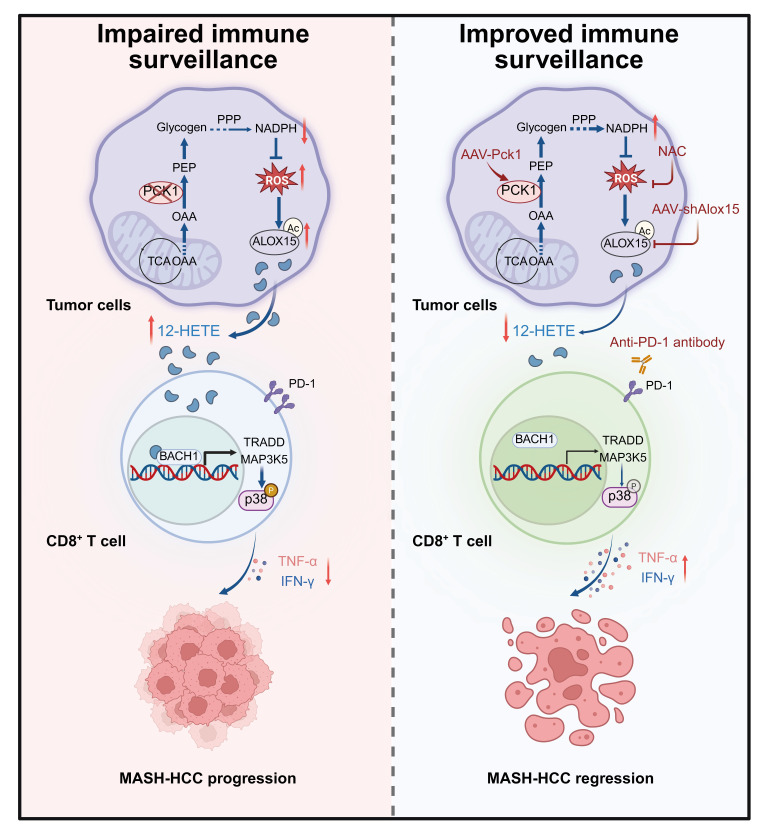
- PCK1 deficiency promotes MASH-HCC tumor progression by inducing accumulation of 12-hydroxyeicosatetraenoic acid (12-HETE), a metabolite impairing CD8+ T cell effector function.
- 12-HETE triggers CD8+ T cell dysfunction via the p38 MAPK pathway through interaction with the BTB and CNC homology 1 transcription factor.
- Restoring PCK1 levels or inhibiting 12-HETE synergizes with anti-PD-1 immune checkpoint blockade to boost antitumor immunity in MASH-HCC.
Study Background
Metabolic dysfunction-associated steatohepatitis (MASH), a severe form of non-alcoholic fatty liver disease, increasingly contributes to hepatocellular carcinoma (HCC) development worldwide. MASH-HCC is associated with distinct metabolic and immunological tumor microenvironment remodeling, which significantly reduces responsiveness to immune checkpoint inhibitors such as anti-PD-1 antibodies. The precise metabolic mechanisms driving immune evasion and tumor progression in MASH-HCC remain incompletely understood. This represents a critical clinical challenge, as immunotherapy is less effective in these patients, necessitating mechanistic insights to identify novel therapeutic targets. The gluconeogenic enzyme phosphoenolpyruvate carboxykinase 1 (PCK1), essential for hepatic glucose metabolism, has been implicated in cancer metabolism; however, its role in MASH-HCC and the tumor immune microenvironment is unclear.
Study Design
The study employed hepatocyte-specific knockout mouse models to investigate PCK1’s role in MASH-HCC. Mice with biallelic deletion of phosphatase and tensin homologue (Pten) and Pck1 in hepatocytes were generated, facilitating spontaneous liver tumorigenesis mimicking human MASH-HCC conditions. Dietary models were used to induce metabolic liver disease and tumor formation. Extensive single-cell RNA sequencing characterized tumor-infiltrating immune cell populations and their functional states. Multiparametric flow cytometry validated immune cell phenotypes. Untargeted metabolomics elucidated alterations in hepatic metabolic profiles correlated with PCK1 deficiency. Functional assays assessed CD8+ T cell effector responses and signaling pathways involved. Therapeutic interventions included PCK1 restoration vectors and pharmacologic 12-HETE inhibitors, both combined with anti-PD-1 antibody therapy to evaluate antitumor efficacy.
Key Findings
PCK1 Downregulation in Human and Murine MASH-HCC
Analysis of tumor tissues from MASH-HCC patients revealed significant suppression of PCK1 expression compared to adjacent non-cancerous liver tissues, suggesting a tumor-intrinsic metabolic alteration. Corresponding murine models recapitulated these findings, where hepatocyte-specific Pck1 knockout markedly accelerated liver tumorigenesis under steatohepatitis conditions.
CD8+ T Cell Dysfunction Linked to PCK1 Deficiency
Immune profiling demonstrated that tumors arising in Pck1-deficient livers harbored dysfunctional CD8+ T cells characterized by reduced production of cytotoxic cytokines and impaired tumor-clearing capacity. Single-cell transcriptomics revealed an exhausted CD8+ T cell phenotype, implicating metabolic factors in driving this immune suppression.
Metabolic Mechanism: 12-HETE Accumulation and Immune Modulation
Untargeted metabolomics identified a significant accumulation of 12-hydroxyeicosatetraenoic acid (12-HETE), an arachidonic acid metabolite, in Pck1-deficient hepatic tumor tissues. Mechanistic studies showed that 12-HETE is absorbed by CD8+ T cells and activates the p38 mitogen-activated protein kinase (MAPK) pathway. Molecular binding assays revealed that 12-HETE directly interacts with BTB and CNC homology 1 (BACH1) transcription factor, mediating downstream signaling events that culminate in CD8+ T cell dysfunction.
Therapeutic Implications: Enhancing Immunotherapy Efficacy
Restoration of PCK1 expression in tumor hepatocytes or pharmacological inhibition of 12-HETE significantly improved CD8+ T cell function. When combined with anti-PD-1 immune checkpoint blockade, these interventions yielded potent suppression of tumor growth in murine MASH-HCC models, suggesting a promising combinatorial immunometabolic strategy.
Expert Commentary
This study by Wu et al. delineates a novel metabolic immunosuppressive axis in MASH-HCC linking hepatocyte-intrinsic gluconeogenic enzyme deficiency to dysfunctional cytotoxic T lymphocytes via metabolite signaling. The identification of 12-HETE as a critical mediator provides mechanistic insight into how metabolic dysregulation impairs antitumor immunity. The direct engagement of the p38 MAPK pathway through the BACH1 transcription factor elaborates a precise intracellular signaling cascade in immune cells. Importantly, the work highlights PCK1 as a metabolic checkpoint that could be exploited therapeutically to sensitize otherwise refractory MASH-HCC to immunotherapy. However, potential limitations include the challenge of translating murine genetic models to heterogeneous human tumors and the safety profile of systemic 12-HETE inhibition. Future clinical studies need to validate these findings and explore biomarkers predicting response.
Conclusion
The study provides compelling evidence that PCK1 deficiency in hepatocytes fosters an immunosuppressive microenvironment in MASH-HCC via 12-HETE–p38 MAPK–BACH1 driven CD8+ T cell dysfunction. Targeting this metabolic-immune interplay offers a promising avenue to overcome immune checkpoint inhibitor resistance in this increasingly prevalent liver cancer subset. Restoration of PCK1 activity or blockade of 12-HETE, combined with anti-PD-1 therapy, could form the basis of novel, tailored immunometabolic treatments enhancing therapeutic outcomes for patients with MASH-HCC.
Funding and ClinicalTrials.gov
The original study was supported by multiple national science foundations and institutional grants, reflecting extensive multidisciplinary collaboration. No registered clinical trials are directly associated with the PCK1-12-HETE axis in MASH-HCC therapy to date; however, these preclinical results provide a rationale for future clinical exploration.
References
1. Wu K et al. PCK1 deficiency promotes MASH-HCC progression by 12-HETE-induced CD8+ T cell dysfunction. Gut. 2026;75(9):1816-1830. PMID: 41407525.
2. Younossi ZM, et al. Global Epidemiology of Nonalcoholic Fatty Liver Disease—Meta-Analytic Assessment of Prevalence, Incidence, and Outcomes. Hepatology. 2016;64(1):73-84.
3. Sharma A et al. Immunotherapy in hepatocellular carcinoma: current status and future prospects. J Hepatol. 2020;72(2):350-369.
4. Zanoni M, et al. Metabolic reprogramming in hepatocellular carcinoma: Role in immune evasion and immunotherapy. Front Oncol. 2022;12:939576.
5. Wang R et al. The role of 12-HETE in inflammation and cancer progression. Cancer Lett. 2018;421:56-61.