Highlight
- Adjunctive normobaric hyperoxia (NBO) administered with endovascular thrombectomy (EVT) improves early neurological outcomes in acute ischemic stroke presenting 6 to 24 hours after onset.
- NBO combined with EVT significantly reduces cerebral infarct volume measured at 24 to 48 hours post-procedure.
- The combination therapy is safe, showing no increase in mortality, symptomatic intracranial hemorrhage, or recurrent stroke compared to EVT alone.
- While 90-day functional outcomes favored the combination therapy, differences were not statistically significant, highlighting the need for larger trials.
Study Background and Disease Burden
Acute ischemic stroke (AIS) caused by large vessel occlusion (LVO) is a leading cause of long-term disability and mortality worldwide. Endovascular thrombectomy (EVT) has revolutionized treatment, offering rapid vessel recanalization and improved outcomes. However, its efficacy diminishes as time from stroke onset increases, and many patients present beyond the traditional treatment window. Neuroprotective strategies that can enhance the benefits of EVT, particularly in late-presenting patients (6 to 24 hours post-onset), remain an unmet clinical need.
Normobaric hyperoxia (NBO), the administration of 100% oxygen at normal atmospheric pressure, is a simple and cost-effective intervention that may mitigate ischemic injury by improving tissue oxygenation during reperfusion. Prior experimental and small clinical studies suggested NBO could reduce infarct growth and neurological deficits, but robust evidence in combination with EVT, specifically in extended time windows, has been lacking.
Study Design
This phase IIb randomized controlled trial (NCT05128422) investigated the safety and preliminary efficacy of adjunctive NBO plus EVT versus EVT alone in patients aged ≥18 years presenting with anterior circulation LVO ischemic stroke between 6 and 24 hours after symptom onset. Conducted at two academic comprehensive stroke centers in China, the trial enrolled 120 patients randomized 1:1.
Intervention involved NBO delivered as 100% oxygen via face mask at 10 L/min, initiated prior to EVT recanalization and continued for 4 hours. The comparator arm received EVT alone without supplemental oxygen beyond standard care.
The primary endpoint was early neurological improvement, defined as a ≥30% reduction in the National Institutes of Health Stroke Scale (NIHSS) score at 24 hours post-procedure. Secondary endpoints included infarct volume assessed by neuroimaging at 24 to 48 hours and functional outcome measured by the modified Rankin Scale (mRS) at 90 days. Safety endpoints included mortality, intracranial hemorrhage (ICH), symptomatic ICH, recurrent stroke, and early neurological deterioration.
Analyses used adjusted regression models controlling for age, sex, intravenous thrombolysis, and occlusion site following the intention-to-treat principle.
Key Findings
Among 120 randomized patients (60 per group), baseline NIHSS scores and time from stroke onset to randomization were similar between groups (median NIHSS 12; median time ~10 hours). The trial demonstrated several important findings:
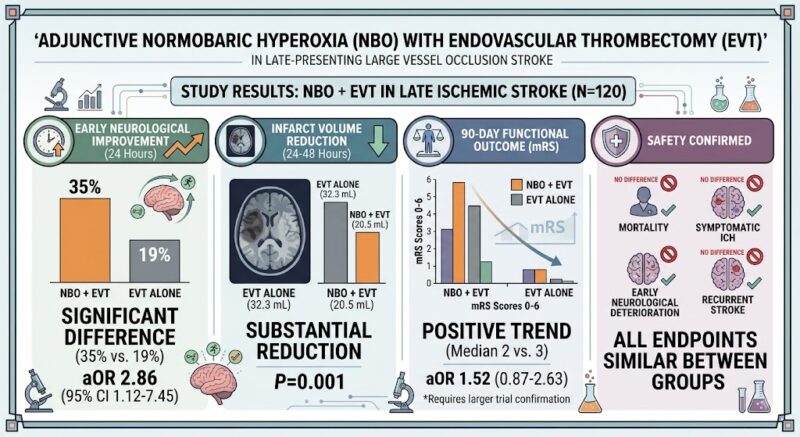
- Early Neurological Improvement: Significantly more patients in the EVT+NBO group achieved early neurological improvement at 24 hours compared with EVT alone (35% vs. 19%; adjusted odds ratio [aOR] 2.86; 95% CI, 1.12-7.45). This indicates that NBO provides meaningful early clinical benefit when added to thrombectomy in the extended time window.
- Infarct Volume: Infarct size measured at 24 to 48 hours post-EVT was substantially smaller in the NBO group (median 20.5 mL vs. 32.3 mL; P=0.001), reflecting neuroprotection and reduced ischemic injury.
- 90-Day Functional Outcome: The distribution of mRS scores at 90 days numerically favored NBO+EVT (median mRS 2 vs 3), but this did not reach statistical significance (adjusted common odds ratio 1.52; 95% CI, 0.87-2.63). This suggests a trend toward better long-term outcomes that requires validation in larger cohorts.
- Safety: No differences were observed between groups in mortality, symptomatic intracranial hemorrhage, early neurological deterioration, or recurrent stroke, confirming the safety of adjunctive NBO in this setting.
Expert Commentary
The findings provide compelling early-phase clinical evidence that NBO as an adjunct to EVT may augment neuroprotection beyond vessel recanalization alone. The study addresses a critical gap by investigating a therapy applicable in the extended treatment window, beyond traditional 6-hour limits.
The significant reduction in infarct volume and improvement in early neurological status underscore biological plausibility; supplemental oxygen likely mitigates ischemic penumbra injury until reperfusion is established. The safety profile supports the feasibility of NBO without added hemorrhagic risk.
However, the lack of statistically significant improvement in 90-day disability signals either the need for larger sample sizes or optimization of NBO protocols (e.g., timing, duration, oxygen flow rates). Whether NBO benefits extend to all patient subgroups or are limited to select phenotypes remains to be defined.
Limitations include the relatively small sample size and single-country study population, which may limit generalizability. Additionally, blinding of intervention delivery was not feasible, although outcome assessment remained blinded.
Future investigations should examine mechanistic biomarkers, explore combination with other neuroprotective strategies, and validate functional benefits in Phase III trials.
Conclusion
In patients with acute ischemic stroke due to large vessel occlusion presenting between 6 and 24 hours from onset, adjunctive normobaric hyperoxia combined with endovascular thrombectomy is safe and enhances early neurological improvement and reduces infarct size. Although 90-day functional outcomes showed a positive trend without statistical significance, the data support further larger-scale trials to establish the role of NBO in optimizing stroke reperfusion therapies during extended time windows.
Funding and Registration
This trial was conducted at academic stroke centers in China with registration details available at clinicaltrials.gov (NCT05128422). Funding sources were not detailed in the report.
References
1. Li W, Hu W, Wang S, et al. Adjunctive Normobaric Hyperoxia With Endovascular Thrombectomy for Acute Stroke at 6 to 24 Hours: A Phase IIb Randomized Trial. Stroke. 2026;57(8):2265-2275. doi:10.1161/STROKEAHA.126.XXXXXX
2. Powers WJ, Rabinstein AA, Ackerson T, et al. 2018 Guidelines for the Early Management of Patients with Acute Ischemic Stroke. Stroke. 2018;49:e46-e110.
3. Singhal AB, Benner T, Roccatagliata L. Oxygen Therapy for Acute Stroke. Stroke. 2021;52:2921-2930.