Highlight
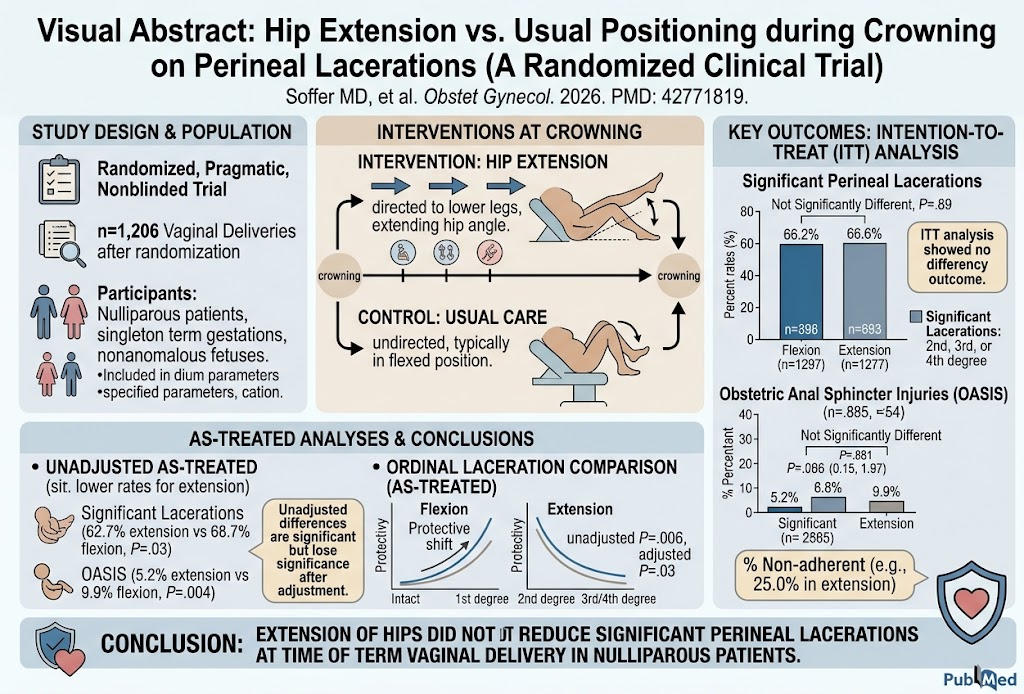
– Hip extension of the mother’s legs at the time of fetal crowning was tested as an intervention to reduce significant perineal lacerations during first vaginal delivery.
– The randomized clinical trial showed no significant difference in the incidence of second-, third-, or fourth-degree perineal lacerations between hip extension and usual flexed positioning.
– While as-treated analyses suggested some protective effect of hip extension on perineal outcomes, these findings were not robust after adjustment.
– Clinical recommendation remains to consider patient comfort and clinical context as hip extension did not demonstrably improve perineal outcomes.
Study Background
Perineal lacerations during vaginal delivery, particularly significant tears involving the muscularis and anal sphincter complex, pose considerable morbidity risks including pain, infection, fecal incontinence, and dyspareunia. Nulliparous women are especially vulnerable to these injuries, with rates of second- to fourth-degree lacerations commonly exceeding 60%. Various maternal positioning strategies during the second stage of labor and delivery have been proposed to minimize trauma by optimizing pelvic outlet dimensions and reducing perineal strain. Hip extension, or straightening the mother’s hips by lowering the legs at crowning, has been hypothesized to improve the angle of delivery and reduce perineal injury, but evidence remains limited and conflicting.
Study Design
This pragmatic, randomized, nonblinded clinical trial enrolled nulliparous patients aged ≥18 years with term singleton pregnancies that involved nonanomalous fetuses. Participants were randomized to either an intervention group instructed to extend their hips (lower their legs) immediately before crowning or a usual care group, where no specific leg positioning directives were given and delivery typically occurred with flexed hips. Randomization occurred shortly before delivery to ensure leg positioning during crowning. The primary composite outcome was significant perineal laceration, defined as second-, third-, or fourth-degree tears. Secondary outcomes included obstetric anal sphincter injuries (OASIS) and perineal lacerations analyzed on an ordinal scale, evaluated under intention-to-treat (ITT) and as-treated analytical approaches.
Key Findings
A total of 1,206 participants completed vaginal deliveries after randomization. In the ITT analysis, no significant difference was found in the primary outcome: 66.2% of women in the usual care group experienced significant perineal lacerations compared to 66.6% in the hip extension group (P=0.89). Adherence to the intervention was 75%, with 25% in the hip extension arm not complying fully, which may influence results.
In the as-treated analysis, unadjusted data showed a modestly lower rate of significant perineal lacerations with hip extension (62.7%) compared to flexion (68.7%), reaching nominal statistical significance (P=0.03). Similarly, obstetric anal sphincter injury rates were lower with hip extension (5.2% vs 9.9%, P=0.004). However, these differences lost statistical significance after adjustment for confounders.
Additional ordinal outcome analysis indicated a shift toward less severe lacerations in the hip extension group in unadjusted (P=0.006) and adjusted models (P=0.03), suggesting possible subtle benefits but limited clinical impact.
Expert Commentary
This large pragmatic trial robustly addresses a clinically relevant question regarding maternal positioning during delivery and its impact on perineal trauma. Strengths include randomized design, large sample size, and real-world clinical setting. Limitations include nonblinding, adherence challenges, and potential residual confounding in as-treated analyses. The high baseline rate of significant lacerations reflects the known risk in nulliparous populations but also underscores the difficulty in preventing these injuries despite positioning strategies.
Guidelines emphasize individualized positioning tailored to comfort and labor progression. This study supports that strict hip extension does not confer a clear advantage and should not replace standard care. Mechanistically, fetal head molding and maternal pelvic geometry are multifactorial, and minor positional changes may have limited effect on complex tissue mechanics during delivery.
Conclusion
The randomized trial demonstrates that hip extension at the time of crowning in nulliparous patients does not significantly reduce the incidence of significant perineal lacerations compared with usual flexed hip positioning. While secondary analyses suggest possible subtle benefits, these are not robust. Clinicians should prioritize maternal comfort and clinical indications in delivery positioning, as targeted hip extension is unlikely to alter perineal injury risk substantially. Further research might explore combined modifiable factors influencing perineal outcomes to develop comprehensive protective strategies.
Funding and Clinical Trial Registration
This study was registered at ClinicalTrials.gov under identifier NCT04616170. Funding sources were not detailed in the abstract but appear commensurate with clinical research standards.
References
1. Soffer MD, James KE, Liang P, Delgado A, Mossayebi MH, Hamp M, Siegel MR, Clapp MA, Kaimal AJ, Barth WH. Effect of Hip Extension Compared With Usual Positioning on Perineal Lacerations During First Vaginal Delivery: A Randomized Clinical Trial. Obstet Gynecol. 2026 Sep 22. PMID: 42771819.
2. Sultan AH, Thakar R, Fenner DE. Obstetric perineal injury and anal incontinence. Clin Gastroenterol Hepatol. 2006;4(3):273-281.
3. Aasheim V, et al. Effect of maternal birth position on obstetric outcomes: a randomized controlled trial. BJOG. 2017;124(12):1909-1917.
4. Gupta JK, et al. Position in the second stage of labour for women without epidural anaesthesia. Cochrane Database Syst Rev. 2017;5:CD002006.