Highlight
- A prospective randomized controlled trial compared side-to-side (SSGJ) versus end-to-side (ESGJ) gastrojejunostomy after pancreatoduodenectomy.
- No significant difference was observed in delayed gastric emptying (DGE) incidence between the two anastomotic techniques.
- Postoperative complications, nutritional outcomes, and quality of life scores were similar in both groups at 90 days.
Study Background
Delayed gastric emptying is a common and challenging complication following pancreatoduodenectomy (PD), occurring in up to 40% of patients. DGE significantly prolongs hospital stay, delays recovery, and increases healthcare costs. The pathophysiology of DGE after PD is multifactorial, involving factors like denervation, inflammation, and reconstruction methods. Among these, the configuration of gastrojejunostomy—the surgical connection between the stomach and jejunum—has been hypothesized to influence gastric emptying dynamics. Retrospective studies have suggested that a side-to-side gastrojejunostomy may facilitate better gastric emptying compared to the conventional end-to-side approach, potentially by reducing anastomotic tension or optimizing flow dynamics. However, until the IPAD (Impact of side-to-side versus end-to-side gastrojejunostomy) study, high-level evidence from randomized controlled trials (RCTs) was lacking to substantiate this hypothesis.
Study Design
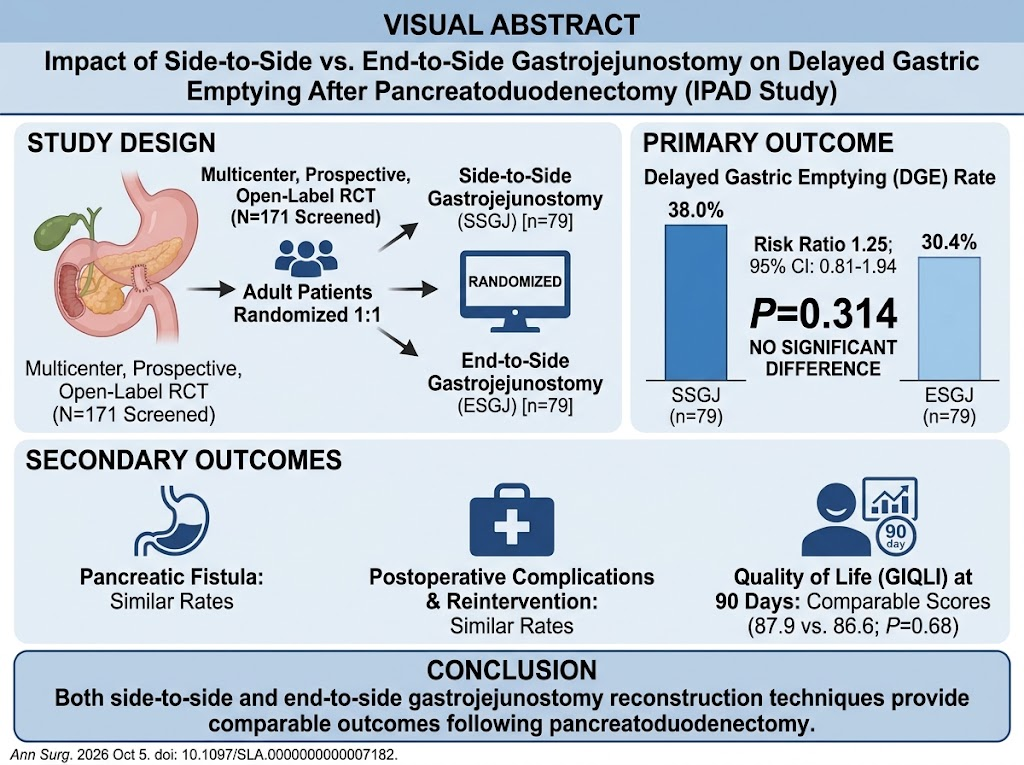
The IPAD study was a prospective, randomized, open-label controlled trial conducted across two high-volume pancreatic centers in France. The study enrolled adult patients undergoing PD for benign or malignant pancreatic or periampullary diseases. Intraoperatively, patients were randomized 1:1 to receive either side-to-side gastrojejunostomy (SSGJ) or end-to-side gastrojejunostomy (ESGJ) reconstruction.
The primary endpoint was the incidence of delayed gastric emptying, defined according to international consensus criteria. Secondary endpoints included postoperative complications such as pancreatic fistula, biliary fistula, reintervention rates, mortality, nutritional parameters, and quality of life (QoL) assessed at 90 days using the GastroIntestinal Quality of Life Index (GIQLI).
A total of 171 patients were screened between May 2021 and July 2023, and 158 patients were randomized (79 to each arm). Baseline demographic and clinical characteristics were balanced except for differences in sex distribution and prevalence of hypertension and chronic obstructive pulmonary disease.
Key Findings
The primary outcome showed that delayed gastric emptying occurred in 38.0% of the SSGJ group and 30.4% of the ESGJ group. The risk ratio was 1.25 (95% confidence interval [CI]: 0.81–1.94), indicating no statistically significant difference between the two techniques (P = 0.314).
Secondary outcomes including rates of clinically relevant pancreatic fistula, biliary fistula, need for surgical or endoscopic reintervention, and 90-day mortality were similar in both groups. Nutritional markers such as body weight and serum albumin levels showed no significant differences at 90 days post-surgery. Quality of life assessed using GIQLI scores was comparable, with mean values of 87.9 in the SSGJ group versus 86.6 in the ESGJ group (P = 0.68).
These findings indicate that substituting a side-to-side with an end-to-side gastrojejunostomy does not confer a clinical advantage in reducing DGE or improving short-term postoperative recovery. Both techniques appeared equally safe and effective in the context of PD.
Expert Commentary
The IPAD study provides valuable randomized evidence addressing a clinically relevant surgical question. While retrospective data hinted at potential benefits of side-to-side anastomosis in reducing delayed gastric emptying, this trial demonstrates that the choice of gastrojejunostomy configuration alone may not be the critical determinant of DGE incidence.
This is consistent with the multifactorial nature of DGE, which involves neural disruption, inflammatory changes, and gastric motility alterations beyond anastomotic configuration. Hence, perioperative management strategies and adjunctive measures remain important. Also, it is noteworthy that DGE rates remain high overall despite surgical technique, underscoring the need for continued research into other preventive interventions.
Limitations include the open-label design and the potential influence of center-specific surgical practices. Nonetheless, the multicenter randomized design and well-defined endpoints strengthen the validity and generalizability of findings. Future investigations may explore combined technical and pharmacologic strategies or enhanced recovery protocols to mitigate DGE.
Conclusion
The IPAD randomized controlled trial concludes that side-to-side and end-to-side gastrojejunostomy produce comparable outcomes in delayed gastric emptying rates after pancreatoduodenectomy, as well as in postoperative complications, nutritional status, and quality of life at three months. Surgeons can confidently select either technique based on individual patient anatomy and surgical preference without concern for increased DGE risk.
Continued efforts are needed to identify the complex contributors to delayed gastric emptying and to develop multifaceted strategies that improve postoperative recovery and reduce morbidity in PD patients.
Funding and Registration
The details regarding funding sources and clinical trial registration were not provided in the abstract. Additional information should be sought from the full publication or trial registry.
References
1. Robin F, Wasielewski E, Chaouch MA, et al. Impact of Side-to-Side Versus End-to-Side Gastrojejunostomy on the Rate of Delayed Gastric Emptying After Pancreatoduodenectomy (IPAD study): A Randomized Controlled Trial. Ann Surg. 2026 Oct 5. PMID: 42832388.
2. Wente MN, Bassi C, Dervenis C, et al. Delayed gastric emptying (DGE) after pancreatic surgery: a suggested definition by the International Study Group of Pancreatic Surgery (ISGPS). Surgery. 2007;142(5):761-768.
3. Mungroop TH, van Rijssen LB, Bosscha K, et al. Delayed gastric emptying after pancreatic surgery: pathophysiology, prediction by gastric emptying scintigraphy and treatment. Curr Gastroenterol Rep. 2016;18(5):23.