Highlight
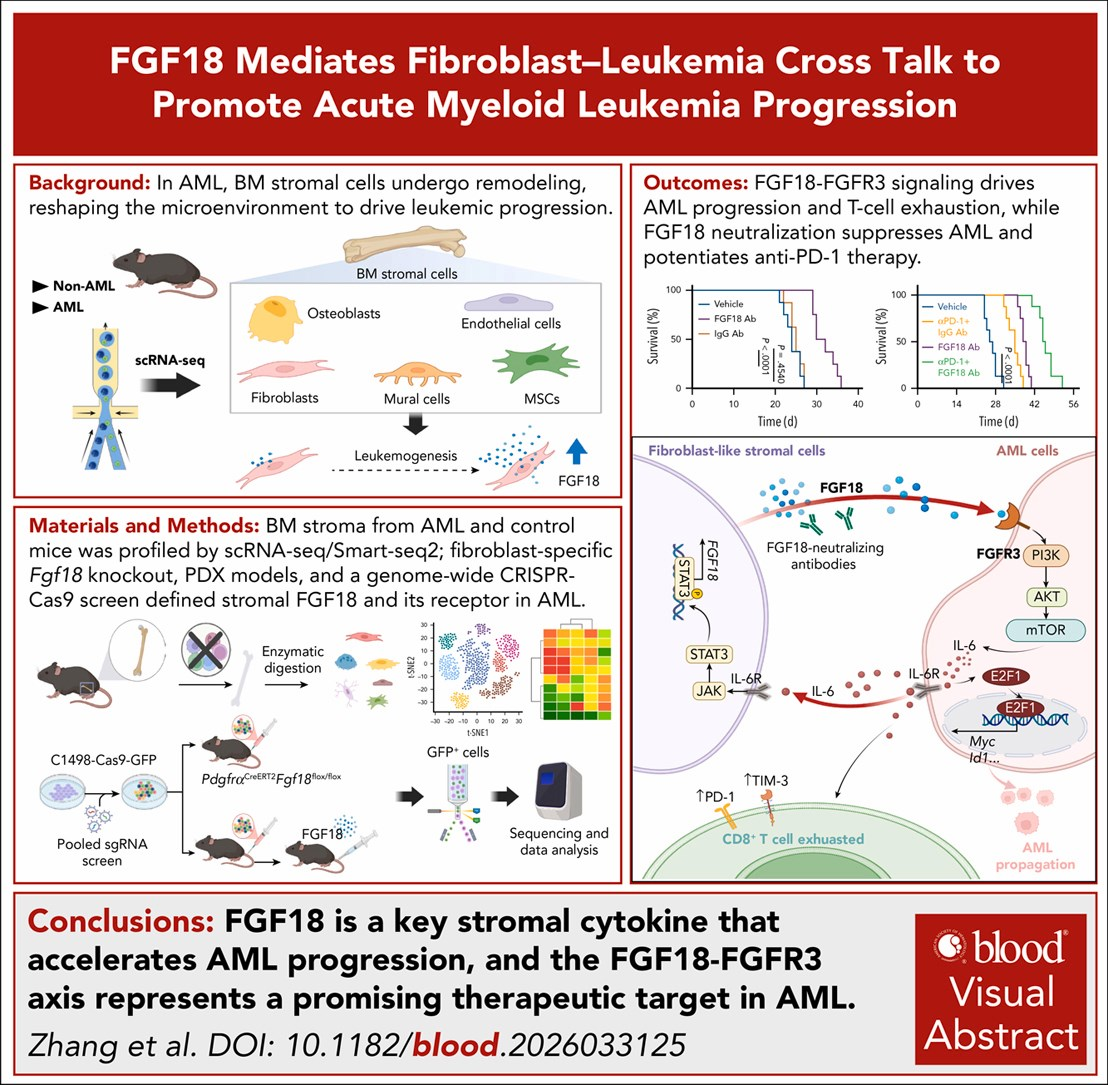
- FGF18 is identified as a fibroblast-derived cytokine upregulated in AML bone marrow, driving leukemia progression.
- FGF18 signals through FGFR3 on AML cells, activating the AKT-mTOR pathway and inducing IL-6 production, reinforcing leukemic growth and stromal activation.
- A feed-forward loop involving IL-6 augments stromal FGF18 expression while suppressing CD8+ T-cell effector function, weakening antileukemic immunity.
- Therapeutic neutralization of FGF18 restores immune function and synergizes with anti-PD-1 therapy to enhance antileukemic efficacy in vivo.
Study Background
Acute myeloid leukemia (AML) is a heterogeneous hematologic malignancy characterized by clonal proliferation of myeloid precursors in the bone marrow (BM), leading to impaired hematopoiesis and immune dysfunction. Despite advances in chemotherapy, targeted agents, and immunotherapies, AML prognosis remains poor, with high relapse rates and immune evasion contributing to therapeutic failure. The BM microenvironment plays a critical role in supporting leukemic cell survival, proliferation, and resistance to therapy. Nonhematopoietic stromal cells, particularly fibroblasts, have been increasingly recognized as key regulators within this niche; however, their specific contributions to leukemogenesis and immune suppression are incompletely understood. Identification of novel stromal factors mediating leukemia–immune interactions with potential as biomarkers or therapeutic targets is an unmet clinical need.
Study Design
This study utilized an integrative approach combining single-cell RNA sequencing (scRNA-seq) of murine AML bone marrow stromal compartments to identify differentially expressed genes, focusing on fibroblasts. Recombinant proteins, genetically engineered mouse models with fibroblast-specific Fgf18 knockout, and CRISPR-Cas9 pooled screening in AML cells were employed to dissect functional roles and receptor-ligand interactions. Key signaling pathways were validated through biochemical assays and in vivo studies monitoring leukemia progression and survival. An FGF18-neutralizing antibody was developed to evaluate the therapeutic potential in combination with anti-PD-1 checkpoint blockade in murine AML models.
Key Findings
Analysis of scRNA-seq data from AML marrow revealed marked upregulation of Fgf18 selectively in stromal fibroblasts, suggesting a disease-associated stromal remodeling. Administration of recombinant FGF18 protein significantly accelerated AML progression in mice, whereas deletion of Fgf18 in fibroblasts delayed leukemic expansion and improved survival, underscoring FGF18 as a critical stromal-derived factor promoting AML.
A CRISPR-Cas9 screen targeting receptor tyrosine kinases in AML cells exposed to FGF18 identified FGFR3 signaling as essential for leukemia cell fitness in the FGF18-enriched microenvironment. Genetic knockout of Fgfr3 in AML cells mirrored the protective effects of Fgf18 ablation on leukemia burden and host survival.
Mechanistically, FGF18 binding to FGFR3 activated downstream AKT-mTOR signaling, leading to increased interleukin-6 (IL-6) production by leukemia cells. IL-6 acted in an autocrine fashion to sustain AML proliferation and in a paracrine manner activated JAK-STAT3 signaling in fibroblasts, further amplifying FGF18 expression and creating a feed-forward loop.
This loop correlated with suppressed CD8+ T-cell effector functions within the leukemic niche, contributing to immune evasion and AML progression. High FGF18 expression in patient AML samples was associated with adverse prognosis.
Therapeutically, an FGF18-neutralizing antibody effectively disrupted this stromal-leukemia feedback loop, restored CD8+ T-cell activity, and synergized with PD-1 checkpoint inhibition to generate durable antileukemic immune responses and improve survival in preclinical models.
Expert Commentary
This study provides compelling evidence implicating stromal fibroblast-derived FGF18 as a key mediator of AML progression through a complex leukemic-stromal-immune interaction axis. The identification of FGFR3 as the critical receptor transducing FGF18 signaling to activate pro-survival pathways highlights a novel target within leukemia cells modulated by the microenvironment.
The feed-forward amplification via IL-6 and subsequent immunosuppression illustrates a mechanism by which the microenvironment fosters leukemic immune escape. Considering the limited success of AML immunotherapies to date, targeting such microenvironmental crosstalk offers a promising adjunctive strategy.
Limitations include the preclinical nature of findings and the need to validate these mechanisms and antibody efficacy in human AML patient samples and clinical trials. Heterogeneity in AML subtypes and patient stromal composition may influence the therapeutic impact.
Conclusion
The discovery of an FGF18-dependent fibroblast-leukemia signaling axis advances understanding of the AML bone marrow niche and reveals a novel mechanism driving disease progression and immune suppression. Targeted disruption of FGF18-FGFR3 signaling effectively reverses leukemic growth advantages and restores antitumor immunity, especially when combined with immune checkpoint blockade. These results provide a strong rationale for clinical development of FGF18-neutralizing agents as part of combinatorial therapies in AML.
Funding and Clinical Trials
Details on funding sources were not provided in the original publication. There are no registered clinical trials on FGF18-neutralizing antibodies in AML to date, highlighting an opportunity for translational clinical research.
References
1. Zhang W, Ye Z, Zhou X, et al. FGF18 mediates fibroblast-leukemia cross talk to promote acute myeloid leukemia progression. Blood. 2026;148(14):1800-1815. PMID: 42360909.
2. Mendez-Ferrer S, Lucas D, Battista M, Frenette PS. Haematopoietic stem cell release is regulated by circadian oscillations. Nature. 2008;452(7186):442-447.
3. Pollyea DA, Gutman JA, Gore L, Smith CA. Targeting microenvironment interactions in acute myeloid leukemia. Leukemia. 2020;34(2):285-291.
4. Burns CJ, DiNardo CD. Immune checkpoint inhibitors in AML. Curr Hematol Malig Rep. 2021;16(4):325-333.
5. Chen J, Sun M, Huang Y, et al. Targeting fibroblast growth factors and their receptors in cancer therapy. Int J Mol Sci. 2018;19(9):2823.
6. Andrew J. Intlekofer, Anthony S. Fauci. Microenvironmental control of acute myeloid leukemia: therapeutic potential. Haematologica. 2021;106(1):20-31.