Highlight
This post hoc analysis from the PREVENT trial elucidates the crucial role of lipid burden in coronary plaques for guiding preventive percutaneous coronary intervention (PCI). Key highlights include:
- Near-infrared spectroscopy (NIRS) quantification of lipid core burden index (LCBI) effectively identifies vulnerable lipid-rich plaques (LRPs) associated with higher risk of adverse cardiac events.
- Preventive PCI reduces the composite outcome of cardiac death, target-vessel myocardial infarction, ischemia-driven revascularization, and hospitalization for unstable angina in patients with LRPs significantly more than optimal medical therapy alone.
- No significant benefit of preventive PCI is observed among patients with non-lipid-rich plaques despite comparable morphological burden and minimal lumen area.
- These findings highlight the importance of plaque composition beyond traditional anatomical parameters to guide clinical decision-making for preventive coronary interventions.
Study Background
Coronary artery disease remains a major global health burden due to its high morbidity and mortality. Vulnerable atherosclerotic plaques, which are prone to rupture and cause acute coronary events, are a central target for prevention strategies. Traditionally, percutaneous coronary intervention (PCI) targets flow-limiting lesions; however, recent evidence suggests that preventive PCI on high-risk non-flow-limiting plaques could reduce adverse events.
Identifying lesions that would most benefit from preventive PCI remains a challenge. Conventional angiography and intravascular ultrasound (IVUS) provide anatomical severity but do not sufficiently characterize plaque vulnerability. Near-infrared spectroscopy (NIRS) is an emerging imaging modality that quantifies lipid content within plaques, with the lipid core burden index (LCBI) serving as a biomarker for plaque vulnerability.
Study Design
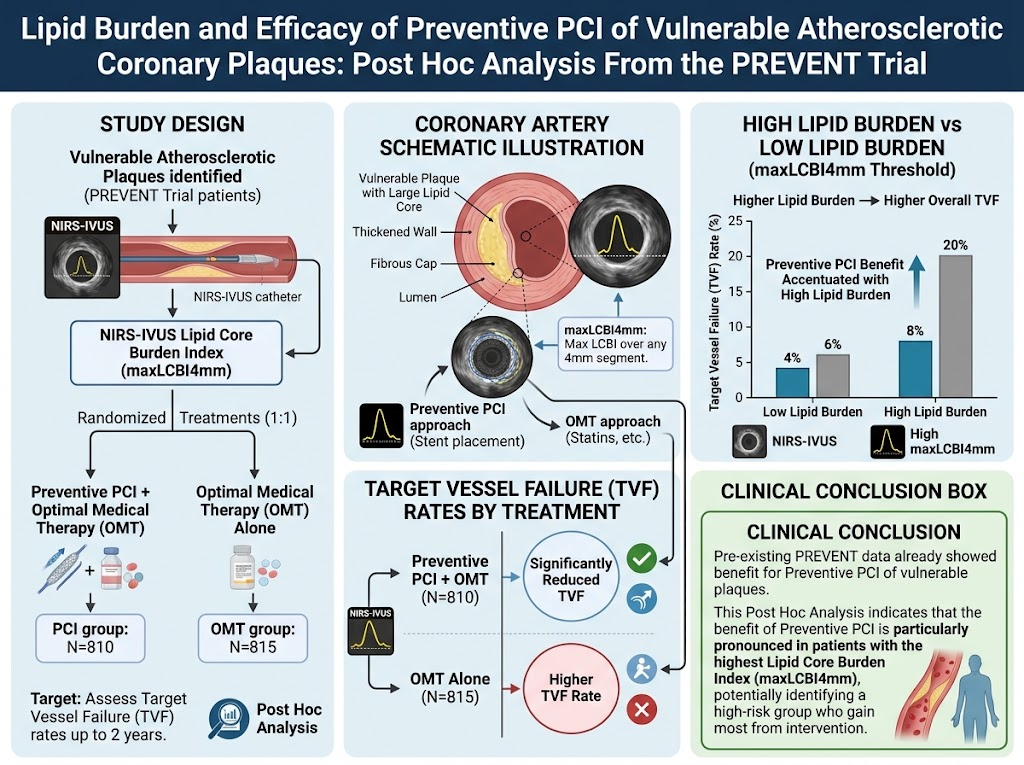
The PREVENT trial was an investigator-initiated, multicenter, open-label, randomized controlled trial conducted from September 2015 to September 2021. The trial evaluated preventive PCI of non-flow-limiting, high-risk coronary plaques defined by fractional flow reserve (FFR) > 0.80, morphological features, and NIRS-derived lipid content.
This post hoc analysis focused on 598 patients with 632 lesions characterized by IVUS showing plaque burden >70% and minimal lumen area <4 mm2, who also had NIRS data available. A threshold of maximum LCBI >315 over a 4-mm segment defined lipid-rich plaques (LRP).
Patients were randomized to preventive PCI plus optimal medical therapy versus optimal medical therapy alone. The primary composite endpoint included death from cardiac causes, target-vessel myocardial infarction, ischemia-driven target-vessel revascularization, or hospitalization for unstable or progressive angina, followed longitudinally over a median of 5.6 years.
Key Findings
Among the cohort, 37.3% had LRPs as defined by the LCBI criterion. The overall event rate for the primary endpoint was significantly higher in patients with LRPs (12.5%) compared to those with non-LRPs (4.7%), with an unadjusted hazard ratio of 2.08 (95% CI, 1.03–4.19; P=0.039), underscoring the prognostic significance of lipid content in plaques independent of size or stenosis.
Within the LRP subgroup, preventive PCI was associated with a substantial risk reduction in the primary outcome compared with medical therapy alone (7.3% vs. 17.6%), with an adjusted hazard ratio of 0.23 (95% CI, 0.13–0.41; P<0.001). Conversely, in non-LRP patients, preventive PCI did not provide a statistically significant benefit (5.5% vs. 4.2%; adjusted hazard ratio, 1.00; 95% CI, 0.54–1.86; P=0.97).
The interaction test between treatment effect and plaque lipid content was highly significant (Pinteraction < 0.001), indicating that the presence of lipid-rich plaque modifies the therapeutic effect of preventive PCI. This emphasizes the clinical value of NIRS LCBI in patient selection for intervention beyond anatomical factors.
Expert Commentary
This post hoc analysis highlights a paradigm shift in coronary intervention strategies by integrating plaque biology, not just anatomy, into clinical decision algorithms. The demonstration that lipid-rich plaques identified via NIRS benefit from preventive PCI suggests personalized approaches may optimize outcomes by targeting the most vulnerable lesions.
These findings align with mechanistic insights that lipid cores contribute to plaque instability and subsequent rupture. By stabilizing these plaques mechanically via PCI, ischemic cardiac events may be mitigated despite non-significant luminal obstruction. This addresses an unmet need for effective risk reduction among patients with subcritical stenoses but high-risk morphologies.
Limitations include the post hoc nature of the analysis and potential selection biases inherent in subset analyses. Additionally, generalizability outside of patients with high plaque burden and narrow minimal lumen areas may be limited. Future prospective trials focusing prospectively on lipid burden-guided PCI strategies will be critical to confirm these promising findings.
Conclusion
The PREVENT trial post hoc analysis substantiates that lipid-rich plaques identified by near-infrared spectroscopy are associated with higher adverse event rates and derive significant benefit from preventive PCI in addition to optimal medical therapy. These results underscore the importance of incorporating plaque composition assessment into routine interventional cardiology practice.
<pPersonalizing PCI decisions based on combined functional, anatomical, and compositional plaque characteristics could revolutionize coronary artery disease management, enhancing prevention of major cardiac events. Integration of NIRS or similar lipid quantification techniques into clinical workflows promises improved risk stratification and targeted interventions, ultimately guiding precision cardiovascular therapy.
Funding and Clinical Trial Registration
The PREVENT trial was an investigator-initiated study conducted across multiple centers. The study is registered on ClinicalTrials.gov with identifier NCT02316886.
References
- Wee SB, Ahn JM, Kang DY, et al. Lipid Burden and Efficacy of Preventive PCI of Vulnerable Atherosclerotic Coronary Plaques: Post Hoc Analysis From the PREVENT Trial. Circulation. 2026 Oct 6. PMID: 42836296. https://pubmed.ncbi.nlm.nih.gov/42836296/
- Stone GW, Maehara A, Lansky AJ, et al. A Prospective Natural-History Study of Coronary Atherosclerosis. N Engl J Med. 2011;364(3):226-235. doi:10.1056/NEJMoa1002358
- Jang IK, Tearney GJ, MacNeill B, et al. In vivo characterization of coronary atherosclerotic plaque by use of optical coherence tomography. Circulation. 2005;111(12):1551-5. doi:10.1161/01.CIR.0000151815.05252.0F