Highlights
- The combination of midostaurin, low-dose cytarabine, and venetoclax (LVM) is well tolerated in newly diagnosed AML patients aged ≥60 years unfit for intensive chemotherapy.
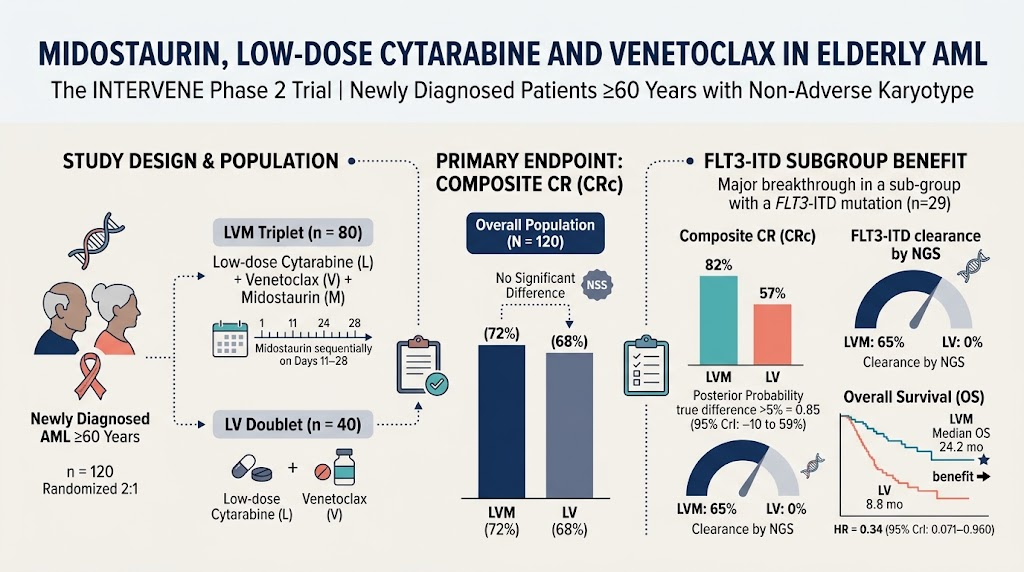
- Although LVM did not significantly improve composite complete remission (CRc) overall compared to low-dose cytarabine and venetoclax (LV), it markedly enhanced CRc rates in patients harboring FLT3-ITD mutations.
- LVM led to significantly improved molecular clearance of FLT3-ITD mutations as assessed by ultrasensitive next-generation sequencing, correlating with prolonged overall survival in this high-risk population.
- Compared to other FLT3 inhibitors combined with venetoclax-based regimens, midostaurin addition showed favorable tolerability with reduced marrow toxicity, facilitating sustained treatment intensity.
Background
Acute myeloid leukemia (AML) remains a challenging hematologic malignancy particularly in older adults (≥60 years), who frequently exhibit comorbidities precluding intensive chemotherapy. The presence of FLT3-ITD mutations confers an adverse prognosis and poses a major resistance mechanism to standard lower-intensity therapies such as hypomethylating agents or low-dose cytarabine (LDAC) combined with venetoclax. Previous randomized studies integrating FLT3 inhibitors into treatment regimens for older, unfit patients have yielded disappointing outcomes, failing to significantly enhance survival. Additionally, while second-generation FLT3 inhibitors like gilteritinib and quizartinib show preclinical and early-phase promise in combination with less intensive regimens, their marrow suppressive toxicity often necessitates treatment dose reductions, potentially compromising efficacy. The INTERVENE study was designed to explore a novel triplet regimen combining midostaurin — a first-generation multi-kinase FLT3 inhibitor — with LDAC and venetoclax, hypothesizing that sequential midostaurin administration might maximize anti-FLT3 efficacy while mitigating hematologic toxicity in older AML patients with non-adverse karyotypes.Key Content
Clinical Evidence from the INTERVENE Trial
The phase 2 INTERVENE trial (ACTRN12619001655134) enrolled 120 patients aged ≥60 years with newly diagnosed AML possessing non-adverse cytogenetics who were unfit for intensive chemotherapy. After establishing safety in an 18-patient run-in phase, participants were randomized 2:1 to receive LDAC plus venetoclax (LV) or LDAC plus venetoclax plus midostaurin (LVM). Venetoclax was administered from days 1 to 28, with midostaurin given sequentially from days 11 to 28. The primary endpoint—composite complete remission (CRc)—showed no significant difference between LVM and LV arms (72% vs 68%). However, in the FLT3-ITD subpopulation (n=29), LVM markedly improved CRc rates (82% vs 57%), with a 25% absolute difference and posterior probability suggesting true effect. Importantly, molecular monitoring using ultrasensitive next-generation sequencing revealed superior clearance of FLT3-ITD clones in the LVM group (65%) compared to none in the LV arm. This molecular remission translated into prolonged median overall survival (OS) of 24.2 months versus 8.8 months (HR=0.34) for LVM vs LV respectively. These findings suggest that midostaurin enhances minimal residual disease eradication specifically targeting FLT3-ITD leukemic clones.Tolerability and Toxicity Profile
A critical advantage of midostaurin addition was its favorable tolerability and limited marrow suppressive toxicity relative to other FLT3 inhibitors combined with venetoclax-based regimens. The sequential dosing strategy—initiating midostaurin after venetoclax and LDAC—may mitigate overlapping toxicities, enabling patients to maintain adequate treatment intensity and cumulative drug exposure. Adverse events documented were consistent with expectations for AML therapy in elderly populations, with no emergent safety signals specifically attributable to the triplet combination.Context within FLT3-Targeted Therapy Landscape
Recent randomized studies have demonstrated survival benefits of midostaurin in younger, fit AML populations receiving intensive chemotherapy (e.g., RATIFY trial) but failed to replicate these gains in older or unfit patients. In contrast, next-generation FLT3 inhibitors (gilteritinib, quizartinib) combined with venetoclax-based therapies have shown preliminary efficacy but suffer from high rates of hematologic toxicity requiring dose attenuation. The INTERVENE study’s approach of combining midostaurin with LDAC and venetoclax thus represents an important clinical advance, providing proof-of-concept that an effective FLT3 inhibitor can be safely integrated into lower-intensity front-line regimens for elderly patients with FLT3-ITD AML.Expert Commentary
The INTERVENE phase 2 trial contributes valuable insights into optimizing therapy for the challenging population of older patients harboring FLT3-ITD AML ineligible for intensive chemotherapy. FLT3-ITD mutation has remained a stubborn barrier to success in venetoclax-based lower-intensity therapies due to its role in resistance and relapse. By demonstrating selective efficacy of midostaurin addition in improving molecular remission and survival, this study addresses a critical unmet need. The tolerability and manageable toxicity profile observed with sequential midostaurin contrasts with experiences using other FLT3 inhibitors in triplet combinations, supporting midostaurin as a viable option in the elderly AML setting. The lack of overall CRc improvement in the broader patient cohort underscores the importance of molecular risk stratification and suggests this triplet’s benefit is specifically linked to FLT3-ITD mutation presence. Biologically, midostaurin’s kinase inhibition of FLT3 limits proliferative signaling and leukemic clone propagation. Venetoclax’s BCL-2 inhibition synergistically promotes leukemic cell apoptosis, while LDAC serves as a cytotoxic backbone with modest marrow suppression. The timing of midostaurin initiation after venetoclax likely facilitates combinatorial synergy with reduced overlapping cytopenias. Guidelines from expert bodies (NCCN, ELN) currently endorse venetoclax combined with hypomethylating agents or LDAC in older AML patients unfit for intensive chemotherapy, with limited recommendations regarding adding FLT3 inhibitors in this context. The INTERVENE data support future guideline consideration for incorporating midostaurin in FLT3-ITD AML among older unfit patients, pending confirmation in larger randomized trials. Limitations of the study include the relatively small FLT3-ITD subgroup and phase 2 design, warranting cautious interpretation. Further research is needed to validate survival benefits and optimize dosing schedules.Conclusion
The combination of midostaurin with low-dose cytarabine and venetoclax is a well-tolerated, promising therapeutic strategy targeting FLT3-ITD AML in patients aged ≥60 years who are unfit for intensive chemotherapy. It enhances molecular remission and overall survival in this high-risk group by effectively clearing FLT3-ITD clones with manageable toxicity. This novel triplet regimen provides a meaningful advancement over current standards and opens avenues for improved precision approaches in elderly AML treatment. Ongoing and future randomized phase 3 studies are needed to confirm these findings, refine patient selection, and integrate sequential FLT3 inhibitor strategies into broader AML therapeutic paradigms.References
- Chua CC et al. A randomized phase 2 study combining midostaurin, low-dose cytarabine and venetoclax in newly diagnosed AML ≥60 years. Blood. 2026 Oct 19. PMID: 42895904.
- Stone RM et al. Midostaurin plus chemotherapy for acute myeloid leukemia with a FLT3 mutation. N Engl J Med. 2017;377(5):454-464.
- Wei AH et al. Venetoclax combined with hypomethylating agents in treatment-naïve, elderly patients with AML: a meta-analysis. Leukemia. 2021;35(11):3115-3125.
- Perrot A et al. Gilteritinib combined with venetoclax and azacitidine in FLT3-mutated AML. Blood Adv. 2021;5(21):4715-4720.
- DiNardo CD et al. Quizartinib combined with hypomethylating agents in FLT3-ITD AML. J Clin Oncol. 2021;39(15_suppl):7009.