Highlight
This comprehensive multicenter study and international patient survey reveal significant reproductive health considerations in women with bronchiectasis, especially highlighting the impact of primary ciliary dyskinesia (PCD) on fertility. Key findings include increased use of assisted reproductive technologies among women with PCD, frequent pregnancy exacerbations, and the importance of pre-pregnancy lung function linked to neonatal outcomes.
Study Background
Bronchiectasis is a chronic respiratory disease characterized by irreversible bronchial dilatation, recurrent infections, and inflammation. In women of reproductive age, bronchiectasis poses unique clinical challenges with potential implications for fertility, pregnancy, and neonatal health. Despite growing recognition of bronchiectasis in this population, data specific to reproductive outcomes and patient experiences remain sparse. Given the chronic airway inflammation and potential for lung function impairment, it is critical to understand how bronchiectasis and its underlying etiologies, such as PCD, affect women’s reproductive health and pregnancy outcomes.
Study Design and Methods
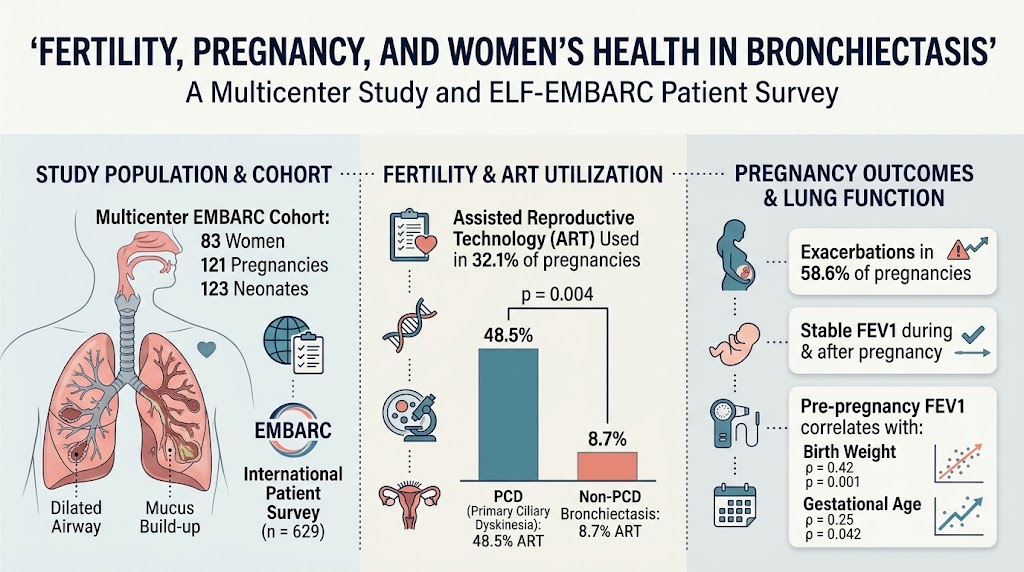
This study employed a combined retrospective cohort and patient survey approach. The cohort study included data from 83 women with bronchiectasis who experienced 121 pregnancies across multiple EMBARC-affiliated centers from 2012 to 2023. Clinical data encompassed pulmonary function tests, obstetric records, and neonatal outcomes. Assisted reproductive technology (ART) utilization rates were noted, and exacerbation frequency during pregnancy was recorded. Concurrently, an international ELF-EMBARC patient survey involving 629 women with bronchiectasis gathered patient-reported data on fertility, pregnancy experiences, hormonal influences, and menopause onset.
Key Findings
Fertility and Assisted Reproductive Technologies
ART use was notably elevated, particularly in women with PCD, at 48.5%, compared to 8.7% in non-PCD bronchiectasis, indicating subfertility predominantly driven by PCD etiologies (P=0.004). Women with early-onset bronchiectasis without PCD had fertility rates resembling the general population, underscoring the distinct fertility implications of PCD’s ciliopathy mechanism affecting reproductive tract motility.
Pregnancy Outcomes and Exacerbations
Exacerbations of bronchiectasis occurred in 58.6% of pregnancies, highlighting the frequent clinical challenges during gestation. Despite these respiratory events, lung function, measured by FEV1, remained stable during and post-pregnancy. The mean gestational age was 38 weeks, and the average birth weight was 2.99 kg. Importantly, pre-pregnancy FEV1 correlated positively with both gestational age (ρ=0.25, P=0.042) and birth weight (ρ=0.42, P=0.001), indicating that better baseline pulmonary function supports more favorable neonatal outcomes.
Neonatal and Maternal Health
Neonatal outcomes were generally favorable, with most infants born at term and appropriate birth weights despite the maternal disease burden. The data suggest that effective multidisciplinary care and pulmonary optimization before and during pregnancy can mitigate adverse outcomes. However, the study emphasizes that exacerbations remain a common complication, necessitating vigilant management.
Hormonal Factors and Menopause
Survey data revealed an earlier onset of menopause in women diagnosed with bronchiectasis before age 50 compared to those diagnosed at or beyond 50 years. This observation raises considerations about systemic effects of chronic pulmonary disease or its treatments on reproductive aging, warranting further study.
Expert Commentary
This study represents an important advance in understanding the intersection of bronchiectasis and women’s reproductive health. The identified link between PCD and subfertility aligns with the pathophysiology of impaired ciliary function extending beyond the lungs to the reproductive tract. Importantly, lung function stability during pregnancy and its positive correlation with neonatal outcomes underscore the necessity for targeted preconception care in this population.
Limitations of the study include its retrospective design for clinical data collection and potential selection bias as participants were recruited from specialized centers affiliated with EMBARC, possibly limiting generalizability. Additionally, survey responses may be subject to recall bias and may not capture all variables influencing menopause timing. Despite this, the combination of clinical and patient-reported data provides a comprehensive perspective.
Conclusion
Women with bronchiectasis, particularly those with PCD, face distinct reproductive challenges, including increased need for assisted reproduction and risk of pregnancy exacerbations. Nevertheless, neonatal outcomes are generally positive when pre-pregnancy lung function is optimized and multidisciplinary care is delivered. These findings advocate for proactive pulmonary and reproductive health management in women with bronchiectasis, reinforcing the value of integrated care models addressing respiratory and reproductive health. Further prospective studies are warranted to elucidate mechanisms underlying early menopause and to optimize therapeutic strategies for this vulnerable population.
Funding and ClinicalTrials.gov
The original study was supported by EMBARC consortium funding and conducted under clinical research collaborations with participating centers. No specific clinical trial registration was reported.
References
1. Boehm-Cohen L, Pollock J, Kompatsiari E, et al. Fertility, pregnancy, and women’s health in bronchiectasis: a multicenter study and ELF-EMBARC patient survey. Chest. 2026 Oct 19. PMID: 42896706.
2. Ringshausen FC, de Roux A, et al. Bronchiectasis: clinical and pathophysiological aspects with insights into early diagnosis and management. Eur Respir Rev. 2020;
3. Lucas JS, Walker WT, et al. Primary ciliary dyskinesia in adults. Lancet Respir Med. 2021;