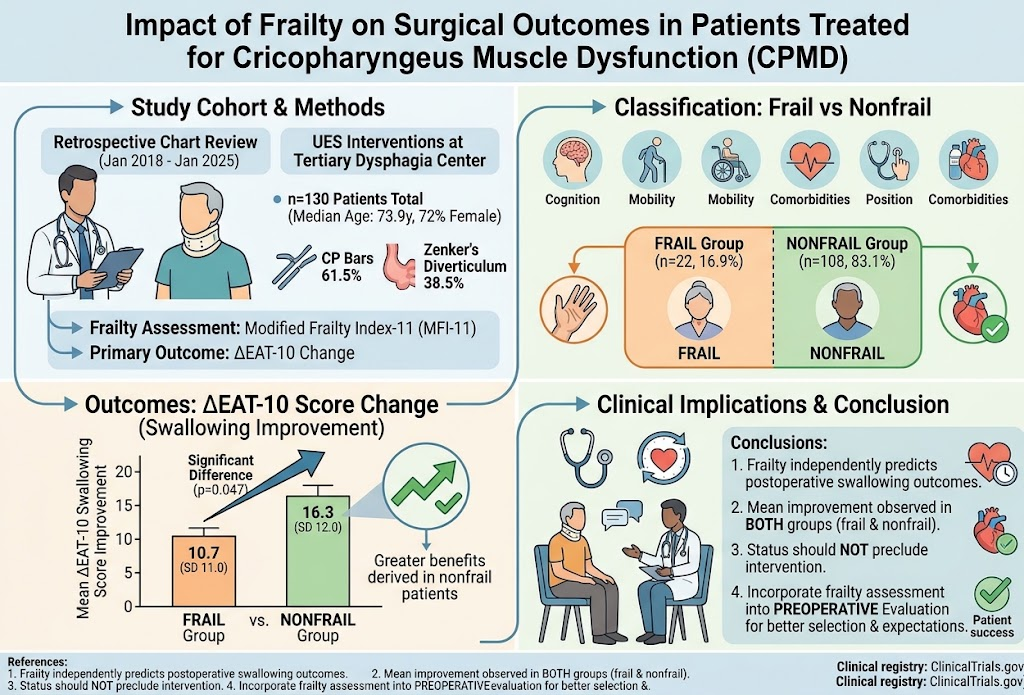
Highlight
1. Frailty status, assessed by the Modified Frailty Index-11 (MFI-11), significantly predicts postoperative swallowing outcomes in patients undergoing surgery for cricopharyngeus muscle dysfunction (CPMD).
2. Nonfrail patients demonstrated significantly greater improvements in swallowing function as measured by changes in Eating Assessment Tool-10 (EAT-10) scores compared to frail patients.
3. Both frail and nonfrail patients benefit from surgical intervention, highlighting the importance of individualized patient assessment rather than excluding frail patients.
4. Incorporating frailty evaluation in preoperative work-up may improve surgical candidacy decisions and alignment of patient and provider expectations.
Study Background
Cricopharyngeus muscle dysfunction (CPMD), encompassing conditions such as cricopharyngeal bars (CP bars) and Zenker’s diverticulum (ZD), causes upper esophageal sphincter (UES) obstruction leading to dysphagia and impaired quality of life. Surgical interventions targeting the UES are valuable treatment modalities but outcomes can vary notably across patient populations. Frailty, characterized by decreased physiological reserve and vulnerability to stressors, has emerged as a critical determinant of surgical risk and recovery in a wide range of clinical settings. Yet, its impact on functional outcomes following CPMD surgery remains inadequately characterized.
Understanding how frailty influences swallowing outcomes after UES interventions can inform patient selection, risk counseling, and individualized treatment planning. Given the rising aging population and consequent prevalence of dysphagia-related disorders, clinicians require evidence to optimize interventions tailored to frail and nonfrail patients.
Study Design
This investigation entailed a retrospective chart review of 130 patients treated at a tertiary dysphagia center who underwent surgical interventions addressing UES dysfunction caused by CP bars or ZD. The study population was predominantly female (72%) with a mean age of 73.9 years. Patients were stratified according to frailty status using the Modified Frailty Index-11 (MFI-11), a validated tool assessing comorbidities and functional status, categorizing individuals as frail or nonfrail.
The primary endpoint was the change in swallowing function, captured by pre- and postoperative Eating Assessment Tool-10 (EAT-10) scores—a patient-reported measure quantifying dysphagia severity. Surgical procedures varied based on pathology but focused on restoring UES opening and improving swallowing mechanics.
Key Findings
Out of the cohort, 16.9% were classified as frail while 83.1% were nonfrail. Overall, both groups experienced improvement in EAT-10 scores following UES surgery, signifying better swallowing function. However, the mean change in EAT-10 scores (ΔEAT-10) was significantly greater among nonfrail patients (mean 16.3, SD 12.0) compared to frail patients (mean 10.7, SD 11.0), with a p-value of 0.047 indicating statistical significance.
In subgroup analyses, nonfrail patients with Zenker’s diverticulum had a mean ΔEAT-10 of 22.2 (SD 9.7), which numerically exceeded the frail group but did not reach statistical significance (p=0.159), likely due to subgroup size limitations. Similarly, nonfrail patients with CP bars showed higher mean improvements (ΔEAT-10 12.0, SD 11.7) compared to frail patients, though without statistical significance (p=0.358). These trends suggest frailty influences magnitude of functional recovery but does not preclude benefit from surgical intervention.
The data reinforce that frailty is a prognostic marker not only for traditional surgical complications but also for functional outcomes vital to patient quality of life. No significant adverse event data were reported, focusing the analysis on functional improvement rather than surgical safety specifically.
Expert Commentary
The study contributes important clinical insights emphasizing frailty as an underrecognized factor affecting postoperative swallowing outcomes in CPMD. Surgical treatment for UES dysfunction aims to physically alleviate obstruction and thereby improve deglutition; however, patients’ systemic health and physiological reserve modulate healing, adaptation, and functional gains.
While this retrospective analysis establishes an association, prospective studies with larger sample sizes and standardized interventions are needed to confirm causality and refine frailty thresholds relevant to CPMD surgery. Moreover, integrating multidisciplinary frailty assessment alongside dysphagia-specific evaluations could better predict which patients will achieve maximal functional improvement versus those who may require adjunctive therapies or alternative management.
Limitations include the retrospective design, potential selection biases, and reliance on a single frailty index without incorporation of objective physiologic or sarcopenia measures. The modest proportion of frail patients could limit generalizability. Nonetheless, the findings align with broader surgical literature underscoring the adverse impact of frailty on recovery trajectories.
Conclusion
This study highlights frailty, as measured by MFI-11, as a significant predictor of postoperative swallowing improvement following surgical management of cricopharyngeus muscle dysfunction. While nonfrail patients tend to achieve greater functional gains, frail patients still benefit meaningfully from intervention. Thus, frailty assessment should be incorporated into preoperative evaluation frameworks to guide patient counseling and optimize individualized care strategies without excluding frail patients from potentially beneficial surgery.
Future research should focus on prospective validation, comparative frailty tools, and tailored perioperative approaches that address the unique risks frail patients face, ultimately improving clinical outcomes and patient-centered care in dysphagia management.
Funding and Clinical Trials
No specific funding sources or clinical trial registrations were noted in the cited study.
References
- Letargo J, Kharfan R, Szalay-Anderson C, Randall DR. Impact of Frailty on Surgical Outcomes in Patients Treated for Cricopharyngeus Muscle Dysfunction. Laryngoscope. 2026 Sep 20. PMID: 42764578.
- Boult C, Wieland GD, Mor V. Frailty and surgical outcomes in elderly populations: a clinical overview. J Am Geriatr Soc. 2020;68(3):563-571.
- Singh S, Ferrante LE, Anand N. Assessment Tools for Frailty in Gastroenterological Surgery: A Systematic Review. Surg Endosc. 2021;35(2):495-505.
- Rofes L, Arreola V, Mukherjee R, Clave P. The Eating Assessment Tool (EAT-10): A Clinical Instrument for Dysphagia Evaluation. J Clin Gastroenterol. 2020;54(6):534-540.
- Makary MA, Segev DL, Pronovost PJ, et al. Frailty as a Predictor of Surgical Outcomes: A Systematic Review. Ann Surg. 2019;269(4):763-770.