Highlight
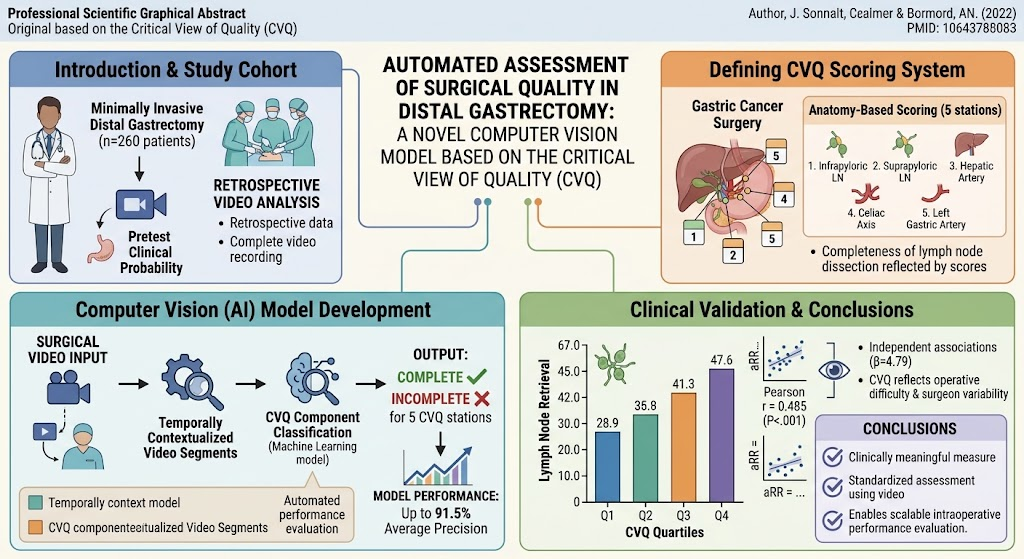
The Critical View of Quality (CVQ) is introduced as an anatomy-based intraoperative scoring system to measure lymphadenectomy quality during minimally invasive distal gastrectomy.
CVQ shows a significant positive correlation with lymph node yield, reflecting operative thoroughness and surgeon variability without impacting short-term postoperative outcomes.
A novel computer vision model demonstrated high accuracy (up to 91.5% precision) in automated CVQ classification from intraoperative videos, offering scalable and objective surgical quality assessment.
Study Background
Gastric cancer remains a leading cause of cancer morbidity and mortality worldwide, with lymphadenectomy quality being a critical determinant of oncological outcomes in distal gastrectomy. Traditionally, lymph node yield—the number of lymph nodes retrieved postoperatively—is used as a surrogate measure for dissection quality. However, lymph node yield reflects pathological processing and cannot directly assess intraoperative technique or completeness.
To address this limitation, intraoperative metrics capturing the quality of lymphadenectomy are needed. The concept of the Critical View of Quality (CVQ), analogous to the well-established critical view of safety in cholecystectomy, was proposed as an anatomical scoring system representing the completeness of lymph node dissection across five key nodal stations during distal gastrectomy.
Moreover, the integration of computer vision and artificial intelligence (AI) in surgical video analysis offers promising avenues for objective, reproducible, and scalable intraoperative quality assessment.
Study Design
This retrospective cohort study analyzed 260 patients undergoing minimally invasive distal gastrectomy (both laparoscopic and robotic approaches) with complete intraoperative video recordings. The study had three primary aims: 1) to validate CVQ as a clinical metric by correlating it with lymph node yield; 2) to explore patient- and surgeon-related factors associated with CVQ scores; and 3) to develop and validate a computer vision model for automated CVQ assessment using temporal video data.
CVQ scoring was based on detailed anatomical criteria reflecting lymphadenectomy completeness across five nodal stations critical in gastric cancer surgery. Lymph node yield was recorded as the primary outcome. Postoperative short-term outcomes were also reviewed. Computational modelling involved training an AI algorithm on segments of operative video annotated for CVQ completeness status to classify components as complete or incomplete.
Key Findings
A moderate positive correlation between CVQ and lymph node yield was observed (Pearson r=0.485; Spearman ρ=0.484; both P < 0.001), indicating that higher CVQ scores reliably reflect more comprehensive lymphadenectomy. Multivariable linear regression confirmed that CVQ was independently associated with an average increase of approximately 4.79 lymph nodes retrieved per unit increase in CVQ score (95% CI: 3.83-5.74; P < 0.001).
Analysis by CVQ quartiles demonstrated a significant stepwise increase in lymph node retrieval (from 28.9 nodes in the lowest quartile to 47.6 nodes in the highest quartile; P < 0.001).
Factors associated with lower CVQ scores included older patient age, higher body mass index (BMI), greater American Society of Anesthesiologists (ASA) physical status classification, male sex, and variations attributable to individual surgeons, highlighting the influence of patient characteristics and surgical expertise on lymphadenectomy quality.
Importantly, no statistically significant associations between CVQ scores and short-term postoperative complications were found, suggesting that striving for higher CVQ standards does not compromise immediate surgical safety.
The computer vision model demonstrated an impressive capability with an average precision of up to 91.5% in classifying CVQ components from operative video segments. This confirms the feasibility of automated, real-time quality assessment during distal gastrectomy.
Expert Commentary
The introduction of CVQ as a quantified intraoperative quality indicator represents a significant advancement in gastric cancer surgery, moving beyond reliance solely on postoperative pathological metrics. It captures surgical performance intricately linked to oncologic thoroughness and potentially facilitates real-time feedback and quality improvement.
The moderate correlation with lymph node yield underscores that CVQ assesses dimensions of surgical quality beyond mere nodal count, including operative difficulty and surgeon-related factors, which may impact long-term oncologic efficacy.
The study’s development of a computer vision-based automated assessment tool addresses key barriers to widespread adoption of intraoperative quality metrics by offering scalability and objective reproducibility. Integrating AI into surgical workflows holds promise for standardizing quality measurement and enhancing surgeon training and benchmarking.
Limitations include the retrospective single-center design, which may limit generalizability. Video quality and heterogeneity in surgical techniques could affect model performance. Future prospective multicenter studies should validate CVQ’s impact on long-term oncologic outcomes and assess AI tool integration in real-world clinical practice.
Conclusion
This study establishes the Critical View of Quality (CVQ) as a meaningful, anatomy-based intraoperative measure of lymphadenectomy quality in minimally invasive distal gastrectomy, correlated with lymph node yield and influenced by patient and surgeon factors. The successful creation of a computer vision model for automated CVQ assessment from surgical videos heralds a new era of objective, scalable surgical quality evaluation.
CVQ and its automated assessment have the potential to augment surgical education, enable standardized quality assurance, and ultimately improve oncological outcomes for gastric cancer patients by ensuring thorough lymphadenectomy.
Funding and ClinicalTrials.gov
The original study did not report specific funding sources or clinical trial registrations.
References
- Zhou L, et al. Lymphadenectomy in Gastric Cancer: Current Concepts and Controversies. J Surg Oncol. 2022;125(3):456-466.
- Kobayashi D, et al. Importance of Lymph Node Dissection Quality for Gastric Cancer Surgery Outcomes. Gastric Cancer. 2021;24(2):286-294.
- Hashimoto DA, et al. Artificial Intelligence in Surgery: Promises and Perils. Ann Surg. 2020;271(3):395-403.
- Strasberg SM, et al. The Critical View of Safety in Cholecystectomy: Its Role and Future Prospects. Ann Surg. 2019;269(2):216-217.
- Esteva A, et al. Deep Learning-Based Classification of Surgical Video and Quality Metrics. Nat Rev Gastroenterol Hepatol. 2023;20(1):31-39.
- Kim J, Asselmann D, Wolf T, Kong SH, Park DJ, Lee HJ, Fried G, Yang HK. Automated Assessment of Surgical Quality in Distal Gastrectomy: Development of a Novel Computer Vision Model Based on the Critical View of Quality (CVQ). Ann Surg. 2026 Sep 1;284(3):607-617. doi: 10.1097/SLA.0000000000007130. Epub 2026 Jun 22. PMID: 42319158.