Highlight
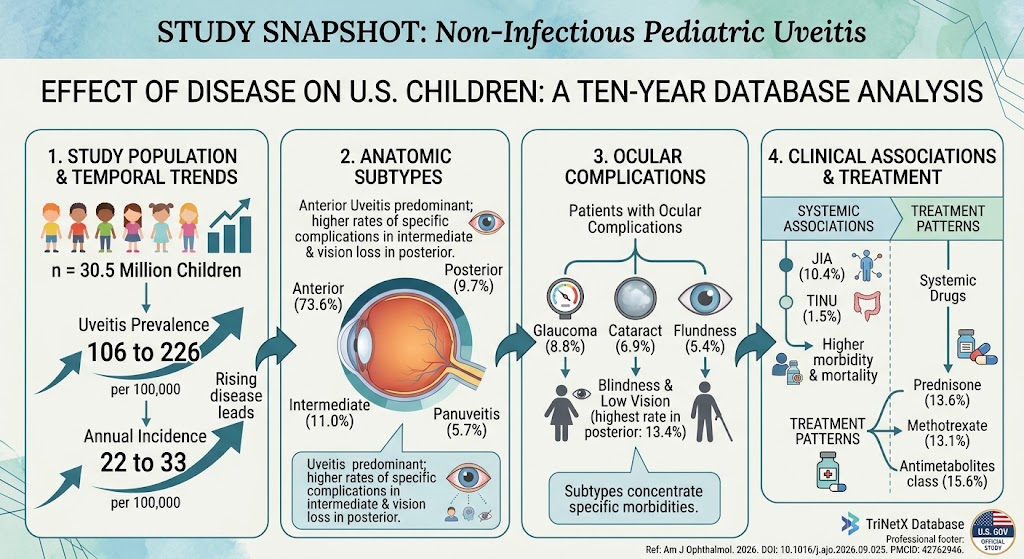
This comprehensive retrospective analysis of a large US pediatric cohort reveals: (1) increasing annual incidence and prevalence of non-infectious pediatric uveitis from 2016 to 2025; (2) anterior uveitis predominates among subtypes, while posterior uveitis associates with higher vision loss rates; (3) glaucoma and cataract are common ocular complications; (4) systemic diseases like juvenile idiopathic arthritis and tubulointerstitial nephritis with uveitis are frequent; (5) immunosuppressive therapy chiefly involves prednisone and methotrexate, with antimetabolites as the main drug class.
Study Background
Non-infectious pediatric uveitis, a rare but potentially sight-threatening intraocular inflammatory condition, poses significant diagnostic and management challenges. It encompasses inflammation of the uveal tract without infectious etiology and is often associated with systemic autoimmune diseases such as juvenile idiopathic arthritis (JIA). The disease burden is amplified by its potential to cause severe ocular complications including glaucoma, cataract, and irreversible vision loss. Despite its clinical significance, contemporary epidemiologic data on pediatric uveitis in the United States remain limited, particularly regarding trends in incidence, prevalence, associated comorbidities, and treatment patterns. Clarifying these aspects is critical for optimizing care strategies and resource allocation.
Study Design
This study was a retrospective incidence and prevalence analysis utilizing the TriNetX US Collaborative Network electronic health record database. The population included patients aged 17 years or younger diagnosed with non-infectious uveitis from 2016 through 2025. Uveitis subtypes were classified per the Standardization of Uveitis Nomenclature (SUN) criteria into anterior, intermediate, posterior, and panuveitis. Key variables extracted included demographics, ocular complications, coexistent systemic inflammatory diseases identified via International Classification of Diseases, Tenth Revision (ICD-10) codes, and details of systemic immunosuppressive therapy from RxNorm and Healthcare Common Procedure Coding System (HCPCS) codes. Incidence and prevalence rates were calculated per 100,000 persons annually and cumulatively. Statistical precision was assessed using Wilson score confidence intervals.
Key Findings
Incidence and Prevalence Trends
Among a total pediatric population base of 30,729,490 children, 30,533 cases of non-infectious uveitis (0.10%) were identified. The median age at diagnosis was 11 years, with a slight male predominance (54.6%). Over the decade of study, annual incidence increased from 22 to 33 cases per 100,000 persons, while prevalence more than doubled from 106 to 226 per 100,000 persons, suggesting either rising disease occurrence or improved diagnostic ascertainment.
Subtype Distribution and Clinical Associations
Anterior uveitis was most frequent (73.6%), with intermediate, posterior, and panuveitis comprising the remainder. Ocular complications included glaucoma in 8.8% and cataract in 6.9% of cases. Posterior uveitis was notable for the highest rates of blindness and low vision (13.4%), emphasizing its severe visual morbidity compared to other subtypes.
Systemic inflammatory associations were common. Juvenile idiopathic arthritis was present in 10.4% of patients, reaffirming its role as the most recognized systemic link in pediatric uveitis. Tubulointerstitial nephritis and uveitis complex, although less frequent (1.5%), represented an important discrete association, warranting clinician awareness for multi-system evaluation.
Immunosuppressive Treatment Patterns
Systemic corticosteroids, mainly prednisone, were prescribed to 13.6% of patients as initial anti-inflammatory management. Methotrexate, an antimetabolite and staple of autoimmune disease treatment, was nearly equally utilized (13.1%). Overall, antimetabolites represented the most common drug class (15.6%), aligning with contemporary standards favoring steroid-sparing agents for long-term control and minimization of steroid-induced ocular and systemic adverse effects.
Expert Commentary
This study furnishes critical epidemiological evidence documenting an apparent rise in pediatric non-infectious uveitis within the United States. Whether this increase represents a true epidemiological shift or reflects enhanced awareness and diagnostic capacity remains uncertain; prospective surveillance studies would elucidate causality. The predominance of anterior uveitis concurs with existing literature, yet the disproportionate visual impairment linked with posterior involvement underscores the necessity for early detection and aggressive management of posterior and panuveitis.
The frequent coexistence of JIA corroborates its pathogenetic imprint on pediatric uveitis; this highlights the importance of interdisciplinary collaboration between pediatric rheumatologists and ophthalmologists. Recognition of less common but clinically pertinent associations like tubulointerstitial nephritis and uveitis further extends the clinician’s index of suspicion for systemic evaluation.
Therapeutic patterns reflect prudent adoption of immunomodulatory therapies aimed at achieving disease quiescence with minimized corticosteroid exposure. However, the study’s retrospective nature and reliance on electronic coding may limit granularity, including disease severity, treatment response, and long-term visual outcomes, which are critical for comprehensive care optimization.
Conclusion
Over a nearly ten-year period, non-infectious pediatric uveitis incidence and prevalence in the U.S. have substantially increased. Anterior uveitis remains the dominant subtype, but intermediate and posterior uveitis account for greater ocular morbidity and vision loss. Juvenile idiopathic arthritis and tubulointerstitial nephritis with uveitis are key systemic associations. Immunosuppressive management primarily involves corticosteroids and methotrexate. Future prospective investigations are warranted to discern whether rising rates reflect increased disease burden or improved detection practices, and to evaluate the impact of evolving treatment approaches on visual prognosis.
Reference
Nijim W, Pham NV, Liu R, Agsalud K, Dutta E, Venkat A, Arepalli S. Incidence, Prevalence, and Clinical Associations of Non-Infectious Pediatric Uveitis in the United States: A TriNetX Database Study. Am J Ophthalmol. 2026 Sep 19:S0002-9394(26)00540-4. doi: 10.1016/j.ajo.2026.09.025. Epub ahead of print. PMID: 42762946.