Highlight
- A combined self-reported questionnaire with demographic and lifestyle data effectively screens for periodontal disease stages.
- The model achieved high accuracy: AUROC 0.888 for periodontitis detection, with over 90% sensitivity and specificity.
- For severe periodontitis (Stage III/IV), the model maintained strong diagnostic performance (AUROC 0.899).
- External validation in a representative Hong Kong population supports its potential for broad community screening applications.
Study Background
Periodontal disease, encompassing gingivitis and periodontitis, is a prevalent chronic inflammatory condition affecting the supporting structures of teeth. Left untreated, it can lead to tooth loss and has been associated with systemic health consequences including cardiovascular disease and diabetes. Traditional diagnosis relies on clinical and radiographic examination, which requires professional dental visits and is resource-intensive.
Given the global disease burden and challenges in early detection, especially in underserved communities, there is increasing interest in self-reported screening tools that are time- and cost-effective. Such tools may enhance public awareness and prompt timely periodontal care. Prior models, such as questionnaires developed by the Centers for Disease Control and Prevention/American Academy of Periodontology (CDC/AAP), combined with demographic and lifestyle factors, have shown promise but require external validation in independent populations to confirm their diagnostic utility.
Study Design
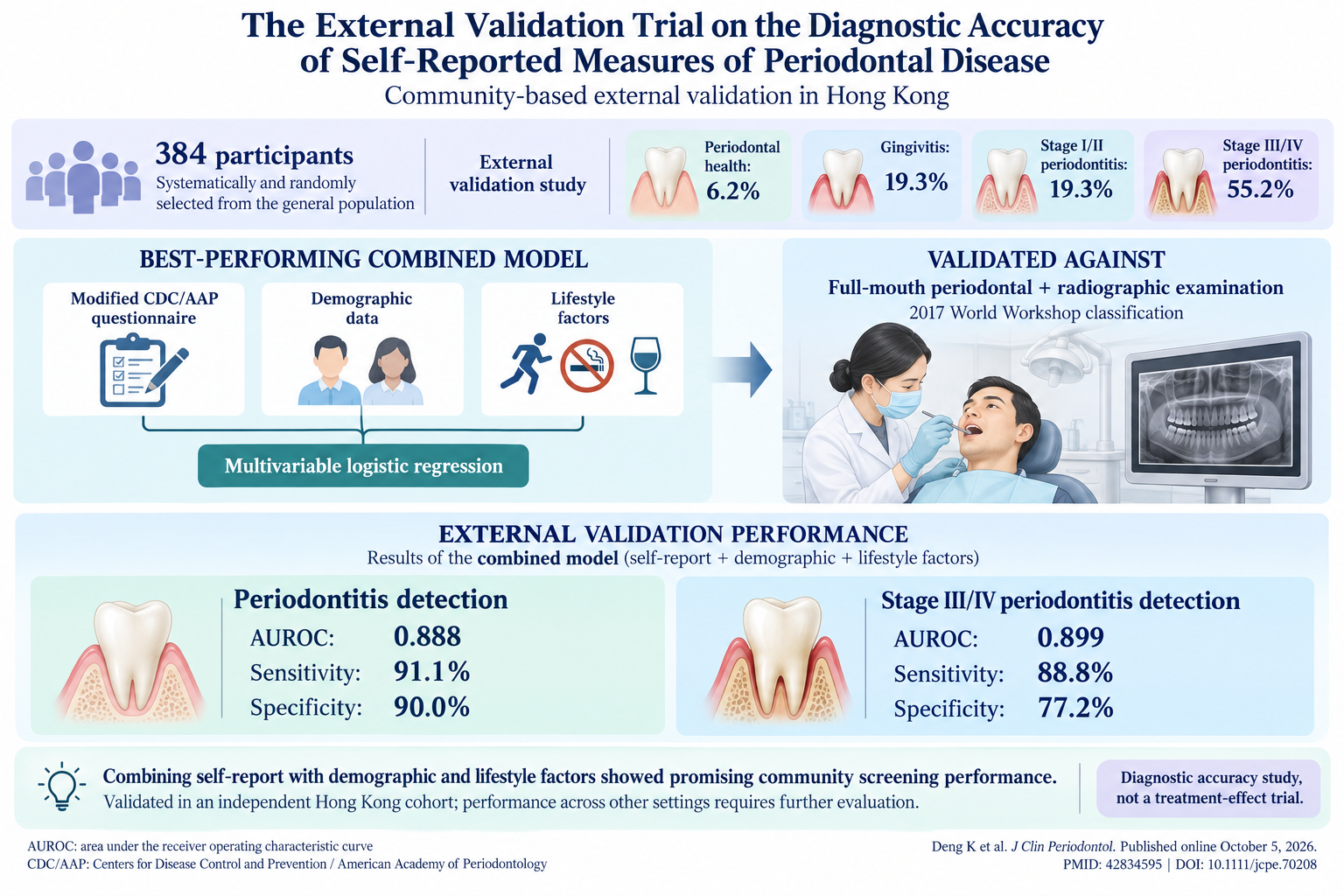
This external validation trial evaluated a modified self-administered questionnaire originally developed by CDC/AAP combined with demographic data and lifestyle factors. The study enrolled 384 participants randomly selected from the general population in Hong Kong to reflect community periodontal health status.
All participants completed the questionnaire followed by standardized full-mouth periodontal and radiographic examinations. Periodontal status was classified according to the 2017 World Workshop Classification of Periodontal Diseases, stratifying subjects into periodontal health, gingivitis, Stage I/II periodontitis, and Stage III/IV periodontitis.
The main endpoint was the diagnostic accuracy of the screening model compared to the clinical periodontal diagnosis. Multivariate logistic regression was used to analyze associations, and model performance was quantified by calculating the area under the receiver operating characteristic curve (AUROC), sensitivity, and specificity.
Key Findings
The cohort comprised 6.2% periodontal health, 19.3% gingivitis, 19.3% Stage I/II periodontitis, and 55.2% with severe Stage III/IV periodontitis, indicating a high prevalence of advanced disease in the population.
The combined model integrating questionnaire responses with demographic and lifestyle factors demonstrated excellent performance in identifying periodontitis overall, with an AUROC of 0.888. Sensitivity was 91.1%, meaning the tool correctly identified over 9 out of 10 true periodontitis cases, while specificity was 90.0%, effectively excluding those without disease.
For detecting severe Stage III/IV periodontitis, diagnostic accuracy remained robust, with an AUROC of 0.899, sensitivity of 88.8%, and specificity of 77.2%. This high sensitivity is critical for screening tools to avoid missing advanced cases requiring urgent care.
These results validate the external applicability of the screening model in an ethnically distinct population from the original development cohort, supporting its utility in diverse community settings.
Expert Commentary
Dr. Maurizio Tonetti, a senior author of the study and a leading expert in periodontal epidemiology, emphasizes the model’s strength lies in balancing accuracy with feasibility for large-scale implementation. While clinical periodontal assessment remains the gold standard, the validated self-report tool offers an efficient alternative for initial case-finding in resource-limited or primary care settings.
Limitations include reliance on self-reported data, which may be subject to recall bias, and the high prevalence of severe periodontitis in the sample that may influence the predictive values. Further studies are needed to evaluate longitudinal predictive performance and integration into public health programs.
Conclusion
This study successfully externally validates a cost-effective, self-reported periodontal disease screening tool that incorporates questionnaire items, demographic, and lifestyle factors. Its high sensitivity and specificity for both overall and severe periodontitis make it a promising candidate to improve early detection and raise oral health awareness at the community level.
Future research should focus on implementation strategies across diverse populations and settings, alongside evaluation of impact on clinical outcomes and cost-effectiveness to guide public health policy and targeted periodontal care.
Funding and Clinical Trials
The study received institutional support from the participating academic collaborators. No specific funding or clinical trial registration information was provided in the source publication.
References
- Deng K, Lam SLT, Kung JCK, Jin L, Tonetti M, Pelekos G. The External Validation Trial on the Diagnostic Accuracy of Self-Reported Measures of Periodontal Disease. J Clin Periodontol. 2026 Oct 5. PMID: 42834595.
- Tonetti MS, Greenwell H, Kornman KS. Staging and grading of periodontitis: Framework and proposal of a new classification and case definition. J Periodontol. 2018 Jun;89 Suppl 1:S159-S172.
- Centers for Disease Control and Prevention. Periodontal Disease: Factsheet. [Internet] Available from https://www.cdc.gov/oralhealth/periodontal_disease/index.htm