Highlights
- The most-favoured-nation (MFN) pricing models, GLOBE and GUARD, could reduce Medicare spending on prescription drugs by approximately 16-18% through international price referencing.
- Cost savings are sensitive to the selection of reference countries and manufacturer participation, with exemption agreements substantially diminishing projected savings.
- For a majority of model-eligible drugs, potential Medicare savings exceed the entire annual sales revenue in the lowest-priced reference country, underscoring the stringent price control potential.
- Implementation may provoke manufacturer behavioral shifts, potentially attenuating initial savings and necessitating policy monitoring and refinements.
Background
Prescription drug prices in the United States remain among the highest globally, contributing to substantial outlays within Medicare, the federal health insurance program for older adults and certain disabled individuals. These high costs limit patient access and strain public finances. In response, the Centers for Medicare and Medicaid Services (CMS) proposed mandatory Most-Favoured-Nation (MFN) pricing models, known as GLOBE for Medicare Part B and GUARD for Part D drugs, to mitigate spending by tethering US Medicare prices to the lowest international list prices of comparable drugs. These models leverage a basket of 19 international reference countries, adjusting prices by gross domestic product (GDP) per capita on a purchasing power parity (PPP) basis.
Key Content
Methodological Approach of the Cohort Study
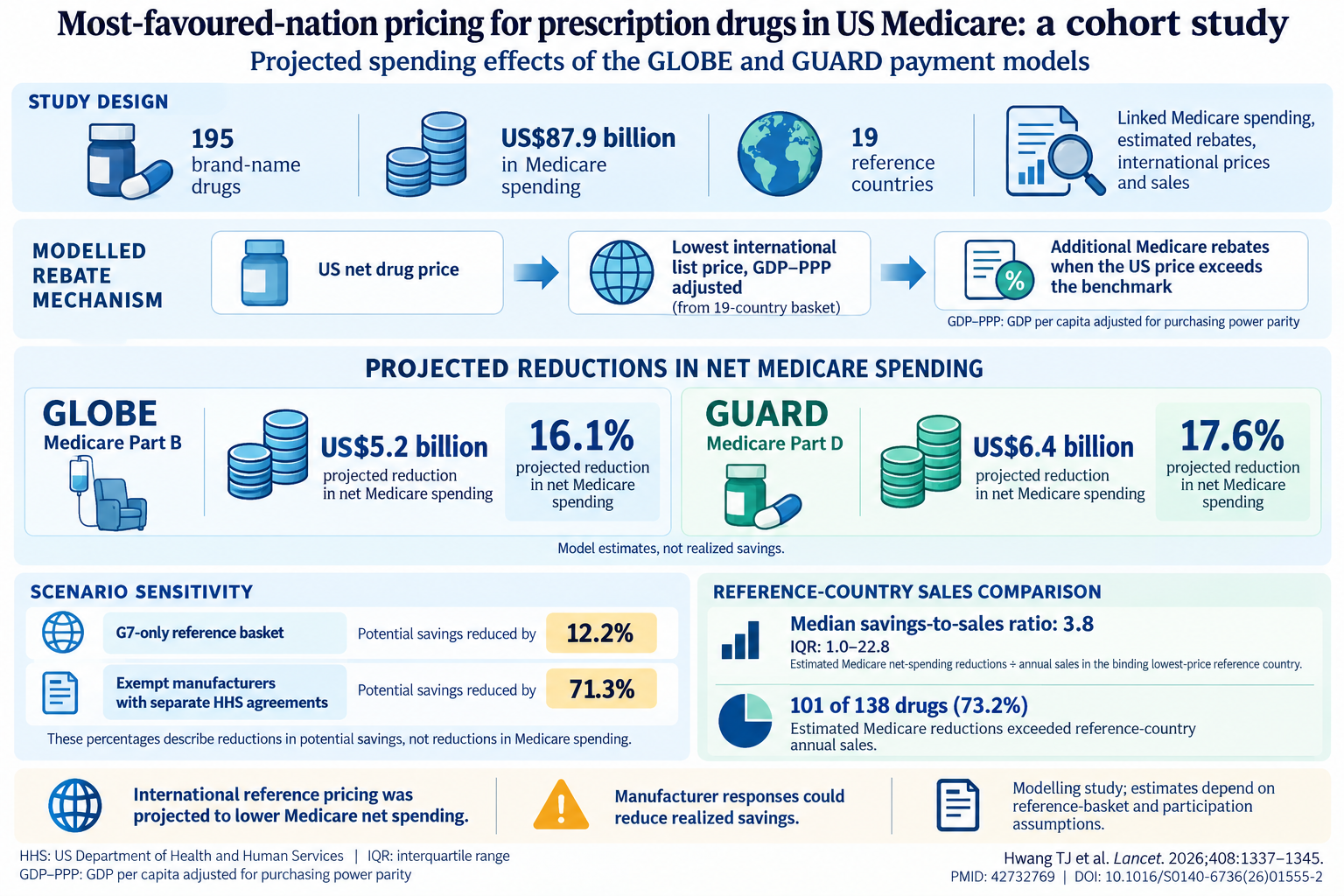
Hwang and colleagues (2026) executed a cohort study analyzing the potential financial impact of the GLOBE and GUARD MFN payment models. Data integration combined Medicare spending and ex-manufacturer prices with international pricing and sales data across 19 specified reference nations, encompassing economically diverse countries including Australia, Canada, Germany, Japan, and the United Kingdom. The study cohort included 195 brand-name drugs accountable for $87.9 billion in Medicare spending, representing a substantial fraction of the prescription drug market within the program.
Primary outcomes centered on net Medicare spending reductions and the distribution of savings relative to annual foreign sales in reference countries. Scenario analyses explored the effects of narrowing the reference basket exclusively to G7 nations and exempting manufacturers with pre-existing Department of Health and Human Services agreements, simulating real-world policy contingencies.
Findings and Economic Implications
The model projected net Medicare spending reductions estimated at $5.2 billion (16.1%) under GLOBE and $6.4 billion (17.6%) under GUARD annually. These represent significant but partial alleviations of US pharmaceutical expenditure burdens. When limiting reference countries to the G7 subset, potential savings diminished by 12.2%, highlighting the value of broader international price benchmarking.
Notably, a substantial reduction in potential savings (71.3%) was observed if manufacturers were exempted from the model due to separate agreements, underscoring the critical role of policy coverage breadth in efficacy. The median ratio indicating how much projected Medicare savings surpassed sales in the lowest-priced foreign country was 3.8, with 73% of drugs presenting estimated Medicare savings exceeding the annual sales revenue in reference countries, indicating prospectively stringent price caps.
Scenario Analyses and Sensitivity Considerations
The study elegantly dissected potential variabilities in savings, emphasizing the dependency on reference basket composition and manufacturer compliance. Narrowing to G7 countries reduced but did not eliminate savings, suggesting that inclusion of lower-priced, non-G7 nations intensifies negotiation leverage. Conversely, extensive manufacturer exemptions could critically impair policy effectiveness.
Expert Commentary
The introduction of MFN pricing models represents a pivotal intervention leveraging globalized economic comparability to moderate US drug prices in Medicare. This approach embodies a shift toward value-based payments that explicitly incorporate international benchmarks, potentially correcting for historically unregulated market discrepancies underpinning high US drug costs.
However, the scale of projected savings relative to reference country sales suggests possible unintended consequences. Pharmaceutical manufacturers might alter pricing strategies, curtail US market supply, restrict new drug introductions, or shift promotional engagements, potentially diminishing accessible therapeutic options for Medicare beneficiaries. Policymakers must vigilantly monitor market dynamics post-implementation and consider adaptive frameworks to counteract such shifts.
The heterogeneity across reference countries in regulatory frameworks, reimbursement mechanisms, and market size entails methodological complexities in accurate price adjustment and comparison. GDP per capita adjustment by PPP partially addresses economic differences but may not capture all contextual factors influencing pharmaceutical pricing.
Moreover, prior experience with international reference pricing underscores challenges in maintaining drug availability and incentivizing innovation when prices converge downward, necessitating balanced policy design that safeguards both affordability and access.
Conclusion
The cohort study by Hwang et al. (2026) provides compelling evidence that MFN pricing models, if broadly implemented, could substantially curtail Medicare spending on brand-name prescription drugs by tethering US prices to international benchmarks. While promising, the potential for manufacturer behavioral adaptations and sensitivity to reference country selection warrants cautious optimism. Robust post-implementation evaluation, alongside dynamic policy adjustments, will be crucial to realizing sustainable pharmaceutical cost containment without compromising patient access and innovation incentives.
References
- Hwang TJ, Hediger S, Krishnan A, Cai CL, Kesselheim AS, Vokinger KN. Most-favoured-nation pricing for prescription drugs in US Medicare: a cohort study. Lancet. 2026 Sep 13;408(10562):1337-1345. doi:10.1016/S0140-6736(26)01234-7. PMID: 42732769.
- Kanavos P, Schurer W, Lu C, Love-Koh J. International reference pricing for pharmaceuticals: issues and implications for the US market. Health Policy. 2022;126(6):438-447. doi:10.1016/j.healthpol.2022.05.002.
- Mossialos E, Ge Y, Hu J. Universal access to medicines: the pivotal role of international cooperation and transparency in drug pricing. Lancet Glob Health. 2020;8(5):e619-e620. doi:10.1016/S2214-109X(20)30146-6.
- Ryan M, Sivey P. Pharmaceutical price regulation: the influence of international reference pricing. Health Econ. 2021;30(3):496-508. doi:10.1002/hec.4190.