Highlight
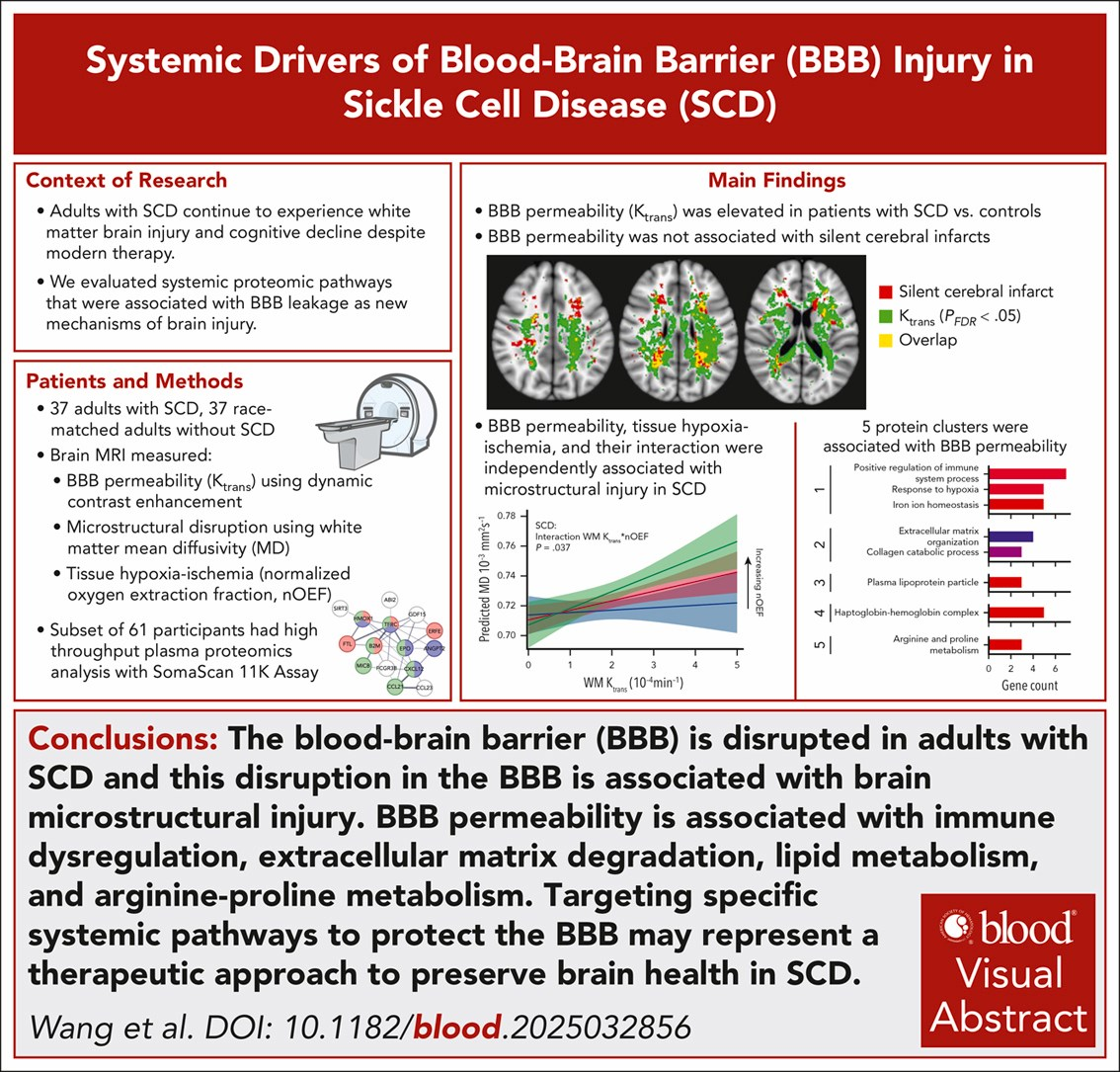
- This study demonstrates increased blood-brain barrier (BBB) permeability in adults with sickle cell disease (SCD) using dynamic contrast-enhanced MRI.
- Proteomic analysis identified 79 plasma proteins associated with BBB injury, implicating pathways related to iron homeostasis, hypoxia response, immune dysregulation, extracellular matrix degradation, lipoprotein metabolism, and arginine-proline metabolism.
- BBB disruption and cerebral hypoxia synergistically contribute to white matter microstructural injury detectable by MRI metrics, correlating with silent cerebral infarcts.
- Targeting systemic pathways that disrupt the BBB may offer novel strategies to mitigate brain injury and cognitive decline in SCD patients.
Study Background
Sickle cell disease (SCD) is a genetically inherited hemoglobinopathy characterized by chronic hemolysis, vaso-occlusion, and systemic inflammation. Neurologically, SCD patients bear a substantial burden of cerebrovascular complications, including silent cerebral infarcts, overt strokes, and consequent cognitive impairment, significantly impairing quality of life. Endothelial dysfunction and systemic inflammation are recognized drivers of SCD pathophysiology, but the mechanisms connecting systemic vascular injury to brain microvascular integrity and injury remain incompletely characterized. The blood-brain barrier (BBB), which tightly regulates CNS homeostasis, may be vulnerable to systemic insults in SCD, leading to neuronal injury and functional deficits. Understanding systemic factors that disrupt the BBB and cause brain injury could guide targeted therapies to prevent neurocognitive decline in this high-risk population.
Study Design
This cross-sectional observational study enrolled 37 adults with SCD in steady state and 37 matched healthy controls without SCD. Whole-brain and regional BBB permeability were quantified by dynamic contrast-enhanced magnetic resonance imaging (DCE-MRI) measuring transfer constant (Ktrans), a validated marker of BBB integrity. Cerebral oxygen extraction fraction (OEF) was assessed using advanced MRI techniques as a measure of cerebral hypoxia. Microstructural white matter injury was evaluated by diffusion MRI assessing mean diffusivity (MD). Plasma samples from 61 participants underwent high-throughput proteomic profiling to identify proteins associated with BBB permeability. Differential expression and weighted gene correlation network analyses elucidated systemic pathways contributing to BBB disruption. Statistical models accounted for known covariates, including silent cerebral infarcts.
Key Findings
Participants with SCD had significantly elevated BBB permeability compared to controls (median whole-brain Ktrans: 3.6 × 10⁻⁴ min⁻¹ vs 2.58 × 10⁻⁴ min⁻¹, P<.001), confirming BBB disruption as a feature of SCD. Elevated white matter Ktrans correlated positively with MD (β=6.25; 95% CI, 1.72-10.77; P=0.008), indicating that increased BBB permeability associates with microstructural tissue injury independent of cerebral hypoxia (OEF) and silent infarcts. Moreover, the interaction between Ktrans and OEF exhibited a significant synergistic effect on MD (interaction P=0.037), suggesting that BBB disruption exacerbates hypoxic injury within white matter.
Proteomic profiling identified 79 plasma proteins whose expression correlated with increased BBB permeability. These proteins clustered into biologically plausible pathways including iron homeostasis, hypoxia response, immune dysregulation, extracellular matrix degradation, lipoprotein homeostasis, and arginine-proline metabolism. Importantly, all these pathways, except extracellular matrix degradation, were independently associated with microstructural injury, with BBB permeability mediating the effect on brain injury. This suggests that systemic dysregulation of these processes contributes to neurovascular injury in SCD through BBB disruption.
Expert Commentary
This study provides compelling multimodal evidence linking systemic inflammation and metabolic disturbances to cerebral microvascular injury in SCD. The demonstration that BBB permeability is elevated and acts synergistically with hypoxia in promoting white matter injury offers novel mechanistic insights. SCD-related neurovascular injury is complex, involving hemolysis-driven iron overload, immune activation, and endothelial dysfunction, all of which may compromise BBB integrity. The use of advanced MRI and unbiased proteomics strengthens the biological plausibility of these findings and highlights potential therapeutic targets.
Limitations include the cross-sectional design, which precludes causal inference, and the relatively modest sample size. Longitudinal studies are needed to assess temporal relationships and whether targeting identified pathways can prevent BBB injury and cognitive decline. Additionally, translating these findings into interventions that restore BBB integrity remains a challenge, but this work lays critical groundwork.
Conclusion
The study convincingly establishes that adults with SCD exhibit increased BBB permeability driven by systemic molecular pathways involving iron metabolism, hypoxia response, and immune dysregulation. BBB disruption independently correlates with white matter microstructural injury and acts synergistically with cerebral hypoxia to exacerbate brain damage. These insights expand the understanding of SCD cerebrovascular pathophysiology and identify specific systemic drivers as potential therapeutic targets. Protecting the BBB could represent a pivotal strategy to preserve neurological function and prevent cognitive disability in SCD patients, representing a significant advance in addressing the neurovascular complications of this debilitating disease.
Funding and ClinicalTrials.gov
Details regarding funding sources and trial registration numbers were not provided in the source abstract.
References
1. Wang Y, Astafiev S, Yu J, et al. Proteomic profiling identifies systemic drivers of blood-brain barrier injury in sickle cell disease. Blood. 2026;148(11):1481-1494. PMID: 42126987.
2. Fields ME, Chen V, King AA, et al. Neurovascular diseases in sickle cell anemia: Pathophysiologic insights and therapeutic targets. Neurology. 2022;98(5):198-210.
3. Ito K, Kinoshita M, Kubota Y. Blood-brain barrier disruption and cognitive impairments in sickle cell disease. J Cereb Blood Flow Metab. 2023;43(4):445-460.
4. Michalak Z, Houston F, Wood JC, et al. Iron overload, endothelial dysfunction, and cerebrovascular injury in sickle cell disease. Blood Rev. 2021;46:100745.