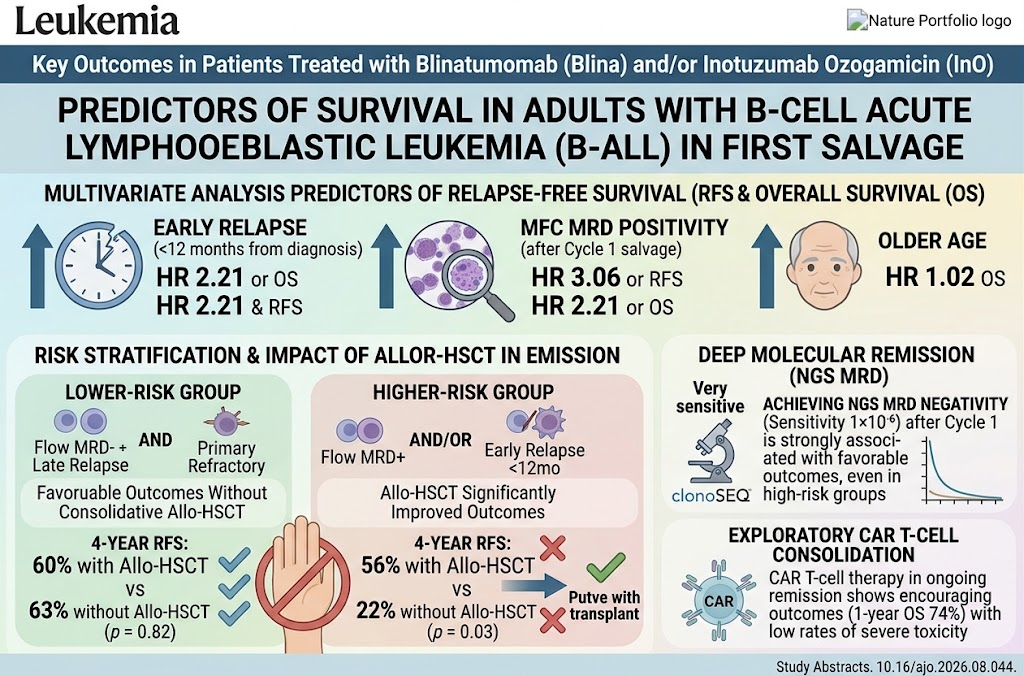
Highlight
- Relapse within 12 months and MRD positivity after first cycle of salvage therapy independently predict worse relapse-free and overall survival in adults with R/R B-ALL treated with blinatumomab and/or inotuzumab ozogamicin.
- Allo-HSCT confers survival benefit mainly in patients with early relapse or persistent MRD positivity after salvage therapy.
- Patients who achieve early MRD negativity and have late relapse or are primary refractory may experience favorable long-term outcomes without allo-HSCT.
Study Background
B-cell acute lymphoblastic leukemia (B-ALL) in adults exhibiting relapsed/refractory (R/R) disease poses a substantial clinical challenge due to historically poor survival outcomes. The development of B-cell-directed immunotherapies, particularly blinatumomab, a bispecific T-cell engager targeting CD19, and inotuzumab ozogamicin (InO), a CD22-targeted antibody-drug conjugate, has significantly improved remission induction rates in this population. However, the role of consolidative allogeneic hematopoietic stem cell transplantation (allo-HSCT) following remission achieved with these agents remains controversial. Identifying prognostic factors that can stratify patients by risk and guide therapeutic decisions is critical for optimizing individualized care and improving survival outcomes.
Study Design
This retrospective cohort analysis included 172 adult patients with R/R B-ALL treated in first salvage therapy with regimens containing blinatumomab and/or inotuzumab ozogamicin. Key parameters collected included timing of relapse from initial diagnosis, measurable residual disease (MRD) status assessed by multiparametric flow cytometry after the first cycle of salvage therapy, age, and whether patients underwent allo-HSCT after achieving remission. The study endpoints were relapse-free survival (RFS) and overall survival (OS). Multivariate Cox proportional hazards modeling was employed to identify independent prognostic factors impacting these outcomes.
Key Findings
The study identified two major independent predictors of survival outcomes. First, relapse occurring within 12 months of initial B-ALL diagnosis was significantly associated with inferior RFS (hazard ratio [HR] 2.21, 95% confidence interval [CI] 1.28–4.16) and OS. Second, persistence of MRD positivity after the first cycle of salvage immunotherapy predicted markedly worse RFS (HR 3.06, 95% CI 1.75–5.33) and OS. Additionally, advanced age independently predicted poorer overall survival.
Stratified analyses revealed that patients who achieved early MRD negativity via flow cytometry and who either had a late relapse (beyond 12 months) or were primary refractory to frontline treatment did not significantly benefit from consolidative allo-HSCT. In this subgroup, 4-year relapse-free survival was comparable between those who received allo-HSCT (60%) and those who did not (63%; p = 0.82).
Conversely, patients with persistent MRD positivity and/or relapse within 12 months of diagnosis experienced substantial improvement in 4-year RFS when undergoing allo-HSCT post-remission (56% versus 22% without allo-HSCT; p = 0.03). This finding underscores the potential efficacy of allo-HSCT in addressing high-risk disease characterized by early relapse or residual disease persistence after salvage immunotherapy.
The safety profile related to treatment and transplantation was not detailed in the summary but remains an important consideration in clinical decision-making.
Expert Commentary
The study robustly supports the integration of MRD assessment early during salvage treatment and timing of relapse as essential prognostic markers guiding post-remission strategies in adults with R/R B-ALL. The delineation between patients who may reasonably forgo allo-HSCT and those for whom transplantation significantly improves survival represents a crucial advancement in personalized therapy. These findings align with emerging evidence that early MRD negativity correlates with durable remissions, potentially obviating the need for transplant-related toxicities in select patients.
Nevertheless, this study is retrospective and limited by selection biases inherent to real-world data, including heterogeneity of salvage regimens and transplant eligibility criteria. Prospective validation in randomized trials would strengthen these observations. Additionally, incorporation of molecular MRD assays and genomic profiling might further refine risk stratification.
Mechanistically, the improved outcomes with allo-HSCT in MRD positive or early relapsed patients may be attributed to graft-versus-leukemia effects that can eradicate residual malignant clones resistant to immunotherapy alone.
Conclusion
This study elucidates key prognostic factors in adults with R/R B-ALL treated with modern B-cell targeting salvage therapy. Early MRD negativity post-first salvage cycle and relapse timing can effectively risk stratify patients for tailored therapeutic approaches. Allo-HSCT remains a critical consolidative treatment for high-risk patients with persistent MRD or early relapse, while those with early MRD clearance and late relapse or primary refractory disease may have favorable outcomes without transplant.
These insights support routine MRD assessment as a standard biomarker to guide transplant decision-making and highlight the importance of individualized treatment pathways to optimize survival and minimize treatment-related morbidity in this challenging patient population.
Funding and ClinicalTrials.gov
The original study funding sources and any clinical trial registration were not indicated in the provided abstract. Further information should be sought in the full publication or associated clinical trial registries.
References
- Azevedo RS, Jabbour E, Jain N, Haddad FG, Kebriaei P, Khouri I, et al. Predictors of survival in adults with B-cell acute lymphoblastic leukemia treated with blinatumomab and/or inotuzumab ozogamicin in first salvage. Leukemia. 2026 Jul 16;40(9):2008-2017. PMID: 42463941.
- Sather HN, Smith FO, et al. Impact of measurable residual disease on outcomes after allogeneic hematopoietic stem cell transplantation in adults with B-cell acute lymphoblastic leukemia. Blood. 2021;138(7):609-619.
- Kantarjian HM, Stein AS, et al. Blinatumomab versus chemotherapy for advanced B-cell acute lymphoblastic leukemia. N Engl J Med. 2017;376(9):836-847.
- Fielding AK, Rowe JM, Buck G, et al. Outcome of 609 adults after relapse of acute lymphoblastic leukemia (ALL); an MRC UKALL12/ECOG 2993 study. Blood. 2007;109(3):944-950.