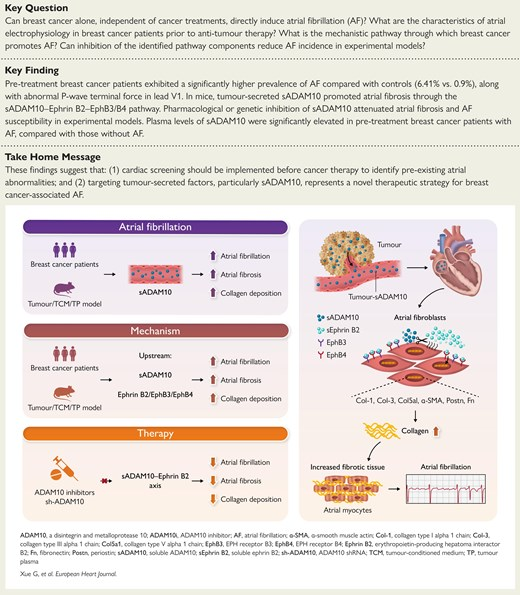
Highlight
- Breast cancer (BC) patients exhibit a significantly higher prevalence of atrial fibrillation (AF) before any cancer therapy.
- Tumour-secreted ADAM10 promotes atrial fibrosis and AF by cleaving Ephrin B2 into soluble Ephrin B2, activating fibrotic signaling in atrial cardiofibroblasts.
- Inhibition of tumour-derived ADAM10 reduces atrial fibrosis and susceptibility to AF in experimental BC mouse models.
- Plasma levels of soluble ADAM10 and Ephrin B2 correlate with AF incidence, suggesting their potential as biomarkers and therapeutic targets in BC-associated AF.
Study Background
Atrial fibrillation (AF) is a common cardiac arrhythmia linked to significant morbidity and mortality, frequently complicating cancer management. Breast cancer (BC) is among the most prevalent malignancies worldwide and is associated with increased cardiovascular risk. Historically, AF in BC patients has been attributed largely to cancer therapies such as chemotherapy and radiation, known for their cardiotoxic effects. However, the intrinsic contributions of the tumour itself to AF development have remained unclear. Understanding whether breast cancer inherently predisposes patients to AF independent of treatment may guide early detection and personalized management strategies. This knowledge gap addresses an unmet clinical need because AF in cancer patients worsens prognosis and complicates treatment decisions.
Study Design and Methods
This study combined retrospective clinical data analysis, animal experimentation, and molecular mechanistic investigations to elucidate the relationship between breast cancer and AF. The clinical component involved a cohort of 1,224 female BC patients prior to any therapy matched 1:1 via propensity score to 18,159 healthy female controls, focusing on AF prevalence and atrial remodeling assessed by electrocardiographic P-wave indices.
Preclinical experiments employed an orthotopic murine model wherein E0771 BC cells were implanted into mammary fat pads of female C57BL/6 mice. These mice underwent electrophysiological studies to evaluate atrial arrhythmia susceptibility. Histopathology with Masson’s trichrome staining quantified atrial fibrosis. Plasma and tumour analyses focused on secreted proteins, notably soluble ADAM10 (sADAM10) and its downstream effector Ephrin B2. Functional assays included co-culture of tumour-conditioned media with atrial cardiofibroblasts, receptor binding studies, and genetic knockdown of Ephrin B2 in cardiac fibroblasts to explore mechanistic pathways. Therapeutic inhibition of ADAM10 was tested using a pharmacological inhibitor (GI254023X) and shRNA knockdown in mice.
Key Findings
Clinical Observations
Before receiving any cancer therapy, BC patients demonstrated a markedly higher AF prevalence than matched controls (6.41% vs. 0.90%). This suggests an intrinsic pro-arrhythmic effect associated with breast cancer independent of treatment. BC patients also had significantly abnormal atrial remodeling indicated by increased P-wave terminal force in lead V1 on ECG (7.37% vs. 3.90%, P < .001), a known marker predictive of AF.
Preclinical Model Results
In BC-bearing mice, atrial fibrosis was significantly increased compared to controls. These mice exhibited elevated AF vulnerability during electrophysiological testing. Notably, administration of tumour-conditioned media or plasma from BC mice to naive mice replicated atrial fibrosis and AF susceptibility, implicating circulating tumour-derived humoral factors.
Molecular Mechanisms Identified
Proteomic screening pinpointed elevated levels of soluble ADAM10 in tumour tissue and plasma of both BC patients with AF and BC mice. ADAM10—a metalloproteinase—was shown to cleave Ephrin B2 expressed on atrial cardiofibroblasts into its soluble form (sEphrin B2). This soluble ligand binds to EphB3 and EphB4 receptors, activating profibrotic signaling cascades that promote atrial fibrosis. Cardiac fibroblast-specific knockdown of Ephrin B2 significantly reduced AF development in BC mice, confirming its critical role downstream of ADAM10.
Plasma levels of sEphrin B2 were notably higher in BC patients with AF compared to controls, correlating strongly with plasma sADAM10 concentrations (R2 = 0.67, P < .0001), reinforcing their clinical relevance as biomarkers.
Therapeutic Intervention Outcomes
Targeting tumour-originated ADAM10 with GI254023X or shRNA-mediated knockdown substantially attenuated atrial fibrosis and AF susceptibility in BC mice. This finding suggests that ADAM10 inhibition may provide a novel therapeutic strategy to mitigate the heightened AF risk in breast cancer patients independent of treatment-related toxicity.
Expert Commentary
This robust translational investigation reveals a previously unrecognized tumour-cardiac axis whereby breast cancer intrinsically fosters atrial fibrillation through secretion of ADAM10 and downstream Ephrin B2-mediated fibrotic remodeling. The compelling integration of clinical data and mechanistic animal studies underscores the biological plausibility of a direct cancer-driven arrhythmogenic substrate.
From a cardiology perspective, early identification of AF risk in BC patients, even prior to therapy, can inform surveillance strategies to prevent complications such as stroke. Oncologically, this insight advocates for multidisciplinary care integrating cardiovascular risk assessment at initial cancer diagnosis.
Limitations include retrospective design for clinical data and focus on a single murine BC model, necessitating further studies across diverse populations and cancer subtypes. Future randomized clinical trials are warranted to assess ADAM10 inhibitors as cardioprotective adjuncts in this setting.
Conclusion
Breast cancer independently increases the risk of atrial fibrillation before any cancer treatment, mediated by tumour-secreted soluble ADAM10, which induces atrial fibrosis through Ephrin B2 signaling pathways. The identification of sADAM10 and sEphrin B2 as biomarkers and therapeutic targets offers a novel avenue for early intervention. Inhibitors of ADAM10 may represent a promising strategy to prevent AF in BC patients, potentially improving overall prognosis and quality of life.
Funding and ClinicalTrials.gov
The study did not specify funding sources or clinical trial registry information. Further investigations may be supported by cardiovascular and oncologic research grants.
References
1. Xue G, Zhang P, Zhan G, et al. Breast tumour-secreted ADAM10 mediates atrial fibrogenesis and fibrillation. Eur Heart J. 2026;47(35):4990-5006. PMID: 41780910.
2. Hu SS, et al. Cancer and atrial fibrillation: a review of mechanisms and management. Heart Rhythm. 2021;18(6):898-904.
3. Wilkins BJ, et al. Myocardial fibrosis and arrhythmias: the clinical implications. Curr Cardiol Rep. 2019;21(4):18.
4. Zhang Y, et al. Role of ADAM metalloproteinases in cardiovascular disease. Hypertension. 2020;76(4):1027-1035.
5. Goette A, et al. The electrophysiological substrate of atrial fibrillation: insights from invasive mapping studies. Circ Arrhythm Electrophysiol. 2019;12(2):e007313.