Highlight
- Comprehensive analyses found no significant sex differences in the efficacy of antipsychotics for acute schizophrenia.
- Dose-response relationships for key antipsychotics plateau similarly in males and females.
- Females show a greater reduction in all-cause treatment dropout rates compared to males.
- Antipsychotic-induced prolactin elevation is more pronounced in female patients.
Study Background
Schizophrenia is a severe, chronic psychiatric disorder characterized by positive symptoms (hallucinations, delusions), negative symptoms (social withdrawal, apathy), and cognitive dysfunction. Antipsychotic medications remain the cornerstone of treatment, aiming to reduce symptoms and improve functional outcomes. However, the influence of biological sex on treatment response, tolerability, and acceptability remains inadequately understood. Prior research into sex differences in antipsychotic effectiveness and adverse effects has been conflicting and hampered by methodological limitations, such as lack of individual participant data and inconsistent reporting.
Given potential sex-based differences in pharmacodynamics, pharmacokinetics, and hormonal influences, understanding whether males and females respond differently to antipsychotic treatment is clinically important. This can inform personalized treatment planning, optimize outcomes, and help address sex equity in clinical research.
Study Design and Methods
This investigation was a rigorous, multifaceted meta-analysis of individual participant data (IPD) from randomized controlled trials (RCTs) of antipsychotic treatments for acute schizophrenia. Data were accessed from the Vivli and YODA clinical trial data-sharing platforms, encompassing trials available up to April 9, 2025. The main analyses focused on 18 fixed-dose trials with a combined sample of 7,062 adult participants (2,168 females and 4,894 males).
Included antipsychotics were haloperidol, olanzapine, paliperidone, risperidone, and placebo control. The primary outcome measured was the change in overall schizophrenia symptoms according to the Positive and Negative Syndrome Scale (PANSS) at approximately 6 weeks. Secondary outcomes covered all-cause dropout rates and various tolerability indicators.
Statistical approaches involved one-stage pairwise meta-analyses to evaluate interactions between sex and treatment effect quantitatively, two-stage sex-stratified dose-response analyses to examine nonlinear relationships between dosage and efficacy, and network meta-analyses to compare treatments across multiple dimensions. The credibility of observed sex differences was systematically assessed using the Instrument to assess the Credibility of Effect Modification Analyses (ICEMAN). The research was registered with PROSPERO (CRD420251022957) and included input from individuals with lived experience.
Key Findings
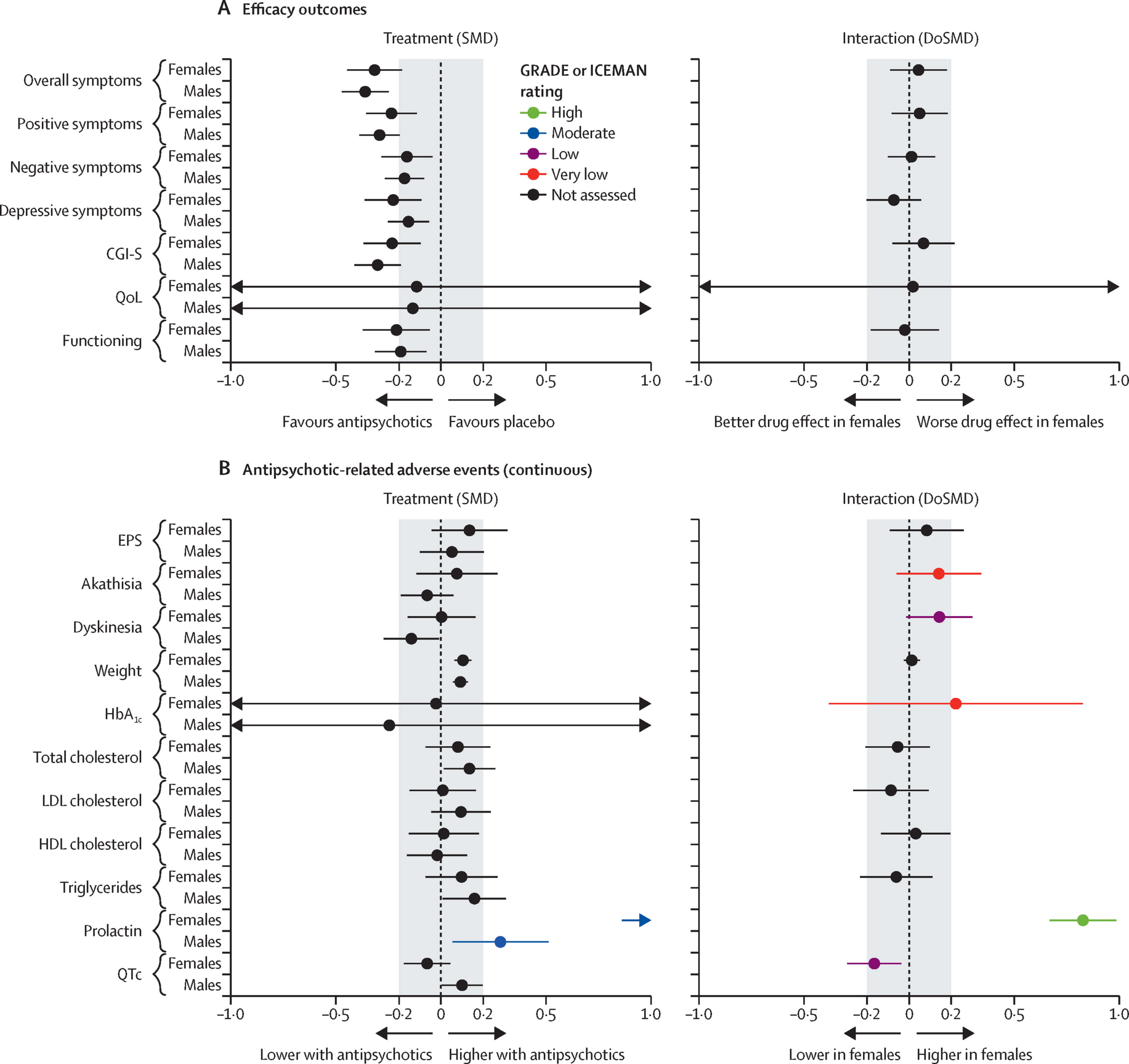
Efficacy: The analysis revealed no statistically significant sex differences in antipsychotic efficacy for reducing schizophrenia symptoms. The difference in standardized mean difference (DoSMD) for symptom reduction between females and males was 0.04 (95% CI -0.09 to 0.18), indicating comparable treatment effectiveness.
Dose-Response Relationship: Dose-response curves for symptom improvement were remarkably similar between sexes, reaching efficacy plateaus at approximately 3 to 5 mg risperidone equivalents. This suggests no need for sex-specific dose adjustments based on efficacy considerations alone.
Network Meta-Analysis: Comparative analyses across multiple antipsychotics showed no clear sex-specific superiority or inferiority among treatments.
Acceptability and Dropout Rates: One notable sex difference was observed in all-cause treatment dropout: antipsychotics reduced dropout rates more substantially in females compared to males, with a ratio of odds ratios of 0.74 (95% CI 0.56–0.98), suggesting better acceptability or adherence among females.
Tolerability and Side Effects: The most prominent sex-specific adverse effect was prolactin elevation, which was significantly greater in females (DoSMD 0.83, 95% CI 0.67–0.99). Other tolerability outcomes, including extrapyramidal symptoms and weight gain, showed no consistent sex differences.
Expert Commentary
This robust IPD meta-analysis addresses a long-standing gap in schizophrenia treatment research by utilizing advanced statistical techniques and large trial datasets to explore sex differences. The finding that efficacy does not differ by sex supports current clinical practice guidelines that do not differentiate antipsychotic dosing by sex based solely on efficacy.
However, clinicians should consider the higher likelihood of prolactin elevation in females, which can have clinical repercussions such as menstrual irregularities, galactorrhea, and bone density loss. This highlights the importance of monitoring prolactin levels and related symptoms particularly in female patients.
The reduced dropout rates among females may reflect multiple factors including differential side effect tolerability, health-seeking behaviors, or psychosocial support. Future research might further explore underlying behavioral and biological mechanisms and evaluate personalized interventions that could reduce dropout in males.
Limitations include that the analysis was restricted to certain antipsychotics and fixed-dose trials, possibly limiting generalizability to other drugs or dosing regimens. While race data were reported, subgroup analyses by ethnicity were not detailed and could be a future focus to explore intersectional effects.
Conclusion
This study provides compelling evidence that antipsychotic efficacy and tolerability profiles in acute schizophrenia are largely similar between females and males, reinforcing the relevance of previous meta-analytic findings across sexes. Notable, clinically relevant sex differences include greater prolactin elevation and lower dropout rates among females, warranting closer endocrine monitoring and consideration to improve adherence.
To promote sex and gender equity in schizophrenia treatment, increased female participation in clinical trials and routine sex-stratified reporting of outcomes are essential. Integrating these insights can enhance personalized care and optimize treatment outcomes for all patients living with schizophrenia.
Funding and Registration
This research was funded by the German Federal Ministry of Research, Technology and Space. The study protocol was registered with PROSPERO (CRD420251022957).
References
- Furukawa Y, Siafis S, Schneider-Thoma J, et al. Sex differences in the efficacy, acceptability, and tolerability of antipsychotics in people with acute schizophrenia: individual participant data pairwise, dose-response, and network meta-analyses. Lancet Psychiatry. 2026;13(11):943-954. PMID: 42815510.
- Kirkpatrick B, Messias E, Harvey PD, Fernandez-Egea E, Bowie CR. Is schizophrenia a syndrome of accelerated aging? Schizophr Bull. 2008;34(6):1024-1032.
- Leucht S, Cipriani A, Spineli L, et al. Comparative efficacy and tolerability of 15 antipsychotic drugs in schizophrenia: a multiple-treatments meta-analysis. Lancet. 2013;382(9896):951-962.
- Abel KM, Drake R, Goldstein JM. Sex differences in schizophrenia. Int Rev Psychiatry. 2010;22(5):417-428.