A multicenter randomized trial evaluated three distinct HFNC weaning protocols in critically ill adults.
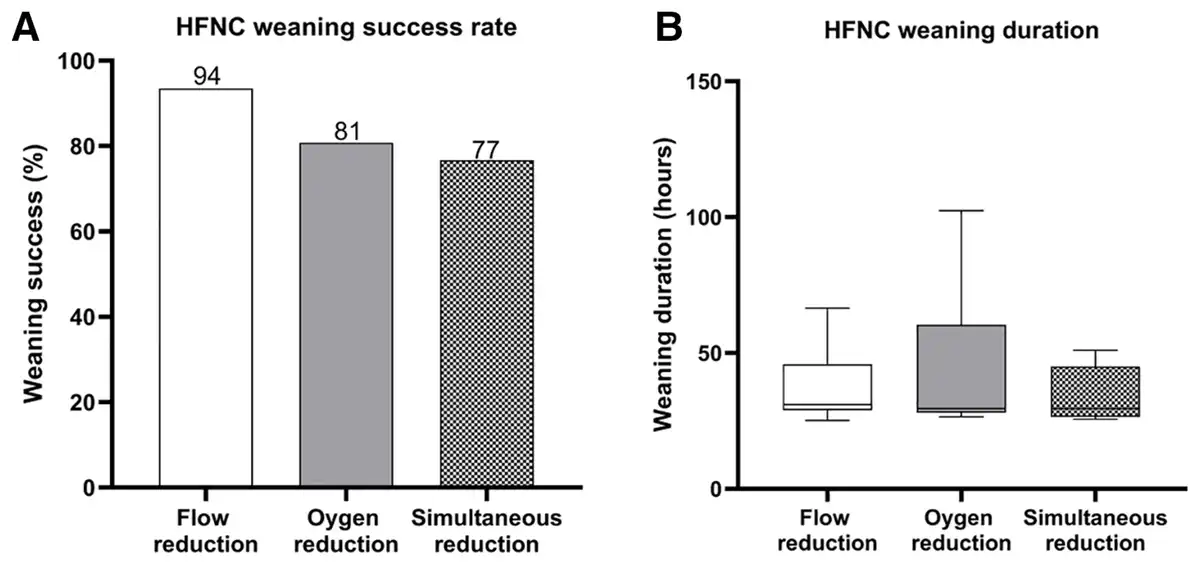
No statistically significant difference was identified in weaning success rates among flow reduction first, FiO2 reduction first, and simultaneous reduction approaches.
The median HFNC weaning duration was comparable across protocols, emphasizing flexibility in clinical practice.
Study Background
High-flow nasal cannula (HFNC) oxygen therapy has gained widespread use in critically ill patients with acute respiratory failure due to its ability to deliver heated, humidified oxygen at high flows, improve oxygenation, and reduce respiratory workload. Despite the widespread adoption, the optimal method for safely and efficiently weaning patients from HFNC remains unclear. Given the risk of respiratory deterioration after premature cessation and the morbidity related to prolonged oxygen support, establishing effective weaning protocols is crucial. This study addressed an important clinical knowledge gap by directly comparing different HFNC weaning strategies to optimize patient outcomes and resource utilization in critical care settings.
Study Design
This prospective, multicenter, randomized controlled trial—the SLOWH trial—was conducted from December 2022 through August 2024 in three tertiary care hospitals. Adults aged 18 years or older in the intensive care unit (ICU) who met established HFNC weaning criteria were eligible. Of 102 screened patients, 87 completed the study after exclusion of 15 patients primarily due to protocol nonadherence or withdrawal.
Participants were randomly allocated by a blinded research coordinator to one of three weaning strategies:
FiO2 Reduction (OR) first: Reducing the fraction of inspired oxygen (FiO2) before flow rate.
Simultaneous Reduction (SR): Concurrent decrease of flow rate and FiO2 in tandem.
The primary endpoint was defined as the HFNC weaning success rate, operationalized as a successful switch to conventional oxygen therapy without the need for HFNC reinstatement, noninvasive ventilation, or invasive intubation within 24 hours post-weaning.
Key Findings
A total of 87 patients completed the trial distributed as follows: 31 in FR, 26 in OR, and 30 in SR. Baseline characteristics were balanced except for a higher proportion of males in the OR group (77%) compared to FR (52%) and SR (53%).
– Weaning success rates were as follows: FR 94%, OR 81%, and SR 77%, with a p-value of 0.15, indicating no statistically significant differences.
– Median weaning duration (hours) was 31.0 (IQR 29.0–45.8) for FR, 29.5 (28.0–60.4) for OR, and 29.5 (26.5–45.0) for SR, showing no statistically significant differences (p = 0.87).
No adverse events related to the weaning protocols were reported. The data suggest that all three protocols are similarly effective and safe for HFNC weaning in critically ill adults.
Expert Commentary
This trial provides valuable randomized evidence addressing HFNC weaning protocols, a key step in respiratory support management in the ICU. Although the FR group exhibited numerically higher weaning success, the lack of statistical significance emphasizes that clinical judgment and patient-specific factors may guide protocol selection rather than a one-size-fits-all algorithm. The comparable durations suggest that no approach confers a substantial time advantage.
Limitations include a relatively small sample size possibly underpowering detection of subtle differences and the exclusion of patients with complex respiratory pathologies or prolonged ventilation needs, which may limit generalizability. Future studies might focus on subgroup analyses including specific diagnoses like COPD or ARDS, and explore long-term clinical outcomes beyond 24 hours post-weaning.
Biologically, gradual flow reduction might better support respiratory mechanics by slowly decreasing positive airway pressure and flow-mediated dead space washout, whereas oxygen fraction adjustments prioritize addressing hypoxia risk but may transiently increase work of breathing. The equivalence found here suggests sufficient physiological reserve in most patients to tolerate varying weaning sequences.
Conclusion
This randomized clinical trial demonstrates that three HFNC weaning strategies—flow reduction first, FiO2 reduction first, and simultaneous reduction—yield similar success rates and durations in critically ill adults. These findings support the use of any of the three weaning protocols tailored to individual patient needs without compromising safety or efficacy. Further research is warranted to clarify optimal approaches in diverse patient populations and integrate weaning strategies with broader respiratory management protocols.
Funding and Trial Registration
Details on funding sources or clinical trial registration were not provided in the source article.
References
1. Kim T, Kwack WG, Park S, Jung S, Song MJ, Kim ES, Lim SY. Weaning Strategies for High-Flow Nasal Cannula in Critically Ill Adults: A Randomized Clinical Trial. Critical care medicine. 2026 Oct 15. PMID: 42878628.
2. Patel M, et al. Physiological basis of high-flow nasal oxygen use and weaning in critical care. Respiratory Care. 2022;67(5):655-664.
3. Frat JP, et al. High-flow oxygen through nasal cannula in acute hypoxemic respiratory failure. N Engl J Med. 2015;372(23):2185-96.
4. Hess DR. High-flow nasal oxygen therapy in adults: physiological benefits, indications, clinical benefits, and adverse effects. Respir Care. 2015;60(10):1380-1394.