Highlight
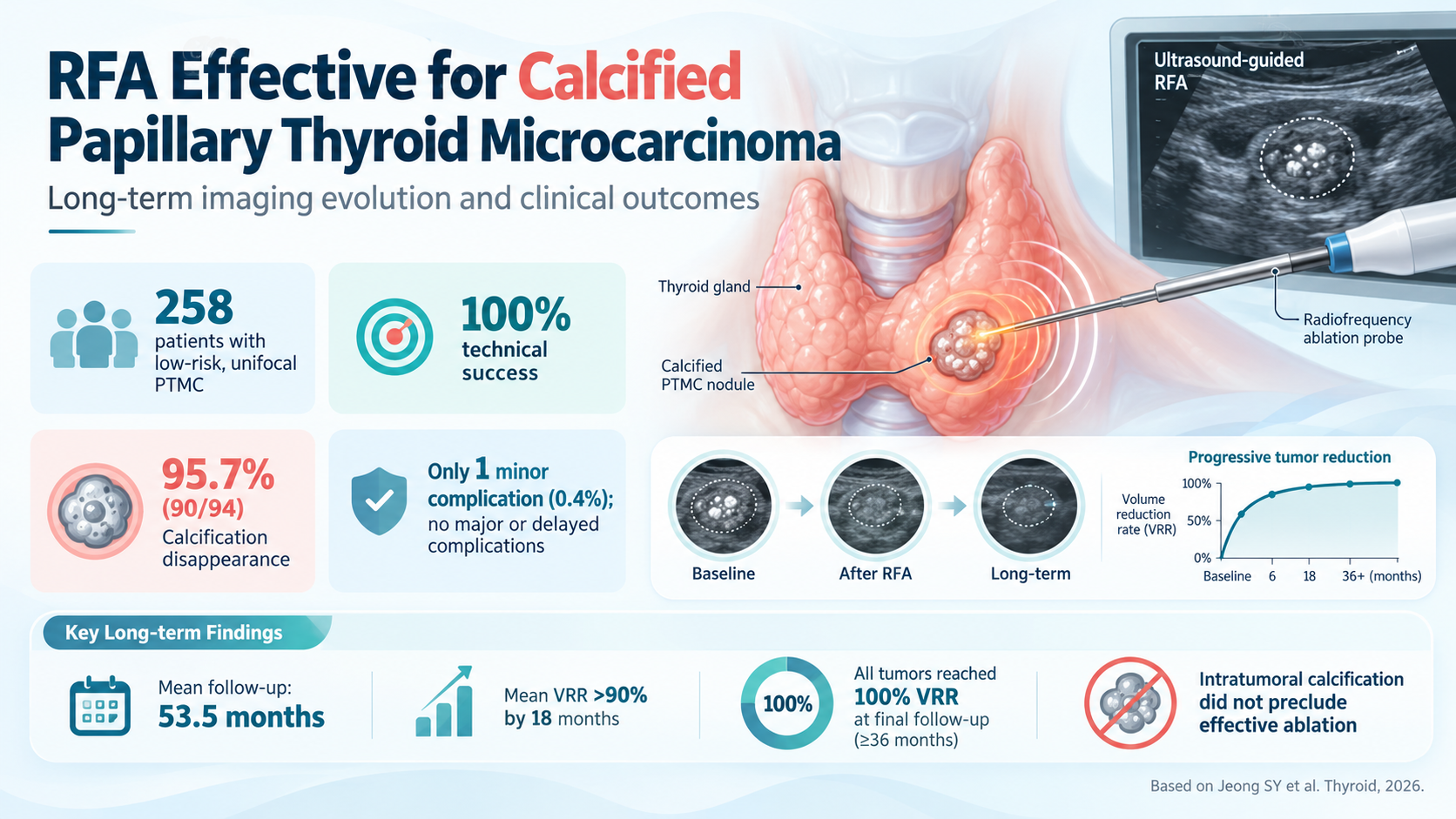
• Radiofrequency ablation (RFA) achieves 100% technical success in treating low-risk papillary thyroid microcarcinomas (PTMC) regardless of presence or type of intratumoral calcification.
• Tumor volume reduction exceeds 90% by 18 months with complete resolution by 36 months post-RFA.
• Calcification disappearance varies by pattern, with microcalcifications resolved fastest and macrocalcifications the slowest.
• RFA demonstrates a low complication rate with only minor transient adverse events reported.
Study Background
Papillary thyroid microcarcinoma (PTMC), defined as papillary thyroid carcinoma measuring 1 cm or less, is increasingly detected due to widespread use of neck ultrasonography. Management of low-risk PTMC has evolved toward less invasive approaches aiming to balance oncologic control with treatment-related morbidity. Radiofrequency ablation (RFA) is a minimally invasive technique that uses thermal energy to induce tumor necrosis, offering an alternative to surgery, especially for patients who refuse or are ineligible for surgery.
Intratumoral calcifications, including microcalcifications and macrocalcifications, are common imaging features in papillary thyroid carcinoma (PTC). Their potential impact on the technical feasibility and efficacy of RFA has remained uncertain. Calcifications might pose challenges in ablative treatment by hindering energy delivery or complicating imaging guidance.
Study Design
This retrospective cohort study included 258 consecutive patients with low-risk, unifocal PTMC treated with RFA from November 2017 through August 2022. Patients were stratified based on the presence and pattern of intratumoral calcification identified by ultrasonography: microcalcification, macrocalcification, rim calcification, and mixed calcification.
Primary endpoints focused on technical success—defined as complete ablation of the viable tumor—and the rate of calcification disappearance categorized by calcification pattern. Secondary endpoints included serial volume reduction ratio (VRR) of the tumor, cumulative disease progression (local recurrence or lymph node metastasis), occurrence of new primary PTC in the remaining thyroid gland, and complication rates.
Key Findings
The cohort consisted of 94 PTMCs with calcifications (68 microcalcifications, 12 macrocalcifications, 14 rim calcifications) and 164 PTMCs without calcifications. The mean follow-up duration was 53.5 months.
Technical Success and Volume Reduction
Technical success was achieved in all cases, independent of calcification status, indicating the feasibility of RFA even in calcified nodules. Mean VRR exceeded 90% by 18 months in both groups and reached 100% at final follow-up (≥36 months), demonstrating sustained tumor control.
Calcification Disappearance
In PTMCs presenting with calcifications, near-complete resolution of calcifications was observed in 95.7% of cases at a mean of 14.2 months post-RFA. Disappearance rates varied by calcification pattern: microcalcifications resolved completely and most rapidly (mean 12.0 months), rim calcifications also showed high resolution rates albeit slower (mean 24.8 months), and macrocalcifications were least likely to completely disappear (75.0%), indicating that calcification morphology influences resolution kinetics.
Importantly, 75.5% of tumors showed concurrent resolution of the solid tumor component and the calcified deposits, suggesting simultaneous biological remodeling post-ablation.
Clinical Outcomes
Disease progression was rare, with only one case (0.4%) developing lymph node metastases at ipsilateral neck levels IV and VI following RFA. New PTCs arose in the remaining thyroid in 5.8% of patients, with no significant difference according to the presence of calcifications, suggesting underlying multifocality rather than ablative failure.
Safety Profile
Only one minor complication—transient hoarseness—was reported (0.4%), and there were no major or delayed adverse events. This reinforces the safety of RFA as a minimally invasive treatment for PTMC, including those with calcified tumors.
Expert Commentary
This large retrospective analysis adds compelling evidence to the applicability of RFA in treating low-risk PTMC with diverse calcification patterns. Calcifications, often considered potential technical challenges, did not adversely affect ablation efficacy or clinical outcomes. The high rate of calcification disappearance, particularly for microcalcifications, supports the biological effectiveness of thermal ablation in remodeling tumor calcium deposits.
While surgery remains the gold standard for many thyroid cancers, RFA offers a valuable outpatient alternative for selected patients, minimizing physical and psychosocial burdens. The low complication rate and durable tumor control observed herein are consistent with recent guidelines supporting active surveillance or minimally invasive approaches for small, low-risk PTCs.
However, this study’s retrospective nature and single-center design may limit generalizability. Prospective randomized studies with longer follow-up are warranted to confirm these findings and investigate the biological mechanisms underlying calcification resolution after RFA.
Conclusion
Radiofrequency ablation is a technically feasible, safe, and effective treatment for low-risk papillary thyroid microcarcinoma, irrespective of the presence or type of intratumoral calcification. The ability to achieve complete tumor ablation with subsequent calcification disappearance and minimal complications highlights RFA as a promising minimally invasive modality in thyroid cancer management. Integration of RFA into clinical practice may expand therapeutic options for patients with PTMC, particularly those with contraindications or preference against surgery.
Funding and ClinicalTrials.gov
The study by Jeong et al. does not specify external funding or clinical trial registration details. Further prospective investigations may benefit from formal trial registration and funding disclosure.
References
Jeong SY, Baek SM, Shin S, Kim H, Suh YH, Baek JH. Radiofrequency Ablation of Calcified Papillary Thyroid Microcarcinoma: Long-Term Imaging Evolution and Clinical Outcomes. Thyroid : official journal of the American Thyroid Association. 2026 Oct 9. doi:10.1089/thy.2026.0144. PMID: 42853595.
Durante C, Grani G. Management of papillary thyroid microcarcinoma: A review of current guidelines. Thyroid. 2021;31(5):697-701.
Pacella CM, Bizzarri G, D’Amore A, et al. Percutaneous laser ablation for papillary thyroid microcarcinoma: results of 5-year follow-up. Thyroid. 2020;30(2):252-259.
American Thyroid Association (ATA) Guidelines Taskforce. 2015 American Thyroid Association Management Guidelines for Adult Patients with Thyroid Nodules and Differentiated Thyroid Cancer.