Highlight
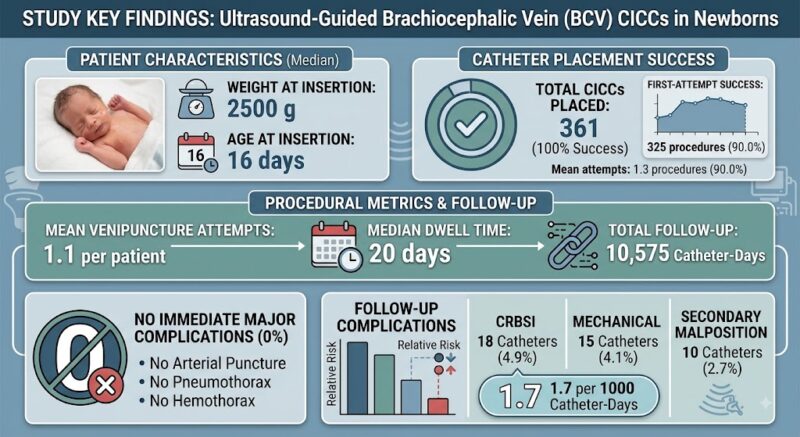
Ultrasound-guided supraclavicular cannulation of the brachiocephalic vein (BCV) is a safe, feasible, and reproducible technique for central venous catheter insertion in critically ill neonates across multiple centers. High first-attempt success (90%) and low procedural complications (none immediate major) support its clinical adoption. Catheter-related bloodstream infection (CRBSI) and mechanical complications showed low incidence over a substantial catheter dwell time (median 20 days).
Study Background
Central venous access in neonates, especially in the neonatal intensive care unit (NICU), is a critical yet challenging procedure. Traditional central venous catheter placement approaches (e.g., internal jugular or subclavian access) can be technically difficult in this small and vulnerable population, with risks of mechanical complications such as arterial puncture, pneumothorax, hemothorax, or infection. The brachiocephalic vein (BCV) accessed via a supraclavicular ultrasound-guided approach represents a relatively new technique that may provide safer and more efficient central access in newborns. However, before widespread recommendation, robust multicenter data are needed to evaluate feasibility, reproducibility, and complication risk. This study addresses this gap by evaluating these parameters in level III NICUs over an extended period.
Study Design
This retrospective multicenter observational study was conducted across three level III NICUs in Italy. The study included 361 ultrasound-guided supraclavicular brachiocephalic vein venipunctures performed for insertion of centrally inserted central catheters (CICCs) in neonates from January 2022 through December 2025. Inclusion criteria encompassed all critically ill neonates requiring central venous access for clinical care. Data collection was performed using both electronic and paper medical records.
The primary outcomes evaluated were immediate procedural complications (such as arterial puncture, pneumothorax, and hemothorax), number of venipuncture attempts, first-attempt success rate, and catheter dwell time. Secondary outcomes comprised catheter-related bloodstream infections (CRBSI), mechanical complications (e.g., catheter dislodgement, occlusion), and secondary catheter malposition.
Descriptive analyses of outcomes were conducted across all three participating centers, emphasizing real-world applicability and feasibility of standardizing ultrasound-guided BCV cannulation protocols in neonates.
Key Findings
The study cohort had a median neonatal weight of 2500 grams and median age of 16 days at the time of catheter insertion. The median catheter dwell time was 20 days, with a total follow-up of 10,575 catheter-days, ensuring robust outcome surveillance.
All 361 central venous catheters were successfully placed via the ultrasound-guided supraclavicular BCV approach, with a high first-attempt success rate of 90% (325/361 procedures). The mean number of venipuncture attempts was low at 1.1 per patient, indicating technical ease and operator proficiency.
Importantly, no immediate major complications such as arterial puncture, pneumothorax, or hemothorax were reported, demonstrating a favorable safety profile. Catheter-related bloodstream infections were rare, occurring in 18 catheters (4.9%), equivalent to 1.7 infections per 1000 catheter-days, consistent with or below rates reported for other central insertion techniques in neonates.
Mechanical complications were observed in 15 cases (4.1%) and secondary catheter malpositions in 10 cases (2.7%), both representing manageable and relatively infrequent adverse events. The multicenter nature implies reproducibility of results despite different operators and center-specific practices.
Expert Commentary
Ultrasound guidance for central venous access is increasingly recognized as standard of care due to enhanced safety and success, especially in fragile populations such as neonates. The supraclavicular puncture of the BCV offers anatomical advantages: the vein is large, superficial, and straight, minimizing risks compared to traditional jugular or subclavian routes. The findings of Prontera et al. align with prior smaller single-center reports but importantly extend evidence through a well-powered, multicenter design, supporting generalizability.
This study also underscores the importance of protocol standardization and operator training to achieve high success and low complication rates. Limitations include its retrospective nature and lack of a comparator group; prospective randomized trials would further validate comparative effectiveness. However, the large sample size and extensive catheter-days observation lend useful insights for clinicians. Future research might explore longer-term catheter outcomes and patient-centered metrics.
Conclusion
Ultrasound-guided supraclavicular venipuncture of the brachiocephalic vein is a safe, feasible, and reproducible method to establish central venous access in critically ill neonates. High first-attempt success, low immediate major complications, and manageable catheter-related adverse events highlight its clinical value. Adoption within NICU practice can optimize venous access outcomes, potentially improving neonatal critical care management. Further prospective studies are warranted to compare this approach with traditional methods and to establish comprehensive best practice guidelines.
Funding and Clinical Trial Registration
Information on funding sources or clinical trial registration was not provided in the source article.
References
1. Prontera G, Cerreti M, D’Andrea V, et al. Safety and Feasibility of Ultrasound-Guided Brachiocephalic Venipuncture for Centrally Inserted Central Catheters in Newborns: A Multicenter Observational Study. Chest. 2026 Aug 5. PMID: 42556561.
2. Verghese ST, et al. Ultrasound-guided central venous cannulation in neonates and infants: A review of anatomy and techniques. Paediatr Anaesth. 2022;32(2):169-180.
3. Ainsworth S, et al. Central venous access in neonates: Approaches and complications. Arch Dis Child Fetal Neonatal Ed. 2021;106(5):488-493.
4. Lamperti M, et al. International Evidence-Based Recommendations on Ultrasound-Guided Vascular Access. Intensive Care Med. 2012;38(7):1105-1117.