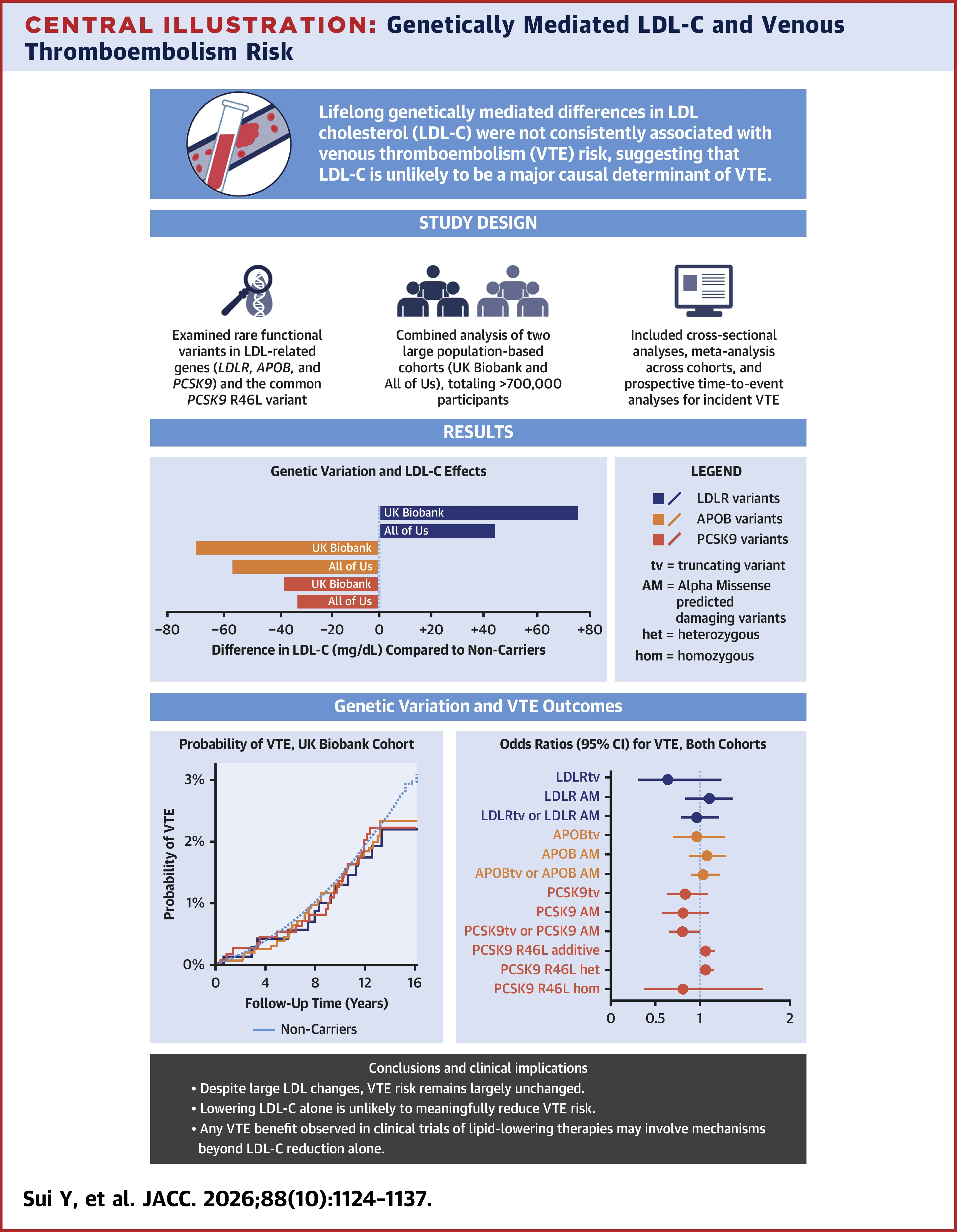
Highlight
- Rare genetic variants causing significant lifelong LDL cholesterol (LDL-C) differences show no consistent association with venous thromboembolism (VTE) risk.
- Large-scale genomic analyses from UK Biobank and All of Us cohorts included over 700,000 participants.
- Common variant and Mendelian randomization analyses suggest LDL-C associations with VTE are confounded by metabolic and obesity-related factors.
- Findings challenge the concept that LDL-C reduction directly lowers VTE risk, emphasizing alternative pathways in venous thrombosis.
Study Background
Venous thromboembolism (VTE), encompassing deep vein thrombosis and pulmonary embolism, is a prevalent and serious cardiovascular condition with significant morbidity and mortality. Traditionally, risk factors for VTE include immobilization, surgery, cancer, and inherited thrombophilias. While elevated low-density lipoprotein cholesterol (LDL-C) is a well-established causal factor in atherosclerotic cardiovascular disease, its role in the pathogenesis of VTE remains controversial. Some randomized trials of lipid-lowering agents, primarily statins, have demonstrated modest reductions in VTE incidence, raising questions about whether LDL-C modulation directly influences venous thrombosis or whether other mechanisms account for these observations.
Genetic studies offer a unique opportunity to interrogate the causal role of LDL-C in VTE via lifelong exposure differences, minimizing confounding. Protein-truncating and damaging missense variants in key LDL regulatory genes such as LDLR, APOB, and PCSK9 significantly alter LDL-C levels from birth. Examining the association between these variants and VTE risk can clarify if LDL-C itself mediates venous thrombosis risk or if prior associations are due to pleiotropic metabolic pathways.
Study Design
This investigation utilized whole-genome sequencing data from two large cohorts: 430,049 participants from the UK Biobank and 283,609 from the All of Us research program. The focus was on rare functional genetic variants (protein-truncating and AlphaMissense-predicted damaging missense variants with minor allele frequency <0.1%) in LDL metabolism genes LDLR, APOB, and PCSK9, alongside the common PCSK9 R46L variant.
LDL-C associations were quantified using linear regression models. VTE associations were analyzed through Firth logistic regression adjusted for potential confounders, followed by fixed-effect meta-analysis integrating both cohorts. Incident VTE events were additionally assessed using Cox proportional hazards models to evaluate prospective associations. Complementary analyses included common variant burden and multivariable Mendelian randomization to dissect potential pleiotropy or mediation by obesity and metabolic factors. Positive controls with known thrombophilia variants validated analytic approaches.
Key Findings
Rare functional variants in LDLR, APOB, and PCSK9 produced substantial LDL-C differences, with some gene-specific variants causing up to approximately 50% change in lifelong LDL-C concentrations. Despite these marked genetically mediated LDL-C variations, no consistent or robust association was observed between rare variant burden and VTE risk across cohorts. Meta-analyzed odds ratios ranged broadly between 0.60 and 1.07, suggesting an absence of a large protective or harmful effect.
Prospective analyses of incident VTE yielded similar null results, reinforcing the lack of longitudinal association. Sensitivity assessments, adjusting for confounders and analyzing variants separately, upheld these conclusions, though small effect sizes cannot be entirely ruled out due to statistical power limits.
Additional analyses employing common variant data and multivariable Mendelian randomization highlighted that previously reported associations linking LDL-C to VTE may partly arise from joint influences of obesity and broader metabolic dysfunction rather than direct LDL-C effects. Established thrombophilia variants used as positive controls showed expected strong associations with VTE, validating the methodological rigor.
Together, these results indicate that genetically induced variations in LDL-C do not substantially modify VTE risk. Observational and trial-based reductions in VTE linked to lipid-lowering therapy may therefore reflect off-target effects or confounding factors like obesity and metabolic syndrome rather than LDL-C lowering per se.
Expert Commentary
The findings presented challenge a simplistic causal narrative attributing VTE risk modification directly to LDL cholesterol levels. While LDL-C is a fundamental driver of arterial atherosclerosis, the biological mechanisms underpinning venous thrombosis differ and likely involve coagulation factor imbalances, endothelial dysfunction, and inflammatory pathways.
This study’s use of rare genetic variants provides robust evidence due to Mendelian randomization principles, leveraging lifelong exposure and minimizing confounding and reverse causation. However, the possibility of subtle effect sizes remains given the low frequency of some variants and resultant statistical power limitations.
Clinicians should appreciate that LDL-C lowering remains critical for atherosclerotic disease prevention but may not substantially impact venous thrombosis risk. The modest VTE risk reductions seen in some lipid-lowering drug trials might be mediated by effects on systemic inflammation, platelet function, or simultaneously modifying metabolic risk factors such as obesity.
Further research should explore the metabolic and inflammatory pathways influencing VTE and evaluate whether integrated risk management targeting obesity and coagulation factors can better reduce venous thromboembolism incidence.
Conclusion
In conclusion, this extensive genetic study involving over 700,000 individuals demonstrates that lifelong genetically mediated LDL cholesterol differences do not consistently associate with venous thromboembolism risk. These findings suggest that LDL-C per se is unlikely a major causal factor in VTE pathogenesis. Observed associations between LDL-C lowering and VTE prevention in clinical trials may reflect confounding by metabolic and obesity-related pathways rather than direct cholesterol effects.
For clinical practice, LDL-C control remains essential for arterial cardiovascular disease risk reduction but should not be primarily relied upon to mitigate VTE risk. Future investigations to comprehensively understand venous thrombosis pathophysiology should emphasize coagulation, inflammation, and metabolic interplay rather than LDL-C alone.
Funding and Clinical Trials Registration
Details on funding sources and trial registrations were not specified in the study abstract. For comprehensive insights, readers should refer to the original publication.
References
1. Sui Y, Kany S, Khurshid S, et al. Genetically Mediated Differences in LDL Cholesterol and Risk of Venous Thromboembolism. Journal of the American College of Cardiology. 2026 Sep 8;88(10):1124-1137. PMID: 42663354.
2. Glynn RJ, Danielson E, Fonseca FA, et al. A randomized trial of rosuvastatin in the prevention of venous thromboembolism. N Engl J Med. 2009;360(18):1851-1861.
3. Klarin D, Emdin CA, Natarajan P. Genetic analysis of venous thromboembolism. J Thromb Haemost. 2020;18(9):2129-2138.
4. Tzoulaki I, Elliott P, Kontis V. Statins and venous thromboembolism: disentangling effects. Lancet. 2010;375(9713):2096-7.