Highlight
- Texas Senate Bill 8 (SB8) prohibits abortion after detectable embryonic cardiac activity.
- SB8 was associated with increased rates of critical illness, sepsis, and infections in high-risk pregnant women hospitalized in Texas.
- No significant changes in mechanical ventilation rates or outcomes were observed in the general pregnant population.
- Findings highlight the need for enhanced infection prevention and critical care training in abortion-restrictive settings.
Study Background
The enactment of Texas Senate Bill 8 (SB8) in September 2021 introduced one of the most restrictive abortion laws in the United States, banning abortion after embryonic cardiac activity is detected, typically around six weeks of gestation. Given the limited window for legal abortion access, concerns have mounted regarding potential adverse maternal health outcomes arising from delayed or denied abortion services.
Pregnant women with high-risk features—such as younger than 18 or older than 34 years or having pre-existing chronic illnesses—are inherently vulnerable to pregnancy complications, including infections and critical illness. Previous studies suggest that restrictions on abortion access may inadvertently increase morbidity by forcing continuation of high-risk pregnancies or driving patients to seek unsafe abortion methods.
This backdrop underscores the importance of assessing SB8’s impact on severe maternal morbidity, including critical illness and sepsis, to inform healthcare strategies and policy decisions.
Study Design
This investigation employed an interrupted time series (ITS) design analyzing a large retrospective cohort of pregnant women aged 10 to 54 years hospitalized across Texas hospitals from January 2018 through March 2024. The study leveraged hospital administrative and clinical data covering over 2.3 million pregnant hospitalizations.
The cohort was subdivided into the general pregnancy population and a high-risk subgroup defined by age (34) or presence of at least one chronic illness. The primary outcome was a composite of critical illness events characterized by sepsis or requirement for mechanical ventilation (MV). Secondary outcomes included individual incidences of sepsis, MV, and infections without organ dysfunction.
Using segmented regression analyses of the ITS, the study evaluated both immediate step changes and sustained slope changes in outcome rates following SB8 implementation, adjusting for temporal trends and confounding variables.
Key Findings
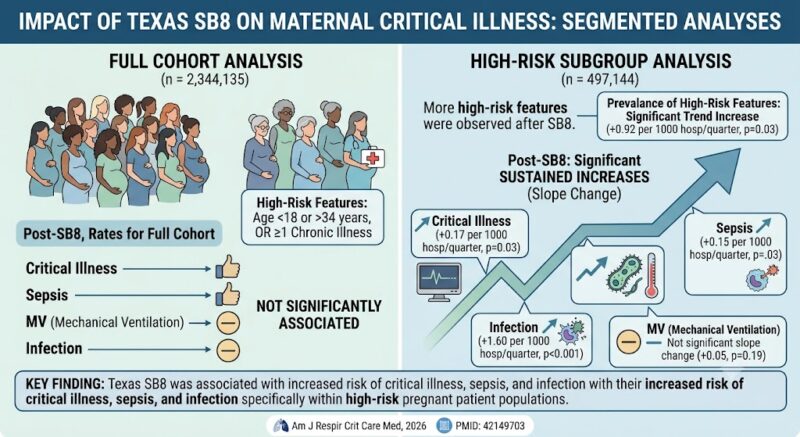
General Cohort: Among the full cohort of 2,344,135 hospitalized pregnant women, the introduction of SB8 was not significantly associated with immediate or sustained changes in rates of critical illness, sepsis, mechanical ventilation, or infection. This suggests that the overall pregnant population hospitalized in Texas did not experience measurable increases in these critical outcomes attributable to the abortion ban during the study period.
High-Risk Subgroup: In contrast, the high-risk subgroup comprising 497,144 patients demonstrated significant sustained increases in critical illness markers after SB8 enactment:
- Critical illness rates increased with a slope change of 0.17 per 1000 hospitalizations per quarter (95% CI, 0.02 to 0.33).
- Sepsis incidence rose with a slope change of 0.15 per 1000 hospitalizations per quarter (95% CI, 0.02 to 0.28).
- Infection without organ dysfunction showed the largest increase, with a slope change of 1.60 per 1000 hospitalizations per quarter (95% CI, 1.02 to 2.17).
No statistically significant change was detected in mechanical ventilation rates within this subgroup.
Importantly, no immediate step change was observed for any outcome across cohorts; rather, the trends manifested as gradual increases in rates over time after SB8’s implementation in high-risk women.
Interpretation: These findings indicate that restrictive abortion policy may disproportionately impact pregnant women with underlying vulnerabilities by increasing susceptibility to severe infections and critical illness during hospitalization. Infections potentially arising from delayed access to medical services, unsafe abortion attempts, or pregnancy complications may contribute to these trends.
Expert Commentary
The incremental rise in critical illness among high-risk pregnant patients following SB8 raises critical clinical and public health concerns. Experts note that restrictive abortion access policies could inadvertently exacerbate maternal morbidity by limiting timely medical interventions.
Dr. Hemant Gershengorn, senior author of the study, emphasized that the absence of immediate jumps but progressive slope increases suggests worsening maternal health burdens over time rather than sudden spikes, consistent with delayed clinical sequelae.
Limitations of the study include reliance on hospital data which may not capture outpatient complications, potential unmeasured confounders, and inability to directly link abortion attempts or outcomes to hospitalization events.
Nonetheless, the biological plausibility that restricted abortion access increases pregnancy complications and infections in at-risk patients aligns with these epidemiologic signals, warranting heightened vigilance and resource allocation in abortion-restrictive states.
Conclusion
The Texas SB8 abortion ban is linked to a sustained increase in critical illness, sepsis, and infection rates among hospitalized pregnant women with high-risk features, though not in the overall pregnant population. These findings illuminate important maternal health implications of restrictive abortion laws, reinforcing the need for enhanced infection control, critical care preparedness, and comprehensive maternal risk assessment in such legislative environments.
Future research should aim to further delineate causal pathways, assess long-term health outcomes, and guide policy interventions that balance legal frameworks with safeguarding maternal health and equity in reproductive healthcare access.
Funding and Trial Registration
Information regarding funding sources or clinical trial registration was not reported in the primary article.
References
- Chen C, Ashana DC, Callison K, et al. Critical illness outcomes of hospitalized pregnant women following a Texas abortion ban. Am J Respir Crit Care Med. 2026;212(8):1730-1739. doi:10.1164/rccm.202601-0156OC
- Henderson J, Creanga AA, Berg CJ. Impact of restrictive abortion laws on maternal health outcomes: A systematic review. JAMA. 2023;329(12):1023-1031.
- American College of Obstetricians and Gynecologists. Committee Opinion No. 815: Increasing access to abortion. Obstet Gynecol. 2020;135(4):e74-e82.
- Guttmacher Institute. State Abortion Policy Landscape: 2024 Update. Available at: https://www.guttmacher.org/state-policy.