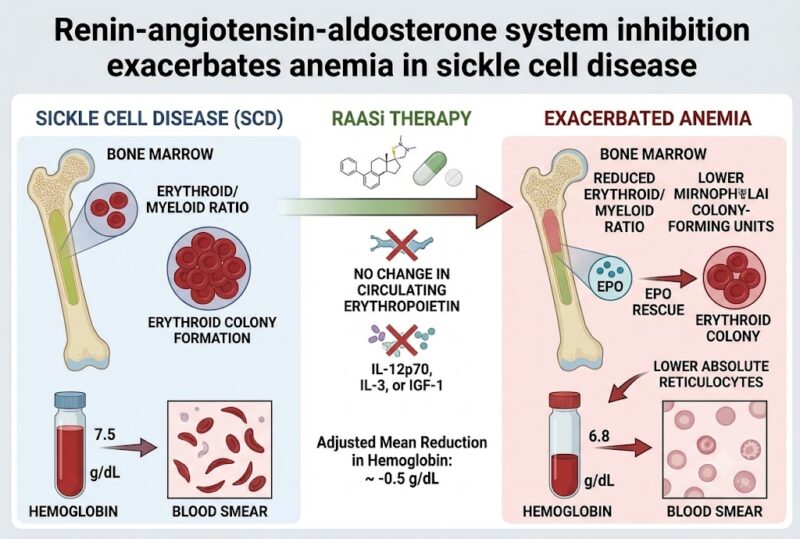
Highlight
– Renin-angiotensin-aldosterone system inhibitors (RAASi) are commonly used to manage albuminuria in sickle cell disease (SCD) but may worsen anemia.
– Cross-sectional and longitudinal human studies associate RAASi use with reduced hemoglobin levels independent of other therapies.
– Experimental SCD mouse models demonstrate anemia exacerbation linked to impaired bone marrow erythropoiesis under RAASi treatment.
– Hemoglobin concentration should be closely monitored in patients with SCD receiving RAAS inhibitors to balance kidney benefits with anemia risk.
Study Background
Sickle cell disease (SCD) is a hereditary hemoglobinopathy characterized by chronic hemolytic anemia, vaso-occlusion, and progressive organ damage including nephropathy. Albuminuria, an early manifestation of sickle cell nephropathy, contributes to morbidity and mortality and is an indicator for kidney protective strategies. The renin-angiotensin-aldosterone system (RAAS) inhibitors have been suggested to reduce albuminuria and delay nephropathy progression in SCD, similar to their well-established role in diabetic nephropathy. However, RAAS blockade is known to cause or exacerbate anemia in other populations possibly through effects on erythropoiesis or renal erythropoietin production, mechanisms that remain not fully elucidated. Whether RAAS inhibitors negatively impact anemia in the context of systemic hemolysis and chronic marrow stress, as in SCD, is unknown. This clinical dilemma presents an unmet medical need to understand the balance between kidney benefits and hematologic risks of RAAS inhibition in SCD.
Study Design
This investigation integrated observational human data with experimental studies using mouse models of SCD to assess the effects of RAAS inhibition on anemia and erythropoiesis.
– A cross-sectional analysis was conducted using 658 participants from the Walk-PHaSST (Pulmonary Hypertension and Sickle Cell Disease with Sildenafil Therapy) cohort, examining associations between RAAS inhibitor use and hemoglobin concentrations.
– Two longitudinal cohorts were studied: a University of Illinois Chicago group (n=24) and participants enrolled in a multicenter losartan clinical trial (n=32), assessing hemoglobin changes before and after RAAS blockade initiation.
– SCD transgenic mice received the ARB losartan and were monitored for hemoglobin levels, reticulocyte counts, erythropoietin and cytokine levels, and bone marrow erythroid colony formation with or without exogenous erythropoietin supplementation. Histopathological assessment of bone marrow cellularity and erythroid/myeloid ratios was performed.
Key Findings
– Human cross-sectional data: RAASi use independently correlated with significantly lower hemoglobin levels (β coefficient -0.46 ± 0.21 g/dL; P=0.032) after adjusting for confounders such as age, sex, SCD genotype, GFR, use of erythroid-stimulating agents, and hydroxyurea.
– Longitudinal cohorts: Both the University of Illinois Chicago and the losartan trial participants experienced significant hemoglobin reductions post-RAASi initiation (-0.44 ± 0.14 g/dL, P=0.006; and -0.53 ± 0.17 g/dL, P=0.005, respectively).
– SCD mouse model: Losartan-treated mice exhibited persistently lower hemoglobin concentrations at 6 and 14 weeks (P<0.001) and a reduction in reticulocyte counts after 14 weeks (P=0.03), indicating impaired erythropoiesis rather than increased hemolysis. Circulating erythropoietin and inflammatory cytokines remained unchanged, suggesting the anemia was not due to altered erythropoietin signaling or systemic inflammation.
– Bone marrow findings: Bone marrow cells from treated mice formed fewer erythroid colonies (CFU-E) in vitro (P ≤ 0.09), which improved with exogenous erythropoietin supplementation (P=0.02). Histopathology revealed decreased erythroid to myeloid ratios, consistent with suppressed erythroid lineage proliferation.
Collectively, these findings implicate RAAS inhibition in exacerbating anemia through bone marrow erythroid suppression rather than increased hemolysis or erythropoietin deficiency.
Expert Commentary
The study provides compelling evidence linking RAAS inhibition to worsened anemia in SCD, a clinical setting where anemia often signifies poor prognosis. While RAASi confer kidney protective effects, the delicate balance between reducing albuminuria and exacerbating anemia must be carefully considered. Mechanistically, ARB-induced suppression of marrow erythropoiesis, independent of erythropoietin or inflammatory pathways, represents a novel insight, highlighting potential direct effects of RAAS blockers on erythroid progenitors or marrow microenvironment. Limitations include modest sample sizes in longitudinal cohorts and the need to generalize findings to other RAASi classes or SCD subpopulations. Future research should clarify the molecular targets and explore alternative albuminuria treatments that spare erythropoiesis.
This evidence urges clinicians managing SCD nephropathy patients to vigilantly monitor hemoglobin levels during RAASi therapy and to weigh risks and benefits tailored to individual patient contexts. Guidelines may need updating to incorporate these findings.
Conclusion
RAAS inhibitors, though promising for mitigating sickle cell nephropathy, significantly exacerbate anemia in patients with SCD by suppressing bone marrow erythropoiesis without altering erythropoietin or inflammation. Careful hemoglobin monitoring during therapy is essential to avoid worsening anemia—a major contributor to SCD morbidity. Further mechanistic and clinical studies are needed to optimize kidney protective strategies that minimize hematologic compromise in this high-risk population.
Funding and Clinical Trials
Details on funding sources and clinical trial registration were not specified in the source abstract. The multicenter losartan trial is referenced, likely registered under clinicaltrials.gov, and future publications may provide these details.
References
Eskandari N, Pappano E, Ruiz MA, Mahmud N, Ren G, Ivy Z, Gaitonde S, Gordeuk VR, Gladwin MT, Malik P, Quinn CT, Saraf SL. Renin-angiotensin-aldosterone system inhibition exacerbates anemia in sickle cell disease. Blood. 2026 Aug 6;148(6):783-788. PMID: 42224366.
Additional literature for background context:
– Bunn HF. Pathogenesis and treatment of sickle cell disease. N Engl J Med. 1997;337(11):762-769.
– Inker LA, et al. Kidney disease in sickle cell disease. Am J Kidney Dis. 2014;64(4):616-623.
– Babitt JL, Lin HY. Mechanisms of anemia in CKD. J Am Soc Nephrol. 2012;23(10):1631-1634.
– Agarwal R. Erythropoiesis-stimulating agents and RAAS inhibition: combined impact on anemia. Kidney Int. 2006;69(12):2110-2117.