Introduction and Context
Heart failure (HF) remains a leading cause of morbidity, hospitalization, and mortality worldwide. Since the first joint Universal Definition in 2021, rapid advances in diagnostics, cardioprotective therapies (notably sodium–glucose cotransporter-2 inhibitors), imaging, and an improved understanding of social and geographic determinants of HF have highlighted limitations in legacy definitions. Ambiguity in terminology—especially around “preclinical” stages, ejection fraction thresholds, and the concepts of remission and recovery—has hindered clinical research, public health surveillance, and patient-centered care.
To address these gaps, an international task force convened by the AHA, ACC, ESC, WHF and partner societies published the Second Universal Definition of Heart Failure (Walsh et al., European Heart Journal, 2026). This expert consensus aims to standardize language, align clinical practice globally, and provide a dynamic framework that reflects modern therapeutics and the lived experience of people with HF.
New Guideline Highlights
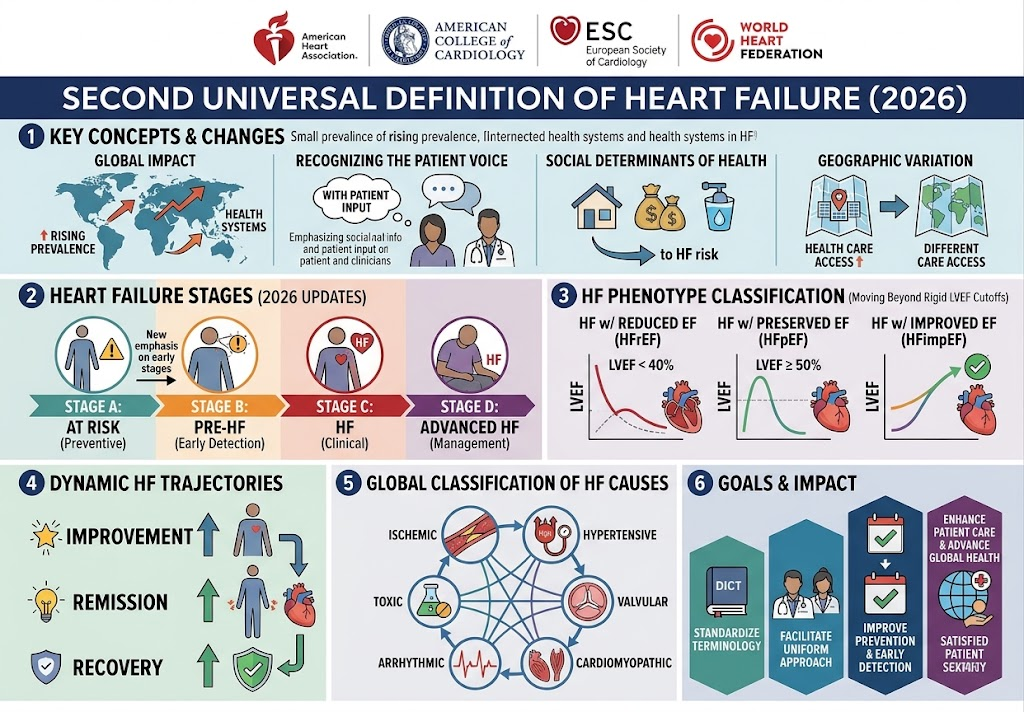
Major themes of the 2026 Second Universal Definition include:
– A pragmatic shift away from rigid left ventricular ejection fraction (LVEF) cutoffs toward three broad phenotypes—HF with reduced EF (HFrEF), HF with preserved EF (HFpEF) and HF with improved EF (HFimpEF)—to better reflect clinical trajectories and treatment implications.
– Formal adoption of “pre-HF” (stage B) to identify individuals with structural heart disease or high risk but without current HF signs or symptoms, prioritizing prevention.
– A universal, hierarchical classification of HF causes to standardize etiology reporting and guide targeted prevention strategies across regions.
– Explicit recognition of dynamic HF trajectories: decline, improvement, remission, and recovery—each carrying distinct prognostic and management implications.
– Guidance on incorporating patient-reported outcomes and social determinants of health (SDOH) into diagnosis, risk stratification, and care planning.
Key takeaways for clinicians:
– Think of HF as a dynamic syndrome with phenotypes that can change over time—document trajectory as well as current status.
– Use biomarkers (natriuretic peptides), imaging, and clinical criteria together—no single metric should define HF alone.
– Prioritize prevention for pre-HF and broaden access to proven therapies irrespective of geography, with attention to disparities.
Updated Recommendations and Key Changes
How the 2026 document differs from earlier guidance (notably the 2021 Universal Definition and 2021/2022 HF management guidelines):
– LVEF classification
– Old: Multiple rigid cutoffs (e.g., HFrEF LVEF <40%, HFmrEF 40–49%, HFpEF ≥50%).
– New: Grouped into HFrEF (reduced), HFpEF (preserved), and HFimpEF (improved) to emphasize therapeutic relevance and trajectories. The document advises clinicians to document the numerical LVEF, but to interpret phenotypes in context of change and treatment response.
– Staging
– Continues to recommend stages that include at-risk, pre-HF (stage B), symptomatic HF, and advanced HF, reinforcing prevention in those with structural disease or elevated biomarkers but no symptoms.
– Etiology
– Introduces a universal, hierarchical cause classification (e.g., ischemic, hypertensive, valvular, cardiomyopathies, infiltrative, inflammatory, congenital, metabolic/drug-induced, and mixed causes) to standardize reporting and population surveillance.
– Recovery vs remission
– Defines recovery as sustained structural and functional normalization with restored reserve; remission denotes clinical stability without full normalization. Both require ongoing surveillance.
– Social determinants
– Stronger emphasis on documenting and addressing SDOH (income, education, access to care, environment) as modifiable contributors to HF risk and outcomes.
Evidence driving updates includes trials demonstrating broad benefit of SGLT2 inhibitors across EF spectrums (DAPA-HF, EMPEROR-Reduced, EMPEROR-Preserved), evolving data on biomarkers and imaging, and international epidemiologic studies demonstrating wide geographic disparities in causes and outcomes.
Topic-by-Topic Recommendations
Diagnostic criteria and definitions
– Core definition: Heart failure is a clinical syndrome caused by structural and/or functional cardiac abnormality, corroborated by elevated natriuretic peptides and/or objective evidence of cardiogenic pulmonary or systemic congestion.
– Diagnostic components (recommended):
– Symptoms (e.g., breathlessness, fatigue) and/or signs of congestion.
– Objective evidence of cardiac dysfunction: elevated NT-proBNP/BNP (thresholds adjusted for age/AF/renal function), imaging (echocardiography, CMR), or hemodynamic testing when needed.
– Exclude primarily non-cardiac causes of symptoms.
Phenotyping and LVEF
– Report the numeric LVEF and classify into: HFrEF (reduced), HFpEF (preserved), HFimpEF (improved). HFimpEF is applied when LVEF has increased by a prespecified amount (e.g., from 40–50%) sustained on therapy; exact numeric thresholds are pragmatic suggestions rather than rigid rules.
– Recognize that HFmrEF (midrange) is not a mandatory separate category for treatment decisions—therapy choices should be informed by prior trajectory and underlying cause.
Staging and risk stratification
– Maintain the continuum: at-risk → pre-HF (stage B) → symptomatic HF → advanced HF.
– For pre-HF, recommend systematic screening in high-risk populations (e.g., ischemic heart disease, diabetes, exposure to cardiotoxic agents) using natriuretic peptides and imaging as indicated.
Treatment strategies (overview of consensus recommendations)
– HFrEF (reduced): Initiate guideline-directed medical therapy rapidly in most patients—foundation therapies include ACEi/ARB/ARNI, beta-blockers, MRA, and SGLT2 inhibitors—titrated to tolerated doses. Device therapies (CRT, ICD) and advanced therapies considered per guideline indications.
– HFpEF (preserved): Management emphasizes treating underlying causes (hypertension, atrial fibrillation, valvular disease), symptom relief, and SGLT2 inhibitors where evidence supports benefit. Diuretics for congestion remain central.
– HFimpEF: Continue evidence-based HF therapies even after LVEF improves; structured surveillance recommended because relapse is common if therapy is withdrawn.
– Acute HF: Rapid assessment of congestion, prompt diuresis, and early identification of precipitants; use imaging and natriuretic peptides for diagnosis and prognostication.
Follow-up and monitoring
– Regular follow-up frequency should be individualized: closer visits during therapy initiation/titration and after hospitalization; longer intervals for stable, low-risk patients.
– Recommended monitoring: symptoms, weight, blood pressure, renal function, electrolytes, natriuretic peptides (selectively), and periodic imaging based on trajectory.
Special populations and global considerations
– Emphasizes regional causes (e.g., rheumatic valvular disease, Chagas disease, peripartum cardiomyopathy, untreated hypertension) and resource-appropriate diagnostic strategies.
– Recommends task-shared models and simplified diagnostic algorithms for low-resource settings, with natriuretic peptides and point-of-care ultrasound when available.
– Calls for systematic collection of SDOH in clinical records and incorporation into risk adjustment for quality metrics.
Recommendation grading
– The Second Universal Definition is an expert consensus document rather than a graded practice guideline; recommendations represent a synthesis of evidence and expert opinion and are intended to harmonize terminology and approach internationally.
Expert Commentary and Insights
Committee perspectives summarized:
– Clarity over rigid numbers: Many panelists argued that strict LVEF cutpoints created artificial barriers to care and research. The new phenotype approach recognizes the continuum and variability of EF, especially under therapy.
– Prevention focus: Panelists stressed that pre-HF identification creates new opportunities for intervention—blood pressure control, lipid management, diabetes therapy, and lifestyle measures—arguing for greater investment in screening high-risk populations.
– Equity and implementation: Experts highlighted the ethical imperative to translate the definition into actionable strategies in low- and middle-income countries. They urged societies and funders to support access to essential diagnostics and core HF therapies.
– Patient voice: The task force emphasized incorporating patient-reported outcomes into definitions of remission and recovery, recognizing the difference between objective measures and lived experience.
Controversies and open questions
– Where exactly to draw numeric LVEF thresholds for therapeutic decisions remains debated—clinicians are advised to combine numeric EF with trajectory and etiology.
– The degree to which natriuretic peptide thresholds should be used for screening in asymptomatic populations is unsettled; the task force recommends targeted screening rather than population-wide testing.
– Optimal duration of continued therapy after recovery or remission requires more prospective study; withdrawal should be cautious and monitored.
Practical Implications
What changes in day-to-day practice?
– Documentation: Record the quantitative LVEF, phenotype label (reduced/preserved/improved), and trajectory (e.g., improving, stable, worsening). Add etiology using the universal classification and note SDOH factors.
– Prevention: Expand targeted screening programs (e.g., natriuretic peptide testing in high-risk groups) and ensure early evidence-based interventions for pre-HF.
– Treatment continuity: Avoid stopping disease-modifying therapies when LVEF improves without careful risk assessment and monitoring; label such patients HFimpEF and plan structured follow-up.
– Global health: Use simplified, resource-adapted diagnostic pathways where advanced imaging is not available and advocate for equitable access to core HF medicines.
Patient vignette (illustrative)
– Emily is a 62-year-old woman with ischemic heart disease and hypertension. She has exertional dyspnea and elevated NT-proBNP. Echocardiography shows LVEF 38%.
– Under the Second Universal Definition, she is classified as symptomatic HFrEF. Initiation of guideline-directed therapies (including an SGLT2 inhibitor, beta-blocker, ACEi/ARNI and MRA as tolerated) is recommended promptly. If Emily’s LVEF later improves to 52% on therapy, she would be labeled HFimpEF and advised to continue therapy with planned surveillance, not automatic discontinuation of disease-modifying drugs.
Future Directions and Research Needs
The task force identified key priorities:
– Prospective studies on stopping versus continuing therapies in HFimpEF/recovered HF.
– Better biomarkers and imaging tools to predict trajectory and guide individualized therapy.
– Implementation research to translate the definition into electronic health records, registries, and public health surveillance, especially in low-resource settings.
– Interventional studies addressing SDOH and demonstrating how targeted social interventions improve HF outcomes.
References
– Walsh MN, Kober L, Sliwa K, et al. AHA/ACC/ESC/WHF Expert Consensus Document: Second Universal Definition of Heart Failure (2026). European Heart Journal. 2026;47(32):4357-4374. PMID: 42366993. https://pubmed.ncbi.nlm.nih.gov/42366993/
– McDonagh TA, Metra M, Adamo M, et al. 2021 ESC Guidelines for the diagnosis and treatment of acute and chronic heart failure. European Heart Journal. 2021;42(36):3599–3726.
– Heidenreich PA, Bozkurt B, Aguilar D, et al. 2022 AHA/ACC/HFSA Guideline for the Management of Heart Failure. Circulation. 2022;145:e895–e1032.
– Bozkurt B, Coats AJS, Tsutsui H, et al. Universal Definition and Classification of Heart Failure: A Report of the Heart Failure Society of America/American College of Cardiology Foundation/European Society of Cardiology/and Professional Societies (2021). (Original universal definition references)
– McMurray JJV, Solomon SD, Inzucchi SE, et al. DAPA-HF Trial. Dapagliflozin in Patients with Heart Failure and Reduced Ejection Fraction. New England Journal of Medicine. 2019;381:1995-2008.
– Packer M, Anker SD, Butler J, et al. EMPEROR-Reduced Trial. Empagliflozin in Heart Failure with Reduced Ejection Fraction. New England Journal of Medicine. 2020;383:1413-1424.
– Anker SD, Butler J, Filippatos G, et al. EMPEROR-Preserved Trial. Empagliflozin in Heart Failure with Preserved Ejection Fraction. New England Journal of Medicine. 2021;385:1451-1461.
(Readers should consult the full 2026 consensus document for detailed tables, flow diagrams and appendices that operationalize these definitions and recommendations.)