Highlight
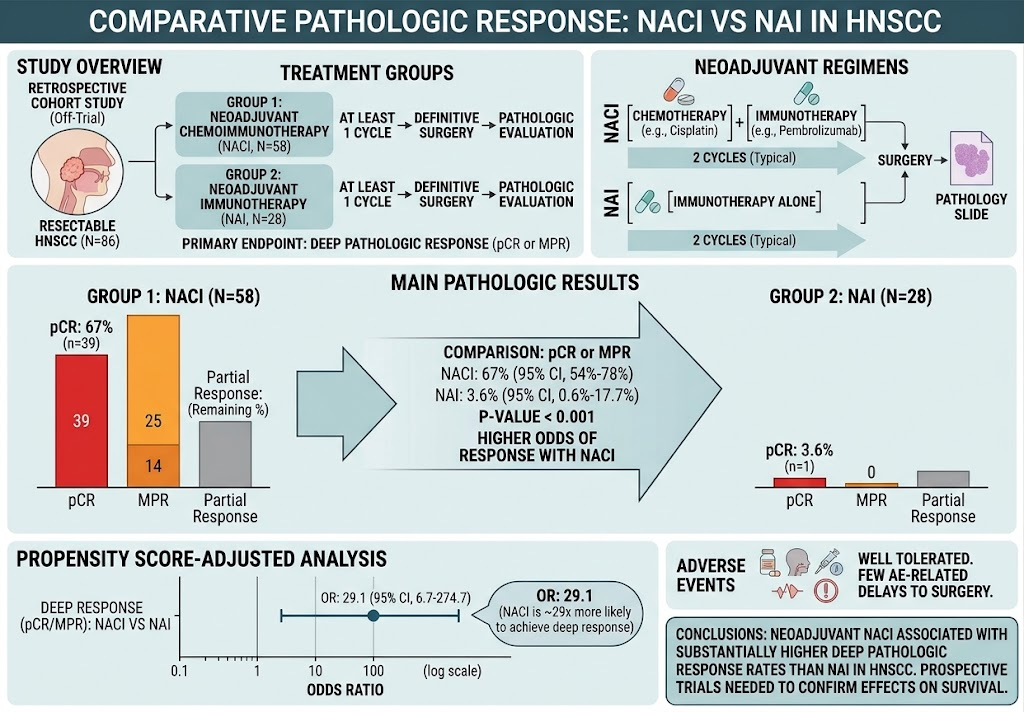
This retrospective cohort study demonstrates that neoadjuvant chemoimmunotherapy (NACI) markedly improves the rates of pathologic complete response (pCR) and major pathologic response (MPR) compared to neoadjuvant immunotherapy (NAI) alone in patients with resectable head and neck squamous cell carcinoma (HNSCC). Treatment with NACI was well tolerated with minimal delays to surgery, supporting its potential role in improving treatment response before definitive surgery.
Study Background
Head and neck squamous cell carcinoma (HNSCC) encompasses a group of biologically aggressive malignancies arising in the aerodigestive tract. Despite advances in surgery, radiotherapy, and systemic therapy, outcomes for locally advanced HNSCC remain unsatisfactory, with significant rates of recurrence and morbidity. Neoadjuvant therapies administered prior to surgery offer a promising approach to reduce tumor burden, eradicate micrometastatic disease, and potentially improve long-term survival. Immunotherapy, especially immune checkpoint inhibitors targeting PD-1/PD-L1 pathways, has revolutionized the treatment of recurrent/metastatic HNSCC. However, when used as a single agent in the neoadjuvant setting, its pathological response rates have been modest. Combining chemotherapy with immunotherapy may potentiate antitumor effects by enhancing tumor antigen release, modulating the tumor microenvironment, and improving immune recognition.
Study Design
This investigation was a single-center retrospective cohort study conducted at a large urban tertiary academic referral center between July 19, 2024, and March 4, 2026. The study population consisted of 86 adults with pathologically confirmed resectable HNSCC involving the aerodigestive tract who received at least one cycle of either neoadjuvant immunotherapy (NAI) alone or neoadjuvant chemoimmunotherapy (NACI) prior to definitive surgical resection. Patients with locoregional recurrences treated with curative intent were also included. Neoadjuvant regimens typically comprised two cycles before surgery. The primary outcome was pathologic response assessed in the surgical specimen, classified as pathologic complete response (pCR), major pathologic response (MPR, defined as ≤10% viable tumor cells), or partial response. Deep pathologic response combined pCR and MPR. Propensity score-adjusted analyses were employed to mitigate baseline differences between treatment groups.
Key Findings
The cohort had a mean age of 63 years with a male predominance (69%). Among participants, 29% achieved pCR and 17% achieved MPR. Notably, deep pathologic response (pCR or MPR) occurred in 67% of patients receiving NACI compared to only 3.6% in those receiving NAI alone, representing a significant difference. Statistical analysis adjusting for confounding variables confirmed that NACI was associated with substantially higher odds of achieving deep pathologic response (odds ratio [OR] 29.1; 95% confidence interval [CI], 6.7 to 274.7). Treatment was generally well tolerated across both groups, and few adverse event-related delays to surgery were observed. These findings suggest that the synergy between chemotherapy and immunotherapy enhances tumor eradication before surgery more effectively than immunotherapy monotherapy.
Expert Commentary
These striking findings align with an emerging paradigm favoring combination neoadjuvant regimens in locally advanced HNSCC. Chemotherapy can potentiate immune responses by inducing immunogenic cell death and releasing tumor antigens, which complement the immune checkpoint blockade effects. The dramatic increase in deep pathologic response rates with NACI may translate into improved long-term oncologic outcomes, including relapse-free and overall survival, although prospective studies with survival endpoints are needed to confirm this. Limitations of this retrospective analysis include potential selection bias, single-center experience, and lack of long-term follow-up data. Moreover, the tolerability and safety profile of combining chemotherapy and immunotherapy in the neoadjuvant setting remains an important consideration pending validation in larger prospective trials. Nonetheless, these results provide biologic and clinical rationale to integrate chemoimmunotherapy into neoadjuvant treatment paradigms for resectable HNSCC.
Conclusion
In patients with resectable head and neck squamous cell carcinoma, neoadjuvant chemoimmunotherapy substantially improves pathologic response rates compared to immunotherapy alone. This study supports the potential of combination regimens to enhance tumor control before surgery with manageable safety profiles. Future prospective randomized trials are warranted to establish the impact on survival outcomes and to optimize patient selection and treatment sequencing. Integration of such regimens into clinical practice could represent a pivotal advance in the management of locally advanced HNSCC, addressing a critical unmet need in this challenging disease.
Funding and Registration
Details on study funding and clinical trial registration were not provided in the available data. Further prospective trials will likely include formal registration and funding disclosures.
Reference
Gomez EA, Kraft DO, Elkersh Y, Cooke PV, Sicard RM, Barrett TF, Shemtob L, Ahn S, Berger MH, Teng MS, Kirke DN, Urken M, Khan M, Chai RL, Khorsandi A, Bakst RL, Sindhu KK, Liu JT, Misiukiewicz KJ, Veremis B, Sohn SY, Brandwein MS, Pujadas E, Genden EM, Roof SA. Pathologic Response After Neoadjuvant Chemoimmunotherapy in Head and Neck Squamous Cell Carcinoma. JAMA Otolaryngol Head Neck Surg. 2026 Aug 13:e262259. doi: 10.1001/jamaoto.2026.2259. Epub ahead of print. PMID: 42593779; PMCID: PMC13474099.