Highlight
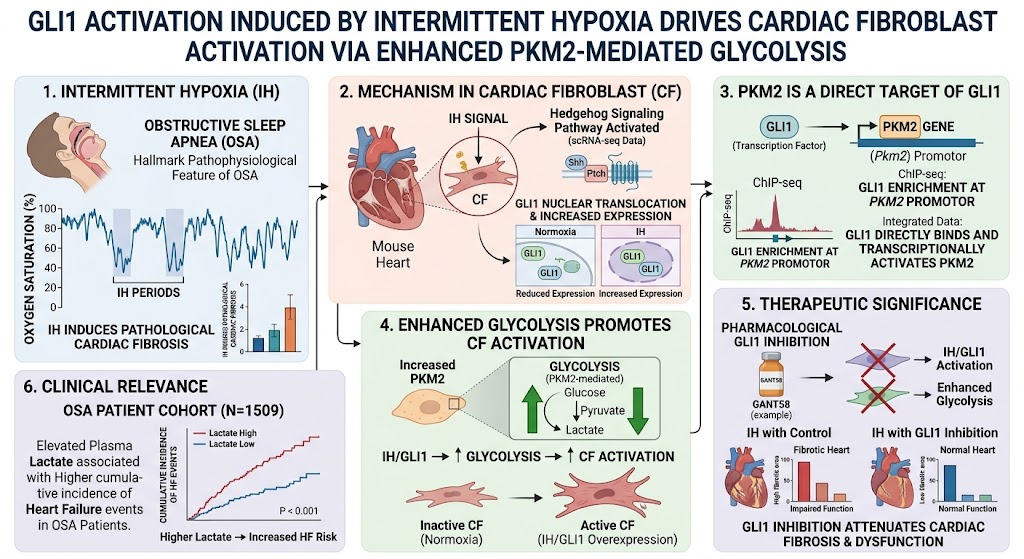
- Intermittent hypoxia (IH), a key feature of obstructive sleep apnea (OSA), induces cardiac fibrosis through activation of cardiac fibroblasts (CFs).
- GLI1, a Hedgehog pathway transcription factor, is upregulated and translocated to the nucleus in CFs exposed to IH, mediating pro-fibrotic effects.
- PKM2, a glycolytic enzyme, is directly regulated by GLI1 and promotes enhanced glycolysis contributing to CF activation and fibrosis.
- Pharmacological or genetic inhibition of GLI1 attenuates fibrosis and cardiac dysfunction in IH models, underscoring GLI1 as a potential therapeutic target.
Study Background
Cardiac fibrosis is a pathological hallmark in various cardiac diseases, characterized by excessive accumulation of extracellular matrix and activation of cardiac fibroblasts (CFs). This process impairs myocardial compliance, disrupts electrical conduction, and predisposes patients to heart failure and arrhythmias. Among the myriad causes of cardiac fibrosis, intermittent hypoxia (IH) stands out as a key pathophysiological feature of obstructive sleep apnea (OSA), a prevalent disorder affecting millions worldwide. OSA-induced IH has been implicated in promoting cardiac injury and fibrosis, yet the molecular mechanisms mediating CF activation in this context remain poorly defined. Understanding these pathways is critical to uncover novel therapeutic targets aimed at mitigating cardiac fibrosis and its sequelae in OSA patients, who face increased cardiovascular morbidity and mortality.
Study Design
This investigation employed a multifaceted experimental approach integrating in vivo, molecular, and translational analyses. Mouse models were exposed to IH to mimic the hypoxic episodes characteristic of OSA. Single-cell RNA sequencing (scRNA-seq) profiled cardiac fibroblast populations under IH versus normoxia to identify molecular pathway activations. Genetically engineered mice with myofibroblast-specific GLI1 overexpression or knockout were developed to dissect the functional role of GLI1 in cardiac fibrosis under IH. RNA sequencing paired with chromatin immunoprecipitation sequencing (ChIP-seq) was utilized to identify GLI1 transcriptional targets. Finally, pharmacological GLI1 inhibition was tested for therapeutic efficacy in attenuating CF activation and fibrosis. To establish clinical relevance, plasma lactate concentrations and heart failure outcomes were analyzed in a cohort of 1509 patients with OSA.
Key Findings
Single-cell RNA sequencing revealed marked activation of Hedgehog signaling pathways in CFs during IH-induced cardiac fibrosis, with GLI1 emerging as a central transcription factor. Under IH, CFs demonstrated increased GLI1 nuclear translocation and upregulated GLI1 expression, directly correlating with fibroblast activation markers and extracellular matrix gene expression.
Functionally, GLI1 overexpression in myofibroblasts recapitulated IH-induced pathogenic effects, inducing spontaneous cardiac fibrosis and impaired cardiac function in murine models. Conversely, both genetic ablation of GLI1 in myofibroblasts and pharmacological GLI1 inhibitors significantly reduced CF activation, extracellular matrix deposition, and cardiac dysfunction in IH-exposed mice, demonstrating GLI1’s causal role.
Mechanistically, enhanced glycolysis emerged as a critical downstream effector of the GLI1 pathway. Metabolic flux analyses identified pyruvate kinase M2 (PKM2), a glycolytic enzyme, as a direct transcriptional target of GLI1, linking transcriptional regulation to metabolic reprogramming in CFs. Increased PKM2 expression and glycolytic activity facilitated CF activation and proliferation, creating a pathogenic metabolic milieu conducive to fibrosis.
Clinically, elevated plasma lactate, a surrogate marker of glycolytic flux, was positively correlated with an increased cumulative incidence of heart failure events in OSA patients, supporting translational relevance of the molecular findings.
Expert Commentary
This study elegantly elucidates a novel pathogenic axis linking intermittent hypoxia, GLI1 activation, and metabolic reprogramming via PKM2, culminating in cardiac fibroblast activation and fibrosis. The findings provide compelling evidence that GLI1 is not merely a bystander but a pivotal driver in cardiac remodeling associated with OSA-related IH. The demonstration that targeting GLI1 can reverse or mitigate fibrosis has significant therapeutic implications.
Previous literature has underscored the role of hypoxia-inducible factors in cardiac fibrosis; however, this study uniquely positions GLI1 within the Hedgehog signaling cascade as a critical node. The integration of scRNA-seq and ChIP-seq adds mechanistic clarity and comprehensiveness. Potential limitations include the focus on murine models which, while informative, may not fully capture human disease complexity. Additionally, long-term effects and safety profiles of GLI1 inhibition require further clinical evaluation.
Overall, these insights expand understanding of metabolic and transcriptional crosstalk in CF activation and suggest innovative intervention points that merit exploration in clinical trials, especially given the high cardiovascular risk in OSA populations.
Conclusion
The study identifies GLI1 as a key pro-fibrotic transcription factor activated by intermittent hypoxia that drives cardiac fibroblast activation through enhanced PKM2-mediated glycolysis. The mechanistic and translational data substantiate GLI1 as a promising therapeutic target to mitigate pathological cardiac fibrosis and its associated dysfunction in patients with obstructive sleep apnea. Future research should focus on advancing GLI1 inhibitors into clinical testing to evaluate efficacy and safety in OSA-related cardiac disease, ultimately addressing a significant unmet cardiovascular need.
Funding and Clinical Trials
Details regarding funding sources and clinical trial identifiers were not provided in the original publication. Further clinical studies are warranted to evaluate GLI1-targeted therapies in human populations.
References
1. Lv B, Zhou L, Du H, et al. GLI1 activation induced by intermittent hypoxia drives cardiac fibroblast activation via enhanced PKM2-mediated glycolysis. European Heart Journal. 2026;47(32):4500-4516. PMID: 42223116.
2. Wang J, Zhou L, et al. The role of Hedgehog signaling in cardiac fibrosis. Cardiovasc Res. 2022;118(1):1-9.
3. Chandel NS. Metabolic regulation of cardiac fibrosis. Nat Med. 2021;27(2):215-217.
4. Shiber JR, et al. Obstructive sleep apnea and cardiovascular disease: Mechanisms and therapy. Lancet Respir Med. 2020;8(10):1009-1022.