Highlights
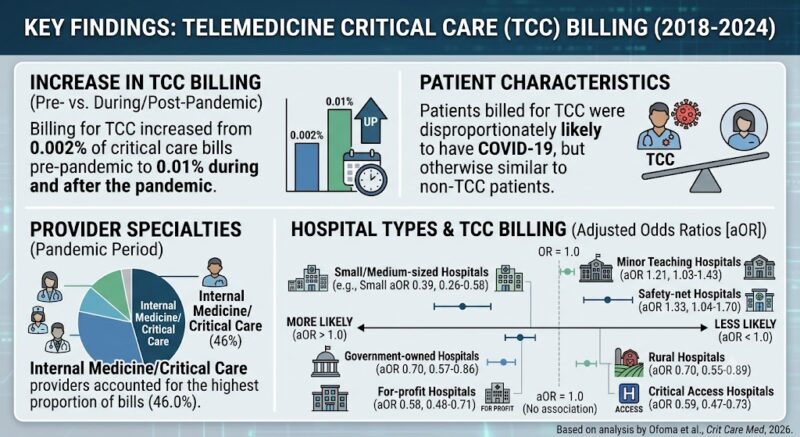
- Telemedicine critical care (TCC) billing, previously negligible, increased significantly during the COVID-19 pandemic, reflecting expanded telehealth reimbursement policies.
- Internal medicine and critical care specialists accounted for nearly half of TCC bills during the pandemic period.
- TCC utilization was more common in minor teaching and safety-net hospitals but less frequent in rural, small, and critical access hospitals, highlighting disparities in telecritical care access.
- Despite growth, TCC billing remains a minor fraction of overall critical care claims, underscoring underutilization and the need to study associated clinical and economic impacts.
Background
The COVID-19 pandemic catalyzed unprecedented expansion in telemedicine to ensure critical care continuity while minimizing exposure risks. Medicare’s temporary policy changes enabled remuneration for telemedicine critical care (TCC) services, which had not previously been widely reimbursed. Understanding how these policy shifts influenced billing practices and utilization patterns for hospitalized Medicare Fee-For-Service beneficiaries is crucial to guide post-pandemic telecritical care integration.
Critical care patients demand intensive resource coordination and expertise often centralized in tertiary centers. Telecritical care platforms can bridge geographic and specialist gaps to improve patient outcomes, particularly when physical presence is limited or impossible. Prior to the pandemic, barriers including regulatory, logistical, and reimbursement issues hampered telecritical care expansion.
Key Content
Chronological Development of Telemedicine Critical Care Billing Utilization
A serial cross-sectional analysis from January 2018 to September 2024 reveals that TCC billing was virtually absent pre-pandemic (0.002% of critical care bills). Expanded telehealth coverage during COVID-19 led to a fivefold increase to 0.01% of critical care bills, continuing into the post-pandemic period. Despite this growth, TCC billing remains a minor component of critical care service billing, suggesting limited penetration and acceptance beyond specific contexts.
Patient-Level Characteristics Associated with TCC Billing
Patients billed for TCC were disproportionately diagnosed with COVID-19, reflecting pandemic-related drivers for telecritical care use. Otherwise, demographics and clinical profiles were comparable to critically ill Medicare beneficiaries not receiving TCC-billed services, indicating broad applicability of telecritical care across typical critical care populations.
Provider and Subspecialty Involvement
Internal medicine and critical care physicians contributed the largest fraction (46.0%) of TCC pandemic-period bills, consistent with their central role in managing critically ill patients. This suggests that telecritical care uptake aligns with specialty training and clinical responsibilities rather than broader multidisciplinary billing expansion.
Hospital-Level Predictors of Telemedicine Critical Care Billing
Multivariable regression identified several hospital characteristics influencing TCC billing likelihood:
- Higher odds in minor teaching hospitals (aOR 1.21; 95% CI, 1.03–1.43) and safety-net hospitals (aOR 1.33; 95% CI, 1.04–1.70), likely reflecting resource availability and patient population needs.
- Lower odds among small (aOR 0.39; 95% CI, 0.26–0.58) and medium-sized hospitals (aOR 0.67; 95% CI, 0.47–0.95), government-owned (aOR 0.70; 95% CI, 0.57–0.86), and for-profit hospitals (aOR 0.58; 95% CI, 0.48–0.71), rural hospitals (aOR 0.70; 95% CI, 0.55–0.89), and critical access hospitals (aOR 0.59; 95% CI, 0.47–0.73).
This uneven distribution underscores existing disparities in telecritical care adoption, potentially related to infrastructure, funding models, and patient demographics.
Mechanistic and Policy Implications
The rapid adoption of TCC billing during the pandemic exemplifies how policy flexibility can accelerate telemedicine integration for critically ill populations. The predominance of internal medicine/critical care specialists in billing aligns with clinical workflows, while hospital characteristics indicate infrastructural and economic factors shaping telecritical care delivery. The association between hospital type and TCC billing also indicates that institutional readiness and commitment critically influence telemedicine implementation.
Expert Commentary
The dramatic increase in telecritical care billing during the COVID-19 pandemic reflects an adaptive response to unprecedented healthcare demands. However, TCC remains a small fraction of total critical care services, spotlighting barriers such as uneven technology penetration, provider acceptance, and reimbursement complexities, especially impacting rural and small hospitals.
The finding that safety-net and minor teaching hospitals more frequently bill for TCC suggests that institutions serving vulnerable populations may rely more heavily on telecritical care to supplement resource needs. Conversely, lower utilization in government-owned and for-profit hospitals may reflect differing administrative priorities or resource constraints.
These utilization patterns raise important questions regarding equity of access, quality of care delivered via telecritical care modalities, and cost-effectiveness. Current evidence gaps exist in outcomes attributable directly to telecritical care interventions and the long-term sustainability of TCC services post-pandemic.
Biologically, telemedicine critical care facilitates timely expert input for complex multi-organ dysfunction syndromes, sepsis, and respiratory failure by overcoming geographic and temporal barriers. Its success depends on robust coordination, interoperability of health information systems, and training of providers in tele-ICU protocols.
Conclusion
Billing for telemedicine critical care services expanded during the COVID-19 pandemic among hospitalized Medicare Fee-For-Service beneficiaries but remains underutilized. Utilization varies widely by provider specialty and hospital characteristics, highlighting infrastructural, economic, and regional disparities.
Future research must elucidate clinical outcomes linked to telecritical care, assess cost-effectiveness, and explore strategies to enhance equitable access—particularly for rural and critical access hospitals. Policymakers should consider these data when contemplating post-pandemic telehealth reimbursement frameworks and support mechanisms to address infrastructure gaps.
In summary, telemedicine critical care represents a promising but nascent component of critical care delivery in Medicare populations, necessitating ongoing evaluation to optimize integration and patient benefit.
References
- Ofoma UR, Graves JM, Waken RJ, Drewry AM, Subramanian S, Scott B, Udeh C, Herasevich V, Joynt Maddox KE. Telemedicine Critical Care Billing For Hospitalized Medicare Fee-For-Service Beneficiaries, 2018-2024. Crit Care Med. 2026 Aug 7. PMID: 42565664.