Highlight
Postoperative delirium is linked to significant long-term cognitive decline in adults aged 70 and older. Rehospitalizations, more frequent in patients experiencing delirium, are independently associated with cognitive deterioration but do not mediate the delirium-cognitive decline relationship. These findings suggest other underlying mechanisms beyond acute illness episodes contribute to the lasting impact of delirium on cognition.
Study Background
Delirium is an acute confusional state frequently encountered after surgery, especially among older adults. It is associated with increased morbidity, mortality, and healthcare utilization. Notably, postoperative delirium has emerged as a risk factor for persistent cognitive decline, which may lead to decreased functional independence and quality of life. However, it remains unclear whether delirium directly precipitates cognitive impairment or serves as a marker for underlying frailty and illness severity, which themselves could drive cognitive decline.
A key aspect in this debate is the role of rehospitalizations after surgery, which are common among those who develop delirium due to complications or frailty. Recurrent hospital stays might exacerbate or accelerate cognitive decline, potentially confounding observed associations with delirium. Thus, elucidating whether the link between delirium and cognitive deterioration is mediated by the burden of rehospitalization is necessary to identify targets for intervention and improve postoperative outcomes.
Study Design
This prospective cohort study analyzed data from the Successful Aging after Elective Surgery (SAGES) longitudinal study. Community-dwelling older adults aged 70 years or older were enrolled between June 2010 and August 2013, with follow-up over five years. The primary exposure was incident postoperative delirium following major elective surgery.
The study differentiated rehospitalizations by type: rehospitalization without intensive care unit (ICU) stay, rehospitalization including ICU stay, and rehospitalization including postacute care stay. The outcome measure was long-term cognitive performance assessed as change in the General Cognitive Performance (GCP) score. This composite score integrates 11 neuropsychological tests and was assessed at baseline and during 10 repeated follow-ups.
Key Findings
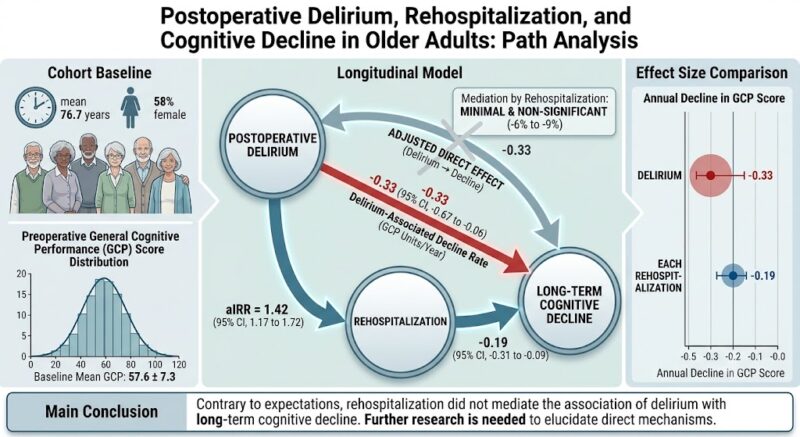
The cohort comprised 560 older adults (mean age: 76.7 years; 58% female), with a mean baseline GCP score of 57.6. Each additional rehospitalization correlated with a modest annual cognitive decline of -0.19 GCP units (95% CI, -0.31 to -0.09). Postoperative delirium was associated with a more pronounced cognitive decline of -0.33 GCP units per year (95% CI, -0.67 to -0.06).
Rehospitalizations were significantly more frequent in participants developing delirium, with an adjusted incidence rate ratio of 1.42 (95% CI, 1.17 to 1.72). Despite this, statistical models adjusting for rehospitalization types showed only minimal and non-significant attenuation (6% to 9%) in the delirium-cognitive decline relationship. This indicated that rehospitalizations did not mediate the association.
These findings highlight that while both delirium and rehospitalizations independently contribute to cognitive decline, the strong link between delirium and long-term cognitive impairment cannot be explained solely by increased hospitalization burden.
Expert Commentary
This rigorous study employs a well-characterized cohort with extensive follow-up and detailed cognitive assessments to clarify an important clinical question. Its prospective design and adjustment for rehospitalization subtypes add robustness.
However, despite comprehensive consideration of rehospitalizations as a proxy for illness burden, other mediating factors remain unexplored. For example, delirium may initiate neuroinflammatory processes, neurodegeneration, or synaptic dysfunction, leading to irreversible cognitive injury independent of further hospitalizations.
Future research should explore biological pathways underpinning delirium-related cognitive decline and potential interventions to prevent or ameliorate its long-term effects. Clinicians should recognize delirium as an independent marker of poor cognitive prognosis and tailor perioperative care accordingly.
Conclusion
This study compellingly shows that recurrent rehospitalizations do not mediate the association between postoperative delirium and persistent cognitive decline in older adults. Delirium itself remains an independent predictor of lasting cognitive impairment, emphasizing the need for focused prevention and management strategies targeting delirium beyond simply reducing hospitalization frequency. A deeper understanding of underlying pathophysiological mechanisms is critical to developing effective interventions.
Funding and Clinicaltrials.gov
The Successful Aging after Elective Surgery (SAGES) study was funded by the National Institute on Aging. The clinical trial registration details were not provided in the provided summary.
References
1. Hshieh TT, Kunicki ZJ, Fong TG, et al. Rehospitalization and the Association of Postoperative Delirium With Cognitive Decline in Older Adults. JAMA Intern Med. 2026;186(8):933-940. doi:10.1001/jamainternmed.2026.1234
2. Inouye SK, Westendorp RGJ, Saczynski JS. Delirium in elderly people. The Lancet. 2014;383(9920):911-922.
3. Marcantonio ER. Postoperative delirium: A 76-year-old woman with delirium following surgery. JAMA. 2012;308(1):73-81.