Introduction
Major depressive disorder (MDD) remains a leading cause of disability worldwide, with many patients exhibiting resistance to standard treatments. Accelerated transcranial magnetic stimulation (aTMS) has emerged as a promising modality, offering rapid antidepressant effects through repeated sessions delivered over a short period. However, the optimal method for targeting brain regions during TMS remains under investigation. Traditionally, scalp-based landmarks such as the Beam F3 method guide coil placement over the left dorsolateral prefrontal cortex (DLPFC), a region implicated in mood regulation. Recent advances in neuroimaging—specifically functional connectivity mapping—offer the possibility to individualize targeting by identifying brain circuits most relevant to depression in each patient.
This study aimed to evaluate whether connectivity-based targeting of aTMS produces superior clinical outcomes compared to conventional scalp-based targeting in adults with treatment-resistant depression. Using resting-state functional MRI data, connectivity-based targets were individualized based on correlation with a well-characterized depression circuit involving negative connectivity to the subgenual cingulate cortex, a key node implicated in mood dysregulation.
Methods
This double-blind randomized clinical trial was conducted at the Center for Brain Circuit Therapeutics (Mass General Brigham and Harvard Medical School, Boston) from July 2023 to March 2025. Forty adults aged 22 to 80 years diagnosed with major depressive disorder met inclusion criteria: moderate to severe depressive symptoms measured by the Montgomery-Åsberg Depression Rating Scale (MADRS) and moderate to severe treatment resistance quantified by the Maudsley Staging Method. Key exclusions included contraindications to TMS or MRI, primary psychiatric diagnoses other than MDD or anxiety disorders, recent receipt of rapid-acting antidepressants, and significant neurological or substance use disorders.
All participants underwent a 41-minute multiecho resting-state functional MRI scan to map functional connectivity. Participants were randomized to receive either connectivity-guided or scalp-based aTMS targeting. Connectivity-based targets were defined in the left DLPFC as the location showing the greatest positive correlation with a published, publicly available convergent depression circuit, which includes the subgenual cingulate cortex and associated networks. For the scalp-based group, the Beam F3 method determined the stimulation site.
The primary outcome was change in MADRS score at 1-month post-treatment, adjusted for baseline scores. Secondary outcomes included the durability of response with follow-up assessments every 3 months for one year. Blinding was maintained among participants, TMS technicians, and physicians administering the treatments.
Results
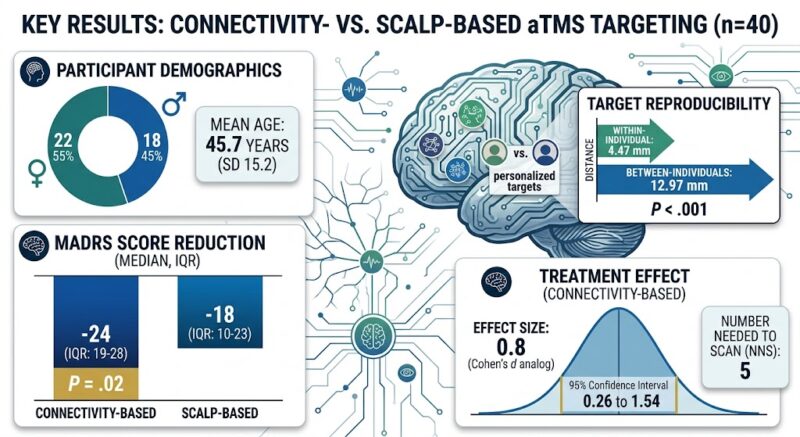
Forty participants (55% female; mean age 45.7 years, SD 15.2) completed treatment. The group receiving connectivity-based targeting demonstrated a median MADRS score reduction of 24 points (interquartile range 19-28) compared to 18 points (IQR 10-23) in the scalp-based group (P=0.02). This corresponds to an effect size analogous to Cohen’s d of 0.8 (95% CI: 0.26-1.54), indicating a substantial improvement in depressive symptoms with connectivity-guided aTMS. The number needed to scan to detect one additional responder was five.
Connectivity-based targets showed high intra-individual reproducibility (mean split-half distance of 4.47 mm) and were significantly different between individuals (mean distance 12.97 mm, P<0.001), supporting the feasibility and precision of individualized targeting. The treatment was well tolerated across groups, with no significant adverse events related to targeting method.
Discussion
This study provides compelling evidence that individualized connectivity-based targeting enhances the antidepressant efficacy of accelerated TMS in patients with treatment-resistant depression. The approach leverages advanced neuroimaging to identify brain circuit dysfunctions unique to each patient, allowing precise modulation of neural activity. These findings add to the growing body of literature supporting biomarker-guided personalized interventions in psychiatry and could inform future clinical guidelines.
In comparison, scalp-based methods, while simpler and widely used, do not account for individual variability in brain anatomy and functional networks, potentially limiting treatment effectiveness. Connectivity-guided targeting also demonstrated good reproducibility, which is vital for ensuring consistent clinical application.
The results suggest that MRI-guided connectivity targeting may improve response rates sufficiently to justify the added scanning costs, especially considering the chronic and debilitating nature of treatment-resistant depression. Further cost-effectiveness studies and confirmatory large-scale trials are warranted to establish the clinical utility of this personalized approach.
Limitations
The study’s sample size, while adequate to demonstrate a significant effect, was relatively small, and participants were treated at specialized centers, which may limit generalizability. Longer-term follow-up beyond one year will be essential to assess the durability of benefits. Additionally, the study focused on a specific connectivity circuit based on prior research and may not represent all potential depression-related circuits.
Conclusion
Individualized targeting of accelerated transcranial magnetic stimulation using connectivity-based neuroimaging significantly improves depression outcomes compared to conventional scalp-based methods. This approach represents a promising advance toward precision psychiatry, offering hope for patients with treatment-resistant major depressive disorder.
Trial Registration
ClinicalTrials.gov Identifier: NCT05680727.
References
Taylor JJ, Kare MR, Haj-Darwish D, et al. Connectivity- vs Scalp-Based Targeting of Accelerated Transcranial Magnetic Stimulation for Depression: A Randomized Clinical Trial. JAMA Psychiatry. 2026;83(8):807-817. doi:10.1001/jamapsychiatry.2026.4307
Additional relevant literature on TMS and depression neuroimaging is available to contextualize and support findings presented in this trial.