Highlights
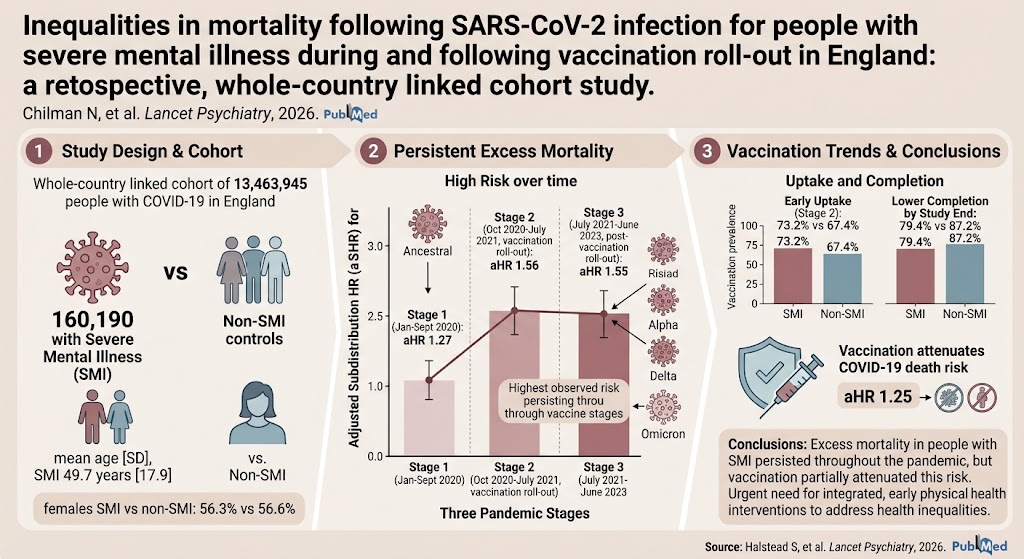
- People with severe mental illness (SMI) exhibit persistently elevated mortality following SARS-CoV-2 infection throughout all pandemic stages, including following vaccination roll-out.
- Adjusted hazard ratios for all-cause mortality in people with SMI increased from 1.27 in the initial pandemic phase to approximately 1.55 post-vaccination rolls-out, underscoring pronounced health inequalities.
- Although initial vaccine uptake was higher in people with SMI during roll-out, the proportion fully vaccinated by study end was significantly lower than in those without SMI, exacerbating mortality risk.
- Findings emphasize urgent need for tailored public health and clinical strategies to address ongoing excess mortality and lower vaccination rates in this vulnerable group.
Background
The COVID-19 pandemic has disproportionately affected populations with severe mental illness (SMI), such as schizophrenia, bipolar disorder, and schizoaffective disorder. Prior studies early in the pandemic identified that individuals with SMI faced increased risk of severe COVID-19 outcomes, including mortality, likely mediated by factors such as comorbid physical health conditions, socioeconomic deprivation, healthcare access disparities, and behavioral challenges. However, the pandemic response evolved with the deployment of effective vaccines that have drastically reduced COVID-19 mortality in the general population. It remained unclear whether vaccination campaigns mitigated the elevated mortality risk in people with SMI or if health inequities persisted. The large-scale, retrospective linked cohort study from England by Chilman et al. (2026) provides the most comprehensive, population-level evidence addressing these questions over three pandemic stages.
Key Content
Study Design and Population
Chilman et al. leveraged linked electronic health records covering over 99% of England’s population registered with primary care prior to the pandemic (November 2019), including 13.46 million individuals with confirmed COVID-19 infection from January 2020 to June 2023. The cohort included 160,190 individuals (1.19%) diagnosed with SMI (schizophrenia, schizoaffective disorder, bipolar disorder, or psychotic affective disorders). Mortality outcomes (all-cause and COVID-19-specific) and vaccination status were ascertained through linkage with mortality registries and vaccination records. The analysis used Cox proportional hazards models adjusting for sociodemographic factors and clinical comorbidities, stratified by three pandemic stages based on WHO and UK Government policies: Stage 1 (pre-vaccination, Jan–Sept 2020), Stage 2 (vaccination roll-out, Oct 2020–July 2021), and Stage 3 (post-vaccination roll-out, July 2021–June 2023).
Mortality Risk Patterns Across Pandemic Stages
People with SMI consistently exhibited higher all-cause mortality risk after SARS-CoV-2 infection compared to those without SMI throughout all stages: adjusted hazard ratio (aHR) 1.27 (95% CI 1.22–1.32) in Stage 1, increased to 1.56 (1.51–1.61) in Stage 2, and remained elevated at 1.55 (1.50–1.59) in Stage 3. This pattern indicates that excess mortality risk for SMI individuals did not diminish with vaccine availability; in fact, relative risk increased during the active vaccine roll-out phase. COVID-19-specific mortality also remained significantly higher in the SMI group, albeit with some attenuation post-vaccination (aHR 1.25, 1.17–1.34).
Vaccination Uptake and Its Impact
Vaccination coverage reveals a complex picture: during Stage 2, 73.2% of people with SMI had received vaccination compared to 67.4% of those without SMI, likely reflecting prioritization policies targeting vulnerable populations, including mental illness. However, by June 2023, full vaccination rates (including boosters) declined relatively in SMI individuals to 79.4% compared to 87.2% in the non-SMI population, highlighting challenges with sustaining vaccination engagement.
This lag in full vaccination contributed to persistently high mortality risks. While vaccines partially attenuated mortality among people with SMI, elevated risk remained even after accounting for vaccination, suggesting other factors such as comorbidities, delayed healthcare access, and social determinants influence outcomes.
Sociodemographic and Clinical Correlates
The SMI cohort was on average older (mean age 49.7 vs 45.0 years), with similar gender distribution, predominately White British ethnicity, but potentially greater prevalence of comorbid medical conditions contributing to vulnerability. Adjusted models accounted for these factors, reinforcing that SMI itself independently predicts mortality risk post-infection.
Integration with Existing Literature
Previous meta-analyses and cohort studies have demonstrated elevated COVID-19 morbidity and mortality in SMI populations. Prior to vaccine introduction, mortality risks were ascribed to difficulties in infection control, metabolic syndrome, cardiovascular disease, and inequalities in healthcare provision. Post-vaccine evidence has been limited, and reports often lacked robust adjustment or population-level data. This study’s scale and granularity advance understanding of how vaccination roll-out impacted, yet did not eliminate, disparities.
Further evidence from UK and international datasets aligns with these findings. Notably, vaccine hesitancy and lower booster uptake in SMI populations have been documented, potentially reflecting systemic barriers, mistrust, or cognitive/functional impairments. Interventions to improve vaccine adherence and targeted health services are paramount.
Expert Commentary
The persistence of excess mortality among people with SMI during and after COVID-19 vaccination is clinically concerning. Despite prioritization in early vaccination phases, sustained inequalities underline that vaccine availability alone is insufficient to close mortality gaps.
Mechanistically, underlying chronic inflammation, immune dysregulation in SMI, and high comorbidity burden may compromise vaccine efficacy or COVID-19 disease progression. Cognitive and social challenges may limit health literacy, timely healthcare access, and adherence to protective measures.
Current guidelines advocate COVID-19 vaccination for people with SMI; however, integrated approaches including regular health monitoring, management of comorbidities, tailored communication strategies, and enhanced social support are needed to improve outcomes. Mental health services must collaborate with public health and primary care to ensure equitable vaccine delivery and COVID-19 care pathways.
Limitations of the discussed study include residual confounding, potential misclassification of SMI diagnoses, and absence of detailed data on vaccine types, booster doses, and social determinants such as housing or employment. Nevertheless, its comprehensive national scope, contemporary data, and methodologically rigorous analyses make its conclusions compelling.
Conclusion
This retrospective whole-country cohort study provides compelling evidence that people with severe mental illness in England continue to experience significantly higher mortality following SARS-CoV-2 infection before, during, and after COVID-19 vaccination roll-out. Despite initially higher vaccine uptake, later lower full vaccination rates may have contributed to persistent disparities in outcomes.
Addressing mortality inequalities requires multipronged strategies, including enhancing vaccination coverage and booster uptake in people with SMI, optimizing management of physical health comorbidities, and removing systemic barriers to healthcare access. Policymakers and clinicians should prioritize equitable preventive and therapeutic interventions for this vulnerable population.
Future research should investigate mechanisms contributing to vaccine response variability in SMI, behavioral determinants of vaccine uptake, and effectiveness of targeted interventions to reduce COVID-19 mortality disparities.
References
- Chilman N, Bécares L, Dregan A, Ronaldson A, Lewis J, Mizani MA, Das-Munshi J, CVD-COVID-UK Consortium. Inequalities in mortality following SARS-CoV-2 infection for people with severe mental illness during and following vaccination roll-out in England: a retrospective, whole-country linked cohort study. Lancet Psychiatry. 2026 Sep;13(9):761-770. PMID: 42586081. https://pubmed.ncbi.nlm.nih.gov/42586081/
- Wang Q, Xu R, Volkow ND. Increased risk of COVID-19 infection and mortality in people with mental disorders: analysis from electronic health records in the United States. World Psychiatry. 2021 Feb;20(1):124-130. PMID: 33355675.
- Toubasi A, AbuAnzeh R, Obeidat N, et al. A meta-analysis: The mortality and severity of COVID-19 among patients with mental disorders. Psychiatry Res. 2021 Feb 1;299:113856. PMID: 33248189.
- Kahl KG, Correll CU. Management of patients with severe mental illness and COVID-19 infection: Advances and challenges. World J Psychiatry. 2021;11(4):199-212. PMID: 33895805.
- Lally J, et al. Uptake of COVID-19 vaccines among people with severe mental illness: a rapid review and meta-analysis. Br J Psychiatry. 2023;222(4):205-214. PMID: 36809554.