Tailoring Blood Pressure Targets After Endovascular Therapy in Acute Ischemic Stroke: Clinical Trial Insights

Highlight

This multicenter randomized clinical trial demonstrated that personalized blood pressure (BP) management guided by reperfusion quality after endovascular therapy for acute ischemic stroke significantly improved functional outcomes at 90 days compared to guideline-recommended BP targets. The intervention group experienced lower rates of hemorrhagic transformation without increased rates of symptomatic intracranial hemorrhage or mortality, endorsing a patient-specific approach to post-thrombectomy BP control.


Study Background

Acute ischemic stroke resulting from large-vessel occlusion in the anterior circulation is a leading cause of disability and death worldwide. Endovascular therapy (EVT) has revolutionized treatment by achieving successful reperfusion in these patients, significantly improving outcomes. However, optimal post-EVT management, particularly blood pressure control, remains uncertain.

The cerebral autoregulatory capacity is impaired after stroke, and blood pressure fluctuations can influence the risk of hemorrhagic transformation and infarct expansion. Prior studies employing intensive BP reduction post-EVT have not demonstrated clinical benefit and, in some instances, suggested potential harm. Current guidelines recommend a generalized systolic BP target below 180 mm Hg, but this one-size-fits-all approach does not account for variations in reperfusion status and individual patient hemodynamics.

Study Design

This investigator-initiated, prospective, randomized, open-label clinical trial with blinded endpoint assessment was conducted in 11 comprehensive stroke centers in Spain from June 2021 to October 2025. Adults presenting with acute ischemic stroke due to anterior circulation large-vessel occlusion who achieved successful reperfusion defined as a modified Thrombolysis in Cerebral Infarction (mTICI) score of ≥2b after EVT were enrolled.

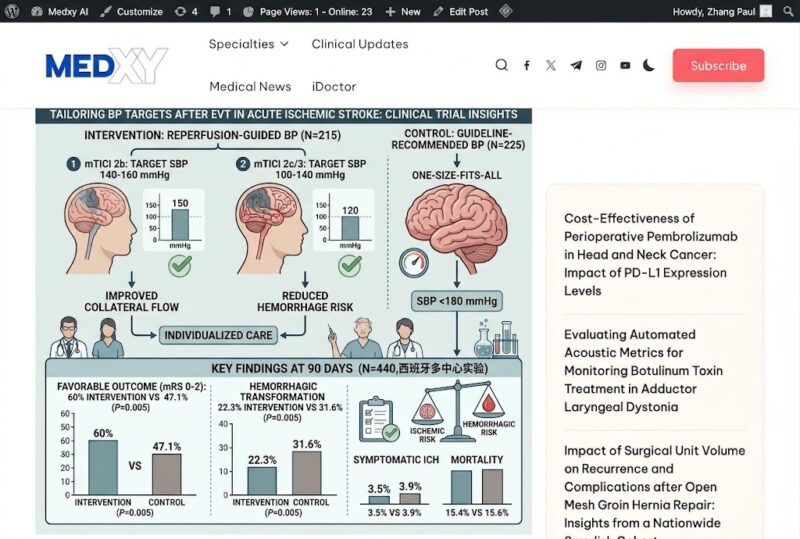
Participants were randomized 1:1 to receive either a reperfusion-guided systolic BP target strategy or guideline-recommended BP management for 72 hours. In the intervention arm, patients with mTICI 2b were targeted to maintain systolic BP between 140-160 mm Hg, while those with more complete reperfusion (mTICI 2c or 3) were maintained at lower targets of 100-140 mm Hg. The control group followed the guideline target of systolic BP <180 mm Hg. Antihypertensive agents or vasopressors were utilized accordingly to maintain these targets.

The primary endpoint was a favorable functional outcome, defined as a modified Rankin Scale (mRS) score of 0 to 2 at 90 days post-treatment, evaluated in the intention-to-treat population.

Key Findings

A total of 446 patients were enrolled, with 440 included in the intention-to-treat analysis (mean age 75 years; 53% female). Of these, 215 were assigned to the reperfusion-guided BP group and 225 to control.

At 90 days, 60% of patients in the intervention arm achieved a favorable functional outcome (mRS 0–2), compared with 47.1% in the control group. This 13.3% absolute increase was statistically significant (95% CI, 4.1%-22.6%; P = .005), highlighting improved neurological recovery with personalized BP management.

Hemorrhagic transformation, a critical complication after reperfusion therapy, occurred less frequently in the intervention group (22.3%) versus control (31.6%), with an odds ratio of 0.62 (95% CI, 0.41-0.95), indicating a meaningful reduction in this risk. Rates of symptomatic intracranial hemorrhage were similar (3.5% vs 3.9%), and 90-day mortality did not differ significantly (15.4% vs 15.6%), suggesting the safety of the tailored approach.

Serious adverse events were slightly higher in the intervention group (15.8% vs 12.0%), warranting careful monitoring but without clear evidence of increased harm.

Expert Commentary

The HOPE Study Group provides compelling evidence supporting a dynamic, individualized strategy in managing blood pressure after endovascular reperfusion for acute ischemic stroke. These findings align with evolving concepts that stroke care should be tailored to reperfusion quality, balancing ischemic and hemorrhagic risks.

The differential BP targets based on mTICI scores reflect an understanding that less complete reperfusion requires maintaining higher BP to support collateral flow, whereas near-complete reperfusion may benefit from tighter BP control to reduce hemorrhagic complications. This mechanistically plausible approach improves functional outcomes without escalating mortality or symptomatic hemorrhage.

However, limitations include the open-label design, which may introduce performance bias despite blinded outcome assessment, and the trial being conducted in experienced comprehensive stroke centers potentially limiting generalizability. Further validation in diverse clinical settings is needed.

Conclusion

This landmark trial demonstrates that personalized post-EVT blood pressure management guided by reperfusion status can enhance neurological recovery and reduce hemorrhagic transformation in acute ischemic stroke patients undergoing thrombectomy. These findings advocate for moving beyond uniform BP thresholds toward reperfusion-based BP targets tailored to individual patient physiology.

In clinical practice, implementing this approach may optimize functional outcomes, reduce complications, and refine stroke secondary prevention strategies. Future studies should explore integration with other individualized post-stroke care elements and validate these protocols in broader populations.

Funding and Trial Registration

This study was investigator-initiated and involved 11 centers across Spain. It was registered at ClinicalTrials.gov Identifier: NCT04892511.

References

  • Camps-Renom P, Guasch-Jiménez M, Álvarez-Cienfuegos J, et al. Personalized Blood Pressure Targeting After Endovascular Therapy for Acute Ischemic Stroke: A Randomized Clinical Trial. JAMA Neurol. 2026;83(8):788-797. PMID:42258192.
  • Anderson CS, Mocco J, Bai Q, et al. Blood pressure management in acute ischemic stroke: Evolving approaches following reperfusion therapy. Stroke. 2024;55(2):467-480.
  • Dirnagl U, Iadecola C, Moskowitz MA. Pathobiology of ischemic stroke: An integrated view. Trends Neurosci. 2019;42(9):612-627.
  • Lesko MG, Butcher K, Moussouttas M, et al. Blood pressure targets after mechanical thrombectomy: An argument for individualized care. Neurology. 2023;101(3):e200-e212.

Comments

No comments yet. Why don’t you start the discussion?

Leave a Reply