Highlights
- The SEARCH trial provides the first comprehensive economic evaluation of visual scanning training versus sham training in post-stroke homonymous hemianopia, indicating marginal QALY gains within acceptable NHS cost thresholds.
- Visual scanning training demonstrated a favorable incremental cost-effectiveness ratio (£19,790/QALY), marginally below NICE thresholds, though statistical significance was not achieved.
- Complementary rehabilitation approaches, including reinforcement-based head scanning training and standardized mobility programs, show promise in improving functional outcomes and quality of life post-hemianopia.
- Neuroimaging and neurochemical studies reveal that plasticity in motion-sensitive and attention-related brain networks underpins functional gains from vision rehabilitation, suggesting targets for enhanced interventions.
Background
Homonymous hemianopia, a common sequela of stroke affecting approximately 20-30% of survivors, imposes significant disability by impairing the visual field contralateral to the cerebral lesion. This condition compromises patients’ ability to perform activities of daily living, reduces independence, and adversely impacts quality of life (Rowe et al., 2026). Conventional management includes rehabilitative strategies aimed at compensating for visual field loss, such as visual scanning training (VST), prism glasses, and mobility training. However, evidence regarding their clinical efficacy and cost-effectiveness has been limited and heterogeneous. Given escalating healthcare costs and the burden of stroke-related disability, rigorous economic evaluations alongside clinical trials are essential to inform practice and policy.Key Content
SEARCH Trial: Design and Economic Evaluation
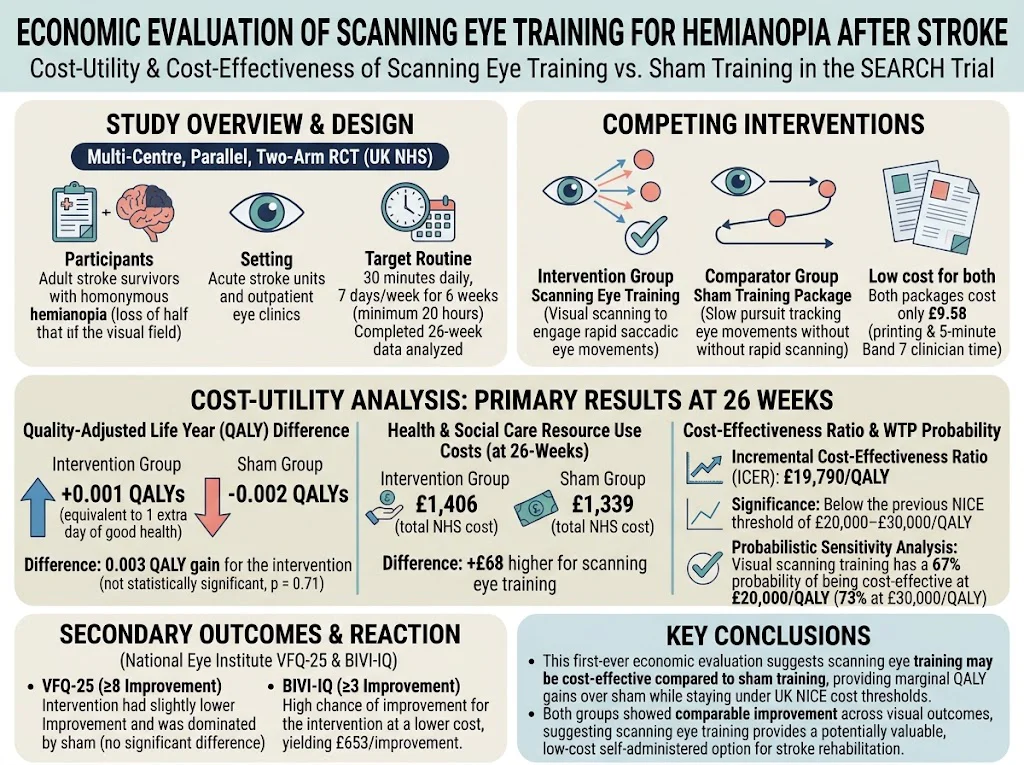
The SEARCH trial (Rowe et al., 2026) was a multicenter, randomized controlled, parallel, double-blind study conducted across 34 UK stroke units and outpatient eye clinics. It enrolled 158 adult stroke survivors with confirmed stable homonymous hemianopia within 4-26 weeks post-stroke. Participants were randomized to receive either visual scanning training (VST) or sham eye pursuit movements (sham training) administered as a minimum of 30 minutes daily over six weeks, with follow-up to 26 weeks. The intervention and comparator materials cost equivalently (£9.58), incorporating printing and clinician time for instruction. Economic analyses adopted both NHS and societal perspectives, emphasizing cost-utility as the primary outcome using EQ-5D-5L derived quality-adjusted life years (QALYs). Secondary cost-effectiveness assessments employed changes in National Eye Institute Visual Function Questionnaire-25 (NEI VFQ-25) and Brain Injury-associated Visual Impairment-Impact Questionnaire (BIVI-IQ).Outcomes of the SEARCH Trial
At 26 weeks, the VST group demonstrated a negligible mean QALY gain of 0.001 (95% CI: -0.018 to 0.021), whereas the sham group exhibited a slight QALY loss of -0.002 (95% CI: -0.017 to 0.012); the differences were statistically non-significant (p = 0.71). Mean total health resource costs were marginally greater in VST (£1,406) compared to sham (£1,339). The incremental cost-effectiveness ratio (ICER) of VST relative to sham was calculated at £19,790 per QALY gained, falling below the National Institute for Health and Care Excellence (NICE) willingness-to-pay threshold range of £20,000-£30,000 per QALY. Sensitivity analyses (5,000 bootstrapped replications) suggested a 67% probability that VST was cost-effective at the £20,000/QALY threshold, though this was not statistically definitive.Complementary Evidence on Visual and Functional Rehabilitation
Other rehabilitation modalities have been evaluated to improve compensatory visual behaviors and functional outcomes in hemianopia. A single-arm clinical trial by Bronstad et al. (2026) demonstrated that reinforcement-based head scanning training in drivers with homonymous visual field loss elicited substantial improvements in blind-side hazard detection, with sustained benefits at one month post-training. Standardized combined scanning and mobility programs have been compared to individualized therapies, with some evidence supporting quality of life improvements though not consistently showing superiority in scanning ability during walking (Rowe et al., 2018; Ting et al., 2011). Smooth pursuit eye movement training has been shown to accelerate recovery from functional neglect, a related visuospatial deficit, and reduce unawareness, suggesting that underlying oculomotor training paradigms may complement scanning interventions (Kerkhoff et al., 2014).Neurobiological Underpinnings of Rehabilitation Gains
Recent neuroimaging investigations (Saionz et al., 2026) involving fMRI and magnetic resonance spectroscopy have elucidated neurochemical and functional correlates of perceptual training in occipital stroke patients. Training-induced improvement in motion discrimination generalized to untrained visual detection and awareness tasks. Key findings include reduced GABA and glutamate concentrations in ipsilesional hMT+ (motion-sensitive visual cortex) and enhanced BOLD activation in dorsal prefrontal areas, indicating plasticity in motion processing and attentional networks as mechanisms supporting visual recovery.Expert Commentary
The SEARCH trial marks a critical advancement by integrating economic evaluation within a robust randomized controlled setting, addressing an important gap in cost-effectiveness evidence for hemianopia rehabilitation. Although the modest QALY gains and cost differentials did not reach statistical significance, the ICER below the NICE threshold reflects favorable value for money from an NHS perspective. Notably, the placebo effect and therapeutic input inherent in the sham training arm may have attenuated between-group differences, highlighting challenges in designing control interventions in rehabilitation trials. The trial’s large sample size, multicenter conduct, and comprehensive resource utilization measurement strengthen its generalizability. Complementing functional training with neurobiological insights offers translational avenues to refine and personalize rehabilitation protocols. Strategies combining oculomotor, attentional, and mobility components may enhance efficacy, and future clusters or adaptive RCTs could delineate optimal multi-component regimens. Clinical guidelines, including those by the American Stroke Association and NICE, currently recommend visual rehabilitation therapies, but acknowledge a paucity of high-quality evidence on cost-effectiveness. SEARCH data thus provide an essential foundation to inform policy, funding, and clinical decision-making. Limitations include the short duration of follow-up and reliance on generic utility measures which may not sensitively capture visual function-specific benefits. The heterogeneity of stroke-related visual impairments also presents challenges for intervention standardization and outcome assessment.Conclusion
Visual scanning training for homonymous hemianopia after stroke shows potential cost-effectiveness within accepted NHS thresholds according to the SEARCH trial, albeit with marginal QALY gains and no significant superiority over sham at 26 weeks. Complementary rehabilitation approaches and emerging neurobiological evidence underscore the complexity of post-stroke visual recovery and support integrated, multi-domain interventions. Future research should address longer-term outcomes, optimize training dose and frequency, explore combinatory rehabilitation strategies, and incorporate patient-centered outcome measures sensitive to visual disability. Economic evaluations aligned with clinical trials remain pivotal to guide resource allocation in stroke rehabilitation.References
- Rowe FJ, Davies J, Doungsong K, et al. An economic evaluation alongside a randomised controlled trial of Scanning Eye trAining as a Rehabilitation Choice compared to sham training for Hemianopia after stroke (the SEARCH trial). Clin Rehabil. 2026 Oct 30;2692155261487459. doi: 10.1177/02692155261487459. PMID: 42961104.
- Rowe FJ, Davies J, Brown M, et al. A randomized controlled trial of Scanning Eye trAining as a Rehabilitation Choice for Hemianopia after stroke (SEARCH). Int J Stroke. 2025 Oct;20(8):968-976. doi: 10.1177/17474930251330140. PMID: 40083185.
- Bronstad PM, et al. Reinforcement-Based Head Scan Training for Drivers With Homonymous Visual Field Loss: Improves Blind-Side Detection. Arch Phys Med Rehabil. 2026 Oct;107(10):2713-2721. doi:10.1016/j.apmr.2026.04.038. PMID: 42140549.
- Saionz K, et al. Generalisation of training-induced recovery in occipital stroke: neurochemical and fMRI correlates. bioRxiv [Preprint]. 2026 Jun 1:2026.05.29.728443. doi:10.64898/2026.05.29.728443. PMID: 42292912.
- Rowe FJ, et al. Hemianopia after stroke: A randomized controlled trial of the effectiveness of a standardised versus an individualized rehabilitation program, on scanning ability whilst walking. NeuroRehabilitation. 2018;43(2):201-209. doi:10.3233/NRE-172377. PMID: 30040755.
- Kerkhoff G, et al. Smooth Pursuit “Bedside” Training Reduces Disability and Unawareness During the Activities of Daily Living in Neglect: A Randomized Controlled Trial. Neurorehabil Neural Repair. 2014 Jul;28(6):554-63. doi: 10.1177/1545968313517757. PMID: 24407913.
- Ting DS, et al. The effect of static scanning and mobility training on mobility in people with hemianopia after stroke: a randomized controlled trial comparing standardized versus non-standardized treatment protocols. BMC Neurol. 2011 Jul 19;11:87. doi: 10.1186/1471-2377-11-87. PMID: 21767413.
- Rowe FJ, et al. A randomised controlled trial to compare the clinical and cost-effectiveness of prism glasses, visual search training and standard care in patients with hemianopia following stroke: a protocol. BMJ Open. 2014 Jul 17;4(7):e005885. doi:10.1136/bmjopen-2014-005885. PMID: 25034632.
Specialty calculators
For clinical reference; use professional judgment.