Highlights
- Dupilumab achieves high and sustained combined clinical, endoscopic, and histologic remission in pediatric eosinophilic esophagitis (EoE), with real-world registry data showing 86% remission at 12 months.
- Treatment simplification is possible, with most pediatric patients successfully managed on dupilumab monotherapy and reducing concomitant EoE therapies within a year.
- Baseline proximal eosinophil density predicts likelihood of sustained remission, informing personalized treatment approaches.
- Dupilumab’s mechanism involves normalization of a dysregulated type 2 inflammatory transcriptome, underpinning durable symptom improvement and esophageal healing across age groups.
Background
Eosinophilic esophagitis (EoE) is a chronic, immune-mediated esophageal disease typified by eosinophilic infiltration (>15 eosinophils per high-power field [HPF]), endoscopic abnormalities, and symptoms such as dysphagia. Pediatric EoE presents unique challenges including growth impairment and impacts on quality of life (QoL). Traditional treatments — proton pump inhibitors (PPIs), swallowed topical corticosteroids, and elimination diets — have limitations regarding efficacy, adherence, and tolerability. The emergence of dupilumab, a monoclonal antibody that inhibits interleukin (IL)-4 and IL-13 signaling pathways central to type 2 inflammation, offers an approved biologic option targeting EoE pathophysiology. Despite regulatory approval, pediatric real-world data remain limited. Recently published results from the multinational European Society for Paediatric Gastroenterology, Hepatology and Nutrition (ESPGHAN)-funded pEEr registry and multiple phase 3 trials provided comprehensive evidence on dupilumab’s safety, efficacy, and mechanistic effects in children with EoE, informing clinical practice and future research directions.Key Content
Clinical Effectiveness in Pediatric EoE: Registry and Trial Evidence
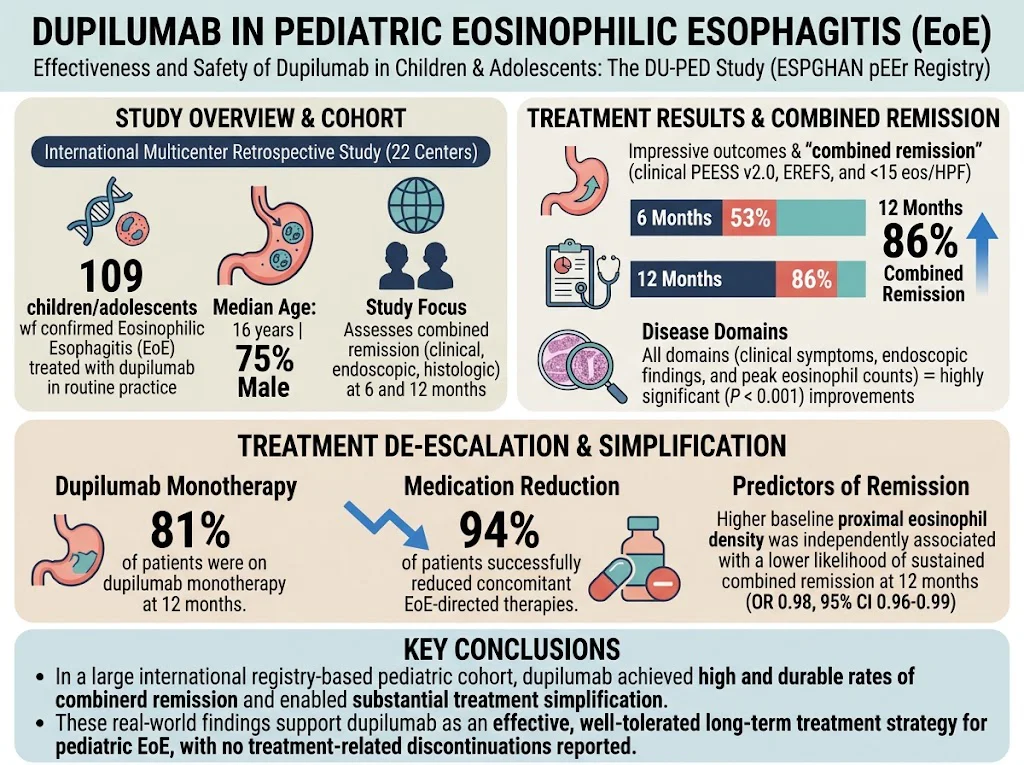
The DU-PED multicenter retrospective cohort analysis enrolled 109 children (median age 16 years; 75% male) treated with dupilumab across 22 centers. The primary endpoint was combined remission — defined by simultaneous clinical improvement (≥75% reduction or symptom resolution measured by Pediatric Eosinophilic Esophagitis Symptom Score [PEESS] v2.0), endoscopic score (EREFS ≤2), and histologic remission (<15 eos/HPF) — assessed at 6 and 12 months. Results showed combined remission rates rising from 53% at 6 months to 86% at 12 months, accompanied by significant improvements in symptom scores, endoscopic appearances, and eosinophil counts (P < 0.001). Notably, 81% of patients were on dupilumab monotherapy at one year, with 94% reducing other EoE therapies, highlighting treatment deescalation. Parallel phase 3 randomized controlled trials (RCTs) provided pivotal data on efficacy and safety. In the EoE KIDS trial of children aged 1–11 years, dupilumab induced histological remission (peak eosinophil count ≤6 eos/HPF) in 68% on higher-exposure regimens versus 3% on placebo at 16 weeks, alongside improvements in endoscopic and transcriptomic markers. Importantly, patients with prior swallowed topical corticosteroid (STC) use or inadequate STC response also responded robustly, demonstrating efficacy irrespective of prior therapy exposure.Comparative Pharmacologic Efficacy and Symptom Response
A comprehensive network meta-analysis incorporating 13 RCTs in patients aged ≥12 years assessed biologics, corticosteroids, and proton pump inhibitors. Dupilumab ranked highest for dysphagia improvement at 12 and 24 weeks with moderate-to-high certainty, alongside histologic remission rates of 60%–84%, outperforming placebo and matching or exceeding other agents such as cendakimab and budesonide suspensions. These findings reinforce dupilumab’s symptomatic and histologic benefits, with prolonged effects up to one year or more.Mechanistic Insights: Transcriptomic Normalization and Type 2 Inflammation Blockade
Molecular analyses from three dupilumab placebo-controlled trials revealed normalization of the EoE disease transcriptome, encompassing genes related to eosinophils, mast cells, fibrosis, epithelial barrier integrity, and other critical pathways of esophageal dysfunction. Dupilumab specifically modulates IL-4 and IL-13 signaling, the central drivers of type 2 inflammation. This molecular correction aligns with clinical and endoscopic remission and is sustained across pediatric, adolescent, and adult populations, indicating a mechanistic basis for durable clinical efficacy.Pharmacokinetics and Dosing Considerations in Children
Population pharmacokinetic modeling using data from adults, adolescents, and children demonstrated body weight and albumin level as significant covariates affecting dupilumab clearance and distribution. Age per se was not significant, supporting weight-tiered dosing approved in pediatrics to achieve exposure similar to adults (300 mg weekly). Simulations informed regulatory approvals for dosing in young children, including those weighing 5–15 kg and 40–60 kg.Safety and Adverse Events
Dupilumab was generally well tolerated in the pediatric population, with no treatment discontinuations reported in the DU-PED study. Reported adverse events included injection site reactions, headaches, and nausea, consistent with previous findings. Infection rates, including COVID-19, did not differ significantly from placebo. Importantly, no serious adverse events or deaths related to treatment were reported. Real-world analyses also support a favorable safety profile. Current expert consensus acknowledges dupilumab’s immunomodulatory role but notes that live vaccines may require caution; nevertheless, vaccination during dupilumab therapy appears generally safe under shared decision-making.Predictors of Response and Treatment Deescalation
Higher baseline proximal eosinophil densities were associated with a lower likelihood of sustained combined remission at 12 months, providing a potential biomarker to guide personalized treatment decisions. The substantial reduction in concomitant therapies highlights the practical advantage of dupilumab as a monotherapy for long-term disease control.Expert Commentary
The robust remission rates and multi-domain improvements documented in both real-world cohorts and rigorous RCTs affirm dupilumab’s position as a transformative therapy for pediatric EoE. Its mechanism directly targets the IL-4/IL-13 axis driving disease pathology rather than merely suppressing downstream inflammation. While corticosteroids and dietary interventions remain first-line, they are often limited by adherence and adverse effects, especially in children. Dupilumab’s favorable safety and efficacy profile supports its use in pediatric patients with inadequate response or intolerance to conventional therapies, or those with severe disease manifestations. Limitations include the relative paucity of long-term follow-up data beyond one year, the need for head-to-head comparisons against other emerging biologics, and economic considerations of biologic therapy cost. Furthermore, discrepancies sometimes exist between histologic and symptom responses, necessitating integrated clinical assessment. Mechanistically, the transcriptomic normalization underscores dupilumab’s potential to modify disease course, possibly preventing fibrosis and strictures in the longer term. Ongoing studies will clarify durability, optimal dosing regimens, and strategies for treatment tapering or cessation.Conclusion
Dupilumab has emerged as an effective, well-tolerated biologic treatment option for pediatric eosinophilic esophagitis. Real-world registry data, supported by multiple phase 3 clinical trials and meta-analyses, demonstrate high rates of combined clinical, endoscopic, and histologic remission sustained up to at least one year. Its capacity to simplify treatment regimens through monotherapy supports a favorable long-term management strategy. Mechanistic insights affirm IL-4/IL-13 blockade as central to reversing disease pathology. Personalized treatment considerations, including baseline eosinophil density, may optimize patient selection and prognostication. Future directions include extended longitudinal studies to examine remission durability, comparative efficacy against other therapeutics, and cost-effectiveness analyses to inform guideline incorporation and health policy.References
- Russo G, Alsarhan A, Slae M, et al; ESPGHAN EGID Working Group. Dupilumab in Pediatric Eosinophilic Esophagitis. Pediatrics. 2026 Nov 3. PMID: 42971260.
- Rubin DT, Rezaie A, et al. Dupilumab Improves Endoscopic Features in Adult and Adolescent Patients with EoE: Post Hoc Analysis of LIBERTY EoE TREET Study. Clin Transl Gastroenterol. 2026;17(10):e01090. PMID: 42658181.
- Gottlieb JD, et al. Efficacy of Biological and Steroid Therapies in EoE: A Network Meta-Analysis. Clin Gastroenterol Hepatol. 2026 Sep;24(9):2374-2386. PMID: 41985777.
- Furuta GT, et al. Dupilumab for Eosinophilic Esophagitis in Patients 1 to 11 Years of Age. N Engl J Med. 2024 Jun 27;390(24):2239-2251. PMID: 38924731.
- Blanchard C, et al. Dupilumab normalizes the eosinophilic esophagitis disease transcriptome. J Allergy Clin Immunol. 2026 Aug;158(2):542-554. PMID: 42031097.
- Kirsch C. Efficacy and Safety of Dupilumab in Eosinophilic Esophagitis: A Systematic Review and Meta-Analysis. Int Arch Allergy Immunol. 2026 Jul 15;1-7. PMID: 42455743.
- Hanauer SB, et al. Efficacy and safety of dupilumab up to 52 weeks in adults and adolescents with eosinophilic oesophagitis (LIBERTY EoE TREET study): a multicentre, double-blind, randomized, placebo-controlled trial. Lancet Gastroenterol Hepatol. 2023 Nov;8(11):990-1004. PMID: 37660704.
- Greenberger PA, et al. Dupilumab improves clinical outcome assessments in children with eosinophilic esophagitis in a randomized phase 3 study. BMC Gastroenterol. 2026 Jul 29;26(1):696. PMID: 42928144.
Specialty calculators
For clinical reference; use professional judgment.