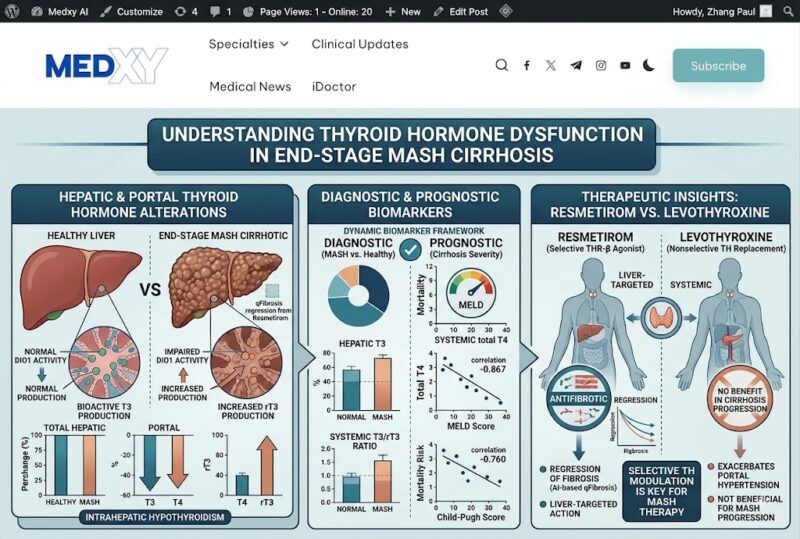
Liver, Portal, and Systemic Thyroid Hormone Alterations in End-Stage MASH: Distinct Diagnostic and Prognostic Roles for T3/rT3 Ratio and T4

Highlights

  • End-stage MASH cirrhosis demonstrates markedly reduced hepatic and systemic T3 and T4 with elevated systemic reverse T3 (rT3), indicating impaired hepatic deiodinase activity and intrahepatic hypothyroidism.
  • The hepatic T3 concentration and systemic T3/rT3 ratio robustly discriminate MASH from healthy liver, highlighting their complementary diagnostic value as functional biomarkers of thyroid hormone metabolism in MASH.
  • Within established cirrhosis, systemic total T4 correlates inversely with established severity scores (MELD and Child-Pugh), positioning T4 as a potent biomarker for disease progression and prognosis.
  • Therapeutic advances such as resmetirom, a selective thyroid hormone receptor β agonist, demonstrate antifibrotic efficacy in non-cirrhotic MASH; however, levothyroxine use in MASH shows no clear benefit in cirrhosis progression, suggesting the importance of selective TH modulation.

Background

Metabolic dysfunction-associated steatohepatitis (MASH), a progressive form of metabolic-associated steatotic liver disease (MASLD), represents a significant cause of liver cirrhosis and hepatocellular carcinoma worldwide. Thyroid hormones (TH) critically regulate hepatic metabolism and fibrosis pathways, primarily through hepatic type 1 deiodinase converting thyroxine (T4) to bioactive triiodothyronine (T3) and clearing reverse T3 (rT3), an inactive metabolite. Selective thyroid hormone receptor β (THR-β) agonists, such as resmetirom, have recently received FDA approval for MASH treatment, targeting liver-specific TH signaling to improve metabolic function and fibrosis. Understanding tissue and systemic alterations in TH homeostasis in end-stage MASH is vital to improve biomarker development and guide therapeutic interventions.

Key Content

Alterations in Thyroid Hormone Concentrations in End-Stage MASH

The pivotal study by Zhang et al. (2026) characterized liver, portal, and systemic plasma concentrations of total T3, T4, and rT3 in 12 patients with end-stage MASH cirrhosis undergoing transplantation compared to 12 healthy liver donors. Utilizing high-sensitivity liquid chromatography-tandem mass spectrometry, results revealed:

  • Significantly reduced total T3 and T4 across all compartments including hepatic tissue, portal, and systemic plasma.
  • Marked elevation of rT3 in portal and systemic plasma, indicative of impaired clearance due to compromised deiodinase activity.
  • Suppression of the T3/rT3 ratio by 65%–83%, reflecting decreased bioactive T3 generation and increased inactive rT3.

These findings provide direct tissue-level evidence supporting intrahepatic hypothyroidism, a pathogenic state in advanced MASH causing metabolic and fibrotic dysregulation.

Diagnostic and Prognostic Significance of TH Parameters

The study demonstrated that hepatic T3 holds the strongest discriminatory power for MASH presence (BMI-adjusted OR 0.009, p < 0.001), followed by the systemic T3/rT3 ratio (BMI-adjusted OR 0.045, p < 0.001). Within the cirrhotic MASH cohort, systemic T4 levels inversely correlated with model for end-stage liver disease (MELD) scores (r = -0.867, adjusted p = 0.005) and Child-Pugh scores (r = -0.760, adjusted p = 0.033), and independently predicted disease severity after adjustment for BMI (standardized β = -0.744, p = 0.004).
This delineates a complementary biomarker framework: hepatic T3 and T3/rT3 ratio reflect thyroid metabolic dysfunction for diagnosis, while systemic T4 serves as a dynamic indicator of cirrhosis progression and prognosis.

Resmetirom and Targeted THR-β Agonists in MASH Therapy

Emerging evidence from the large phase III MAESTRO-NASH trial (PMID: 41895606) illuminates the therapeutic efficacy of resmetirom, a liver-targeted THR-β agonist. Resmetirom improved metabolic and histologic outcomes in non-cirrhotic MASH, including significant regression of fibrosis quantified by advanced AI-based qFibrosis digital pathology. Notably, collagen features, especially within the portal tracts and Zone 2 regions, declined with treatment, underscoring the antifibrotic effects mediated via hepatic thyroid hormone pathways.
The trial’s findings elucidate molecular mechanisms whereby selective liver THR-β activation reverses fibrogenesis and metabolic dysfunction, distinct from systemic thyroid hormone replacement.

Levothyroxine and Cirrhosis Progression in MASH

Conversely, retrospective real-world data from a large matched cohort (PMID: 40884700) evaluating levothyroxine use—a nonselective THR-α/β agonist—in MASH patients revealed no significant reduction in progression to cirrhosis. Moreover, levothyroxine-treated cirrhosis patients manifested a slight but statistically significant increase in portal hypertensive complications.
These findings highlight the nuanced roles of TH signaling in MASH and suggest that nonselective thyroid hormone replacement may not confer benefits in advanced disease stages, emphasizing the need for targeted hepatic THR-β modulation.

Expert Commentary

The integrated evidence underscores a paradigm in which intrahepatic thyroid hormone metabolism is profoundly disrupted in end-stage MASH, manifesting as intrahepatic hypothyroidism. Quantification of hepatic T3 and systemic T3/rT3 ratio offers robust diagnostic utility, reflecting diminished hepatic deiodinase activity and bioactive hormone availability. Systemic T4 serves as a prognostic biomarker correlating strongly with cirrhosis severity indices.
From a therapeutic standpoint, these findings rationalize the clinical application of selective THR-β agonists like resmetirom, which act directly on hepatic receptors to restore metabolic homeostasis and counter fibrosis progression with demonstrable histologic and clinical benefit. This contrasts with conventional levothyroxine therapy, whose nonselective receptor activity may inadvertently exacerbate portal hypertension complications without halting cirrhosis progression.
Mechanistically, diminished hepatic T3 and increased rT3 levels suggest enzyme isoform dysfunction (particularly decreased DIO1 activity), which may drive metabolic impairment and fibrogenesis by reducing T3-mediated transcriptional regulation of lipid and glucose metabolism and fibrotic pathways.
Future clinical guidelines for MASH management should incorporate TH metabolism assessment as a tool for diagnosis, monitoring, and guiding therapy.

Conclusion

End-stage MASH is characterized by distinctive thyroid hormone alterations across liver and circulatory compartments, evidenced by reduced hepatic T3, increased rT3, and suppressed T3/rT3 ratios, hallmarks of impaired hepatic thyroid hormone metabolism. Hepatic T3 and systemic T3/rT3 ratio emerge as sensitive diagnostic biomarkers, while systemic T4 corresponds with disease severity and prognosis in cirrhotic MASH.
Clinical trials affirm that selective thyroid hormone receptor β agonists like resmetirom effectively modulate hepatic thyroid hormone signaling to improve fibrosis and metabolic dysfunction, offering a mechanistically targeted therapeutic avenue superior to nonselective thyroid hormone replacement.
These integrated insights emphasize the critical role of thyroid hormone metabolism in MASH pathogenesis, diagnosis, and treatment, informing biomarker development and personalized therapeutic strategies.

References

  • Zhang X et al. Liver, Portal, and Systemic Thyroid Hormone Concentrations in End-Stage MASH Reveal Distinct Roles for T3/rT3 Ratio and T4. Thyroid. 2026 Aug 6;10507256261476458. PMID: 42558035. https://pubmed.ncbi.nlm.nih.gov/42558035/
  • Finlay M et al. Quantitative regression of qFibrosis with resmetirom: Exploratory histologic endpoints from the MAESTRO-NASH phase III clinical trial. J Hepatol. 2026 Aug;85(2):202-211. doi:10.1016/j.jhep.2026.03.021. PMID: 41895606. https://pubmed.ncbi.nlm.nih.gov/41895606/
  • Patel D et al. Impact of Levothyroxine on Progression to and Complications of Cirrhosis in MASH. Dig Dis Sci. 2025 Oct;70(10):3538-3545. doi:10.1007/s10620-025-09375-3. PMID: 40884700. https://pubmed.ncbi.nlm.nih.gov/40884700/

Comments

No comments yet. Why don’t you start the discussion?

Leave a Reply