Highlight
- Childhood famine exposure initially appears associated with higher risk of edentulism in late life, but this is confounded by age differences between cohorts.
- Analyses using advanced causal inference methods across 10 studies and 8 countries show no causal relationship between famine exposure in childhood and tooth loss decades later.
- The study underscores the critical importance of adjusting for birth-cohort age gradients when evaluating long-term health effects of early-life exposures.
- Natural experiments using historical famines provide valuable but methodologically challenging insights into long-term oral health outcomes.
Study Background
Late-life edentulism, the complete loss of natural teeth, significantly impacts quality of life, nutrition, and general health among older adults worldwide. Identifying modifiable risk factors that contribute to tooth loss remains a key public health goal. Early-life nutritional deficits, such as those caused by famine, have been hypothesized to influence oral health decades later due to effects on tooth development, immune function, and susceptibility to chronic diseases that compromise oral health. However, evidence linking childhood famine exposure and edentulism in old age is scarce and methodologically confounded by age and birth cohort effects. This study sought to clarify whether childhood exposure to famine independently increases the risk of late-life edentulism using robust analytic methods leveraging natural experimental settings across multiple continents.Study Design
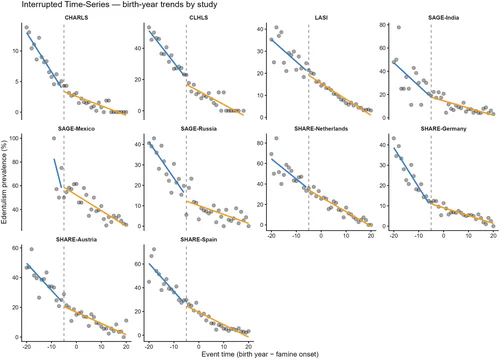
This large-scale investigation pooled data from 10 population-based cohorts spanning eight countries across Asia, Europe, and America, including 165,586 participants aged predominantly in older adulthood. Researchers exploited historical famines as natural, exogenous shock events that affected nutrition unpredictably in defined birth cohorts and regions. Since famine-exposed cohorts were by definition older than comparison groups, analytic methods were designed to disentangle the effects of famine exposure from age-related risk gradients. Key methods included: – Regression discontinuity in time analyses leveraging birthdate cutoffs around famine periods. – Interrupted time series approaches examining trends before, during, and after famine onset. – Difference-in-differences methods comparing variations across regions with differing famine severity within cohorts. – Use of negative control groups (cohorts born before famine) to confirm specificity of associations. The main outcome was edentulism status ascertained in late adulthood, with risk ratios (RR) calculated to quantify associations. Adjustment for confounders, particularly current age, was a central analytic step to address cohort ageing effects.Key Findings
Initial crude analyses found a substantial positive association between childhood famine exposure and edentulism risk (RR 1.69), suggesting those exposed had a 69% higher risk compared to unexposed peers. However, after adjustment for current age, this association effectively disappeared (RR 1.07; 95% confidence interval 0.92-1.23), indicating no significant increased risk attributable to famine itself. Further supporting this conclusion: – The famine cohort’s risk of edentulism was not different from the older, pre-famine birth cohort (RR 0.97). – Regression discontinuity analyses showed a negligible point increase of +0.13% (95% CI from -1.50 to +1.77) in edentulism risk at famine birthdate thresholds. – Interrupted time series revealed a non-significant negative trend (-4.01% points, p=0.15). – Region-of-birth difference-in-differences analyses in two Chinese cohorts were not statistically significant (both p≥0.07) despite unadjusted trends. – Negative control comparisons provided no evidence that famine exposure predicted late-life edentulism beyond age effects. These consistent null findings across multiple sophisticated natural experimental methods underscore that the apparent crude association is largely explained by the older age of famine-exposed cohorts rather than famine exposure per se.Expert Commentary
This extensive multinational analysis effectively addresses a critical methodological challenge in life-course epidemiology — separating exposure effects from age and cohort confounding. The use of natural famines as quasi-experimental settings is innovative but can be hampered by the overlapping influence of temporal aging effects. By applying complementary analytic strategies and negative controls, the authors convincingly demonstrate the absence of a causal relationship between childhood famine and edentulism risk. While early-life nutrition undeniably influences health trajectories, this study suggests that the direct impact on tooth retention into old age is minimal or undetectable when rigorously accounting for age. This finding may reflect the multifactorial nature of edentulism, where later-life behaviors (oral hygiene, dental care access), systemic diseases, and socioeconomic factors are more determinant. A limitation is the reliance on pooled observational data, which may have incomplete individual-level risk factor details. Additionally, the severity and duration of famines varied, possibly obscuring effects in less extreme contexts. Nonetheless, the findings provide important guidance for focusing preventive efforts on more proximal influences on oral health in aging populations.Conclusion
After carefully controlling for birth-cohort age gradients, childhood famine exposure does not appear to increase the risk of edentulism in late life. The previously reported positive associations are largely artifacts of confounding due to the older age of famine-exposed individuals in cross-sectional studies. This study highlights the necessity of rigorous methodological approaches when examining long-term outcomes of early-life exposures. Future research should continue to elucidate modifiable determinants of oral health decline in aging, emphasizing factors beyond early-life nutritional insults.Funding and Registration
The analysis was conducted without specific external funding disclosures. No clinical trials were registered as this study synthesized data from observational cohorts leveraging historical events.References
1. Baumeister SE, McGrath C, Kocher T, Nascimento GG. Childhood Famine Exposure and Late-Life Edentulism: Evidence From Natural Experiments. J Clin Periodontol. 2026;53(11):1673-1680. doi:10.1111/jcpe.14063 2. Sheiham A. Tooth Loss and Oral Health-Related Quality of Life. In: Oral Health and Disease in America. 2020. 3. Barker DJP. The developmental origins of adult disease. J Am Coll Nutr. 2004;23(6 Suppl):588S-595S. 4. Lumey LH, Stein AD, Susser E. Prenatal famine and adult health. Annu Rev Public Health. 2011;32:237-62. 5. Petersen PE, Bourgeois D, Ogawa H, Estupinan-Day S, Ndiaye C. The global burden of oral diseases and risks to oral health. Bull World Health Organ. 2005;83(9):661-9.Specialty calculators
For clinical reference; use professional judgment.