Introduction
Colon cancer remains a major global health challenge, with various subtypes impacting treatment decisions and outcomes. Among these, mismatch repair-deficient (dMMR) colon cancer, characterized by defects in the DNA repair system, is notable for its unique biology and response to immunotherapy. The advent of immune checkpoint inhibitors has revolutionized cancer treatment, prompting investigation into their role not only after surgery but also before — termed neoadjuvant therapy. This article explores the pivotal NICHE-2 trial conducted in the Netherlands, which investigates the long-term survival benefits of neoadjuvant immunotherapy in patients with locally advanced dMMR colon cancer.Understanding dMMR Colon Cancer and Immunotherapy
Mismatch repair deficiency (dMMR) is a genetic alteration in colon cancer cells that impairs their ability to correct DNA replication errors. This leads to a high mutational burden, rendering tumors more visible to the immune system and potentially more responsive to immunotherapy. Immune checkpoint inhibitors, such as ipilimumab and nivolumab, work by blocking the proteins that allow cancer cells to evade immune destruction, reinvigorating the body’s ability to fight tumor cells. Neoadjuvant immunotherapy involves administering these agents prior to surgical removal of the tumor. The rationale is that exposing the immune system to the intact tumor may elicit a stronger and more effective anti-tumor immune response, potentially improving outcomes.The NICHE-2 Trial: Design and Methods
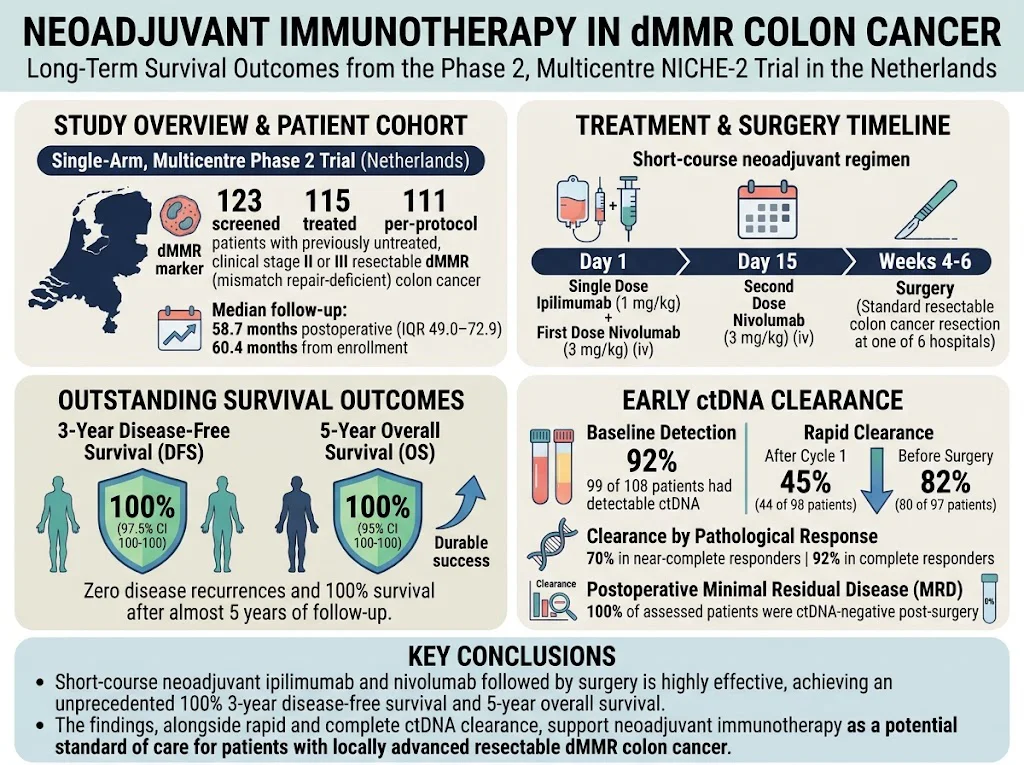
The NICHE-2 trial was a phase 2, single-arm, multicenter study conducted at six hospitals in the Netherlands. It enrolled 115 adult patients diagnosed with clinical stage 2 or 3, resectable dMMR colon cancer who had not received prior treatment. Participants received an immunotherapy regimen consisting of a single intravenous dose of ipilimumab followed by two doses of nivolumab, administered over two weeks. Surgery was then performed to remove the tumor. The study’s primary focus was safety and pathological response, but crucially, NICHE-2 also measured long-term efficacy through three-year disease-free survival and exploratory five-year overall survival rates. Researchers also measured circulating tumor DNA (ctDNA) before and after immunotherapy and after surgery. The presence of ctDNA in the blood is a sensitive marker for minimal residual disease and a predictor of recurrence risk.Key Findings: Exceptional Survival Outcomes
Out of 123 patients screened, 111 were included in the main analysis. After a median follow-up of nearly five years post-surgery, the trial reported remarkable outcomes: – Three-year disease-free survival was 100%, meaning no patients experienced recurrence or death due to cancer during this period. – Five-year overall survival was also 100%, suggesting sustained long-term benefit. Correspondingly, ctDNA analysis revealed: – ctDNA was detectable in 92% of patients before treatment. – Clearance of ctDNA occurred in 45% of patients after the first immunotherapy cycle and in 82% after the second cycle, before surgery. – Patients who showed complete or near-complete pathological response had higher rates of ctDNA clearance. – Post-surgery, all patients tested negative for ctDNA, indicating absence of detectable residual disease.Clinical Implications: Toward a New Standard of Care
These findings provide robust evidence supporting the use of neoadjuvant dual checkpoint blockade in resectable dMMR colon cancer. Traditionally, treatment involved surgery followed by adjuvant chemotherapy, which often carries substantial side effects without guaranteed benefit in this subgroup. Immunotherapy before surgery not only appears safe but also highly effective at eradicating microscopic disease and preventing recurrence. Furthermore, the use of ctDNA as a biomarker for treatment response and minimal residual disease offers a promising tool for personalized patient management. For clinicians, these results may herald a shift toward adopting neoadjuvant immunotherapy as a standard option for eligible dMMR colon cancer patients. For researchers, this opens the door to exploring combination strategies, optimizing dosing, and extending similar approaches to other tumor types.Case Illustration: John’s Journey
John, a 62-year-old man diagnosed with stage 3 dMMR colon cancer, was enrolled in the NICHE-2 trial. He received a single dose of ipilimumab and two doses of nivolumab pre-surgery. His ctDNA levels, initially high, cleared completely after immunotherapy. Surgery revealed a near-complete pathological response with no viable tumor cells left. Five years later, John remains cancer-free and enjoys a high quality of life without the toxicities often associated with chemotherapy.Expert Perspectives
Dr. Emilie Wagner, an oncologist not involved in NICHE-2, comments, “The 100% disease-free and overall survival reported by NICHE-2 is unprecedented in this patient population. The ability to safely integrate immunotherapy before surgery marks a paradigm shift. Future studies will determine how broadly this can be applied.” Dr. Marcel Chalabi, lead investigator of NICHE-2, notes, “Our data emphasize the potency of harnessing the immune system early and robustly. The challenge remains to ensure access, monitor resistance, and refine treatment duration.”Conclusion
The NICHE-2 trial represents a major breakthrough in managing locally advanced dMMR colon cancer. Neoadjuvant immunotherapy with ipilimumab and nivolumab leads to outstanding three-year disease-free and five-year overall survival, underscoring its potential to become a new standard of care. The integration of ctDNA monitoring further enhances personalized cancer therapy. As our understanding of tumor immunology deepens, patients like John may increasingly benefit from treatments that offer durable remission with fewer side effects.Funding and Clinical Trial Registration
The NICHE-2 trial was funded by Bristol Myers Squibb and is registered at ClinicalTrials.gov under identifier NCT03026140.References
1. Chalabi M, van den Dungen LDW, de Gooyer PGM, et al. Disease-free survival and overall survival after neoadjuvant immunotherapy in mismatch repair-deficient colon cancer in the Netherlands: results of the single-arm, multicentre, phase 2, NICHE-2 trial. Lancet. 2026 Oct 21;408(10566):1839-1849. doi:10.1016/S0140-6736(26)32341-9. PMID: 42906564. 2. Le DT, Durham JN, Smith KN, et al. Mismatch repair deficiency predicts response of solid tumors to PD-1 blockade. Science. 2017 Jul 28;357(6349):409-413. doi:10.1126/science.aan6733. 3. Overman MJ, Lonardi S, Wong KYM, et al. Durable Clinical Benefit with Nivolumab Plus Ipilimumab in DNA Mismatch Repair-Deficient/Microsatellite Instability-High Metastatic Colorectal Cancer. J Clin Oncol. 2018 May 10;36(15):773-779. doi:10.1200/JCO.2017.77.0412. — End of Article —Specialty calculators
For clinical reference; use professional judgment.