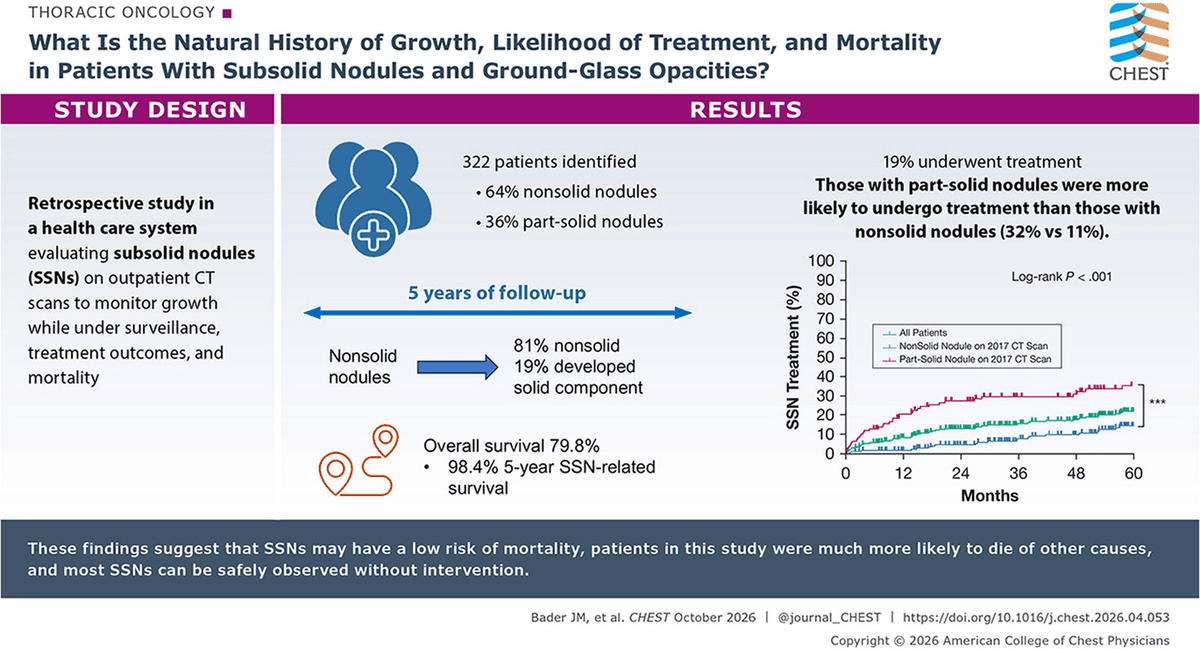
亚实性结节及磨玻璃结节患者的自然病程、治疗、生存情况及死亡原因:一项全面的临床综述

Natural History, Treatment, Survival, and Causes of Mortality in Patients With Subsolid and Ground-Glass Nodules: A Comprehensive Clinical Review

This review synthesizes current evidence on subsolid nodules (SSNs) and ground-glass opacities (GGOs), focusing on their natural history, treatment strategies including ablation and surgery, survival outcomes, and mortality causes. It highlights the safe observational approach for many SSNs and explores emerging minimally invasive treatments.
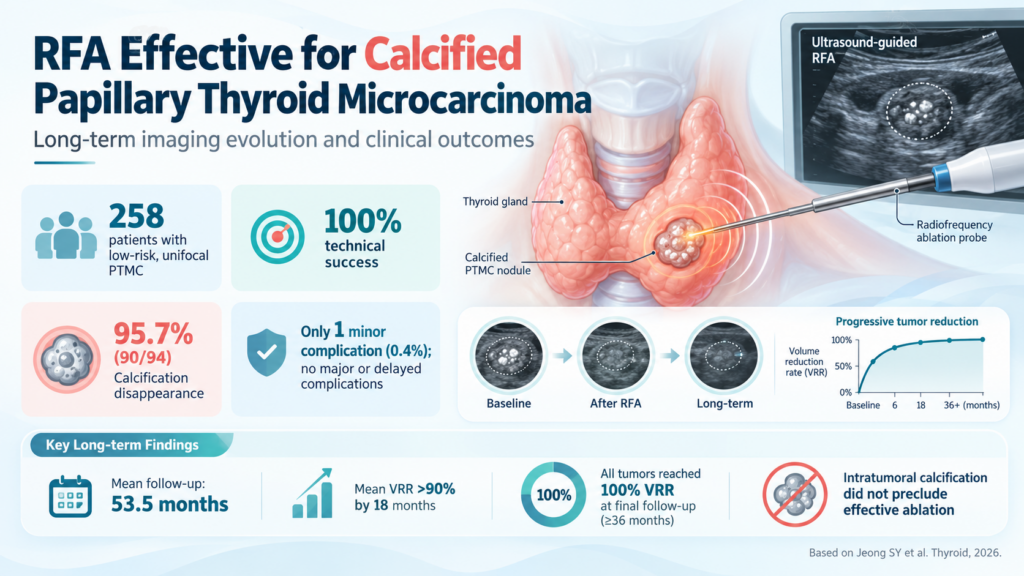
射频消融治疗钙化性乳头状甲状腺微小癌:长期疗效与钙化演变

Long-Term Outcomes and Calcification Dynamics After Radiofrequency Ablation of Calcified Papillary Thyroid Microcarcinomas

This retrospective study demonstrates that radiofrequency ablation (RFA) effectively treats low-risk papillary thyroid microcarcinomas (PTMC), including those with intratumoral calcifications, with excellent technical success, significant tumor volume reduction, and minimal complications over long-term follow-up.
Higher Stroke and TIA Risk With Pulsed Field Ablation Compared to Radiofrequency Ablation in Atrial Fibrillation: Insights From a Large Prospective Registry

Higher Stroke and TIA Risk With Pulsed Field Ablation Compared to Radiofrequency Ablation in Atrial Fibrillation: Insights From a Large Prospective Registry

This prospective registry reveals a significantly increased risk of stroke or transient ischemic attack within 30 days after pulsed field ablation compared to radiofrequency ablation for atrial fibrillation, highlighting important safety considerations and the need for careful surveillance.
Economic Evaluation of Thyroid Radiofrequency Ablation Versus Hemithyroidectomy: A Micro-Costing Perspective in Canadian Healthcare Settings

Economic Evaluation of Thyroid Radiofrequency Ablation Versus Hemithyroidectomy: A Micro-Costing Perspective in Canadian Healthcare Settings

This study quantitatively compares the direct healthcare costs of thyroid radiofrequency ablation (RFA) and hemithyroidectomy over one year, revealing cost advantages of RFA driven by reduced facility use, tempered by factors like repeat procedures and potential delayed surgeries.