Highlight
The PROSpect trial, an international, randomized controlled study, investigated the effectiveness of prone positioning and high-frequency oscillatory ventilation (HFOV) versus conventional mechanical ventilation in children with early moderate-to-severe pediatric acute respiratory distress syndrome (PARDS). Neither prone positioning nor HFOV improved ventilator-free days compared to their respective controls. The study also reported higher rates of airway obstruction and pressure injuries with prone positioning and increased hemodynamic instability with HFOV. These findings advise against the routine first-line use of these interventions for pediatric PARDS.
Study Background
Pediatric acute respiratory distress syndrome (PARDS) is a serious condition characterized by widespread inflammation of the lungs leading to severe respiratory failure in children. It has significant mortality and morbidity, requiring intensive care with mechanical ventilation. Despite advances, optimal ventilation strategies remain debated, particularly concerning the role of prone positioning and HFOV. Adult studies suggest prone positioning can improve oxygenation and outcomes in ARDS, but pediatric data are inconclusive. Similarly, HFOV, which delivers very small tidal volumes at high frequencies, has been proposed to reduce ventilator-induced lung injury but with uncertain benefits in children. Variability in clinical practice reflects the lack of definitive evidence.
Study Design
The PROSpect trial was a rigorous, two-by-two factorial, response-adaptive, phase 3, randomized controlled trial performed across 75 pediatric intensive care units in 18 countries. It enrolled 424 children aged 2 weeks to 20 years with moderate-to-severe PARDS who had been intubated for less than 96 hours. Patients were randomized into four groups: supine position with conventional ventilation, prone position with conventional ventilation, supine position with HFOV, and prone position with HFOV. Randomization was stratified by age and type of lung injury (direct vs indirect). Masking was not feasible due to the nature of interventions. The primary endpoint was ventilator-free days within 28 days after enrollment. Safety outcomes included monitoring for airway complications, pressure injuries, and hemodynamic instability.
Key Findings
Enrollment was terminated early after recruiting 424 of the planned 600 patients due to futility and slow recruitment. The median age of participants was 3.3 years, evenly split by sex. The main results were:
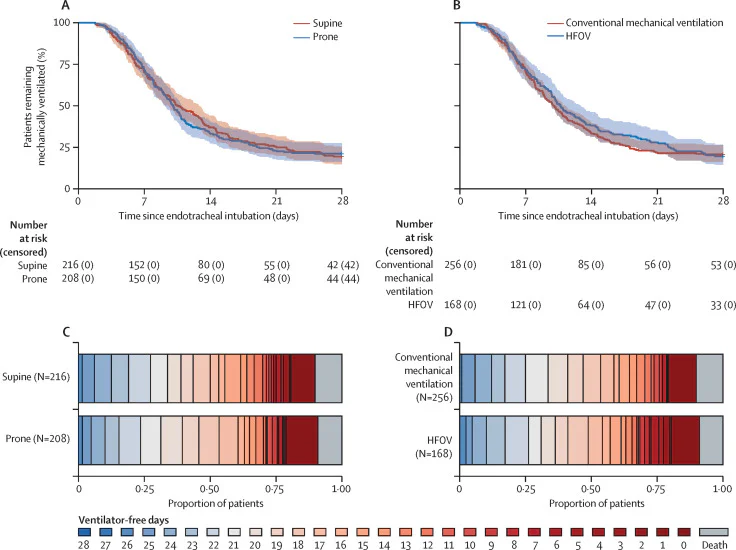
- No significant difference in ventilator-free days between prone and supine positioning groups (median 17.9 days vs 17.4 days, adjusted median difference 0.0 days).
- No significant difference in ventilator-free days between HFOV and conventional ventilation groups (17.3 days vs 18.0 days, adjusted median difference -0.3 days).
- Similar 28-day mortality rates across groups, at approximately 10%.
- Safety concerns were notable: prone positioning was associated with higher rates of airway plugging or obstruction (6% vs 2%) and stage 2 or worse pressure injuries (6% vs 1%) compared to supine positioning.
- HFOV was linked to more frequent hemodynamic instability events compared to conventional ventilation (13% vs 9%).
- One serious adverse event was reported in the prone and conventional ventilation group – a self-extubation leading to cardiopulmonary arrest.
These results indicate that neither intervention yielded clinically meaningful benefits in reducing ventilator dependency or mortality, while both carried specific risks that could adversely affect patient safety.
Expert Commentary
The PROSpect trial provides the most comprehensive pediatric data to date evaluating prone positioning and HFOV as initial strategies in moderate-to-severe PARDS. Its robust design, multicenter international scope, and response-adaptive randomization strengthen the credibility of findings, although early termination limited statistical power. Prior smaller trials and observational studies suggested potential oxygenation benefits with prone positioning but inconsistent survival benefit; this large trial aligns with more cautious recommendations pending further evidence.
HFOV’s lack of advantage echoes prior adult trials, including OSCAR and OSCILLATE, which failed to demonstrate mortality benefit and highlighted hemodynamic risks. Pediatric patients might be particularly vulnerable to HFOV-related instability. The increased airway complications and pressure injuries with prone positioning highlight the need for meticulous airway and skin care if this strategy is used.
Limitations include the unblinded design, potential variable adherence to protocols across centers, and early trial cessation impacting subgroup analyses. Despite this, the neutral findings call into question the widespread routine application of these interventions as first-line therapy in pediatric ARDS.
Conclusion
The PROSpect trial’s evidence does not support routine use of prone positioning or high-frequency oscillatory ventilation as initial strategies to improve ventilator-free days or survival in children with early, moderate-to-severe PARDS. Safety concerns related to airway complications, pressure injuries, and hemodynamic instability further temper enthusiasm for their widespread adoption. Clinicians should consider these results in the context of individual patient scenarios and continue adhering to lung-protective conventional ventilation as the cornerstone of PARDS management.
Future research should explore tailored approaches, including the timing, duration, and patient selection for prone positioning and HFOV, as well as alternative adjunctive therapies to optimize outcomes in this vulnerable population.
Funding and Registration
This study was funded by the US National Institutes of Health/National Heart, Lung, and Blood Institute. It is registered at ClinicalTrials.gov under the identifier NCT03896763.
References
1. Curley MAQ, Kneyber MCJ, Cheifetz IM, et al. Prone positioning and high-frequency oscillatory ventilation in early paediatric acute respiratory distress syndrome (PROSpect): an international, two-by-two factorial, response-adaptive, phase 3, randomised controlled trial. Lancet. 2026;408(10566):1815-1827. doi:10.1016/S0140-6736(26)31592-3
2. Guérin C, Reignier J, Richard JC, et al. Prone positioning in severe acute respiratory distress syndrome. N Engl J Med. 2013;368(23):2159-2168.
3. Young D, Lamb SE, Shah S, et al. High-frequency oscillation for acute respiratory distress syndrome. N Engl J Med. 2013;368(9):795-805.
4. Pediatric Acute Lung Injury Consensus Conference Group. Pediatric acute respiratory distress syndrome: consensus recommendations from the Pediatric Acute Lung Injury Consensus Conference. Pediatr Crit Care Med. 2015;16(5):428-439.
Specialty calculators
For clinical reference; use professional judgment.