Highlight
- Chitosan sponge application significantly improves early palatal donor-site healing compared to gelatine sponge.
- Injectable platelet-rich fibrin (i-PRF) enrichment of chitosan further enhances patient comfort by reducing postoperative pain and burning sensation.
- Both chitosan-based treatments show superior color match during healing, indicating better tissue integration and aesthetics.
- Bleeding incidence and analgesic consumption remain similar across treatment modalities, underscoring safety.
Study Background
Free gingival graft harvesting techniques commonly use the palatal mucosa as a donor site. However, palatal donor-site morbidity, including pain, delayed healing, and discomfort, poses significant challenges affecting patient quality of life and clinical outcomes. Traditional absorbable materials such as gelatine sponges are used to protect the wound and promote healing but may have limitations in accelerating tissue regeneration and improving patient-reported outcomes.
Novel biomaterials including chitosan sponges have emerged due to their biocompatibility, hemostatic capacity, antimicrobial properties, and potential to enhance wound healing. Injectable platelet-rich fibrin (i-PRF), a concentrate of autologous growth factors, further promotes tissue regeneration by stimulating angiogenesis and cellular proliferation. The combination of chitosan with i-PRF could synergistically optimize palatal wound healing and patient comfort, yet direct comparative clinical evidence remains scarce.
Study Design
This three-arm randomized controlled clinical trial evaluated the efficacy and patient-reported outcomes of three interventions applied to palatal donor sites following free gingival graft harvesting.
- Population: Sixty-eight patients (n=68) undergoing free gingival grafts were randomized into three groups.
- Interventions:
• Control group (n=23): absorbable gelatine sponge application.
• Chitosan group (n=23): chitosan sponge application.
• i-PRF + chitosan group (n=22): injectable platelet-rich fibrin enriched chitosan sponge application. - Primary Outcome: Palatal Early Healing Index (PEHI), assessing epithelialization and wound healing status.
- Secondary Outcomes: Patient-reported outcome measures (PROMs): postoperative pain, burning sensation, change in dietary habits; bleeding occurrence; analgesic consumption; and color match assessed by visual analogue scales (VAS).
- Follow-up: Data collected at postoperative days 3, 7, 14, 28, and 56.
Key Findings
The study revealed significant advantages of chitosan-containing treatments over the gelatine sponge control in terms of palatal wound healing and patient comfort.
Palatal Early Healing Index
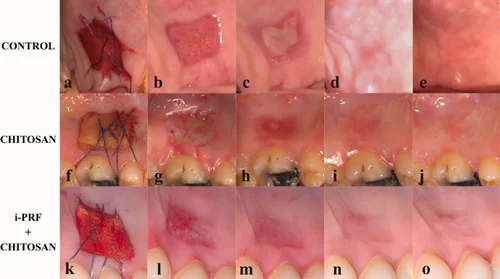
Both chitosan groups demonstrated superior PEHI scores indicating accelerated wound healing particularly on days 14 and 28. Median PEHI scores at day 14 were 8.0 for gelatine sponge, 8.0 for chitosan, and notably higher at 9.0 for i-PRF enriched chitosan. Statistical testing confirmed these differences were significant (p < 0.001), reflecting enhanced epithelialization and wound closure.
Patient-Reported Outcomes
Patients treated with i-PRF + chitosan reported significantly lower pain and burning sensation in the early postoperative period (days 3 and 7) compared to both chitosan alone and control groups (p < 0.05). Additionally, this group experienced less alteration in dietary habits indicative of improved comfort and functional recovery.
Bleeding and Painkiller Consumption
No significant differences among groups were observed in terms of postoperative bleeding episodes or analgesic use, suggesting that all interventions maintained acceptable safety profiles with comparable hemostasis.
Color Match
Visual assessment found significantly better color match with surrounding tissue in both chitosan groups compared to gelatine sponge at days 14, 28, and 56 (p < 0.001). This finding implies improved tissue integration and aesthetic outcomes, important for patients’ perception of recovery.
Expert Commentary
The findings align with the known biological properties of chitosan, which promotes hemostasis, exhibits antimicrobial activity, and supports fibroblast proliferation and collagen synthesis — all critical for mucosal wound healing. The addition of i-PRF likely provides concentrated growth factors such as platelet-derived growth factor (PDGF), transforming growth factor beta (TGF-β), and vascular endothelial growth factor (VEGF), which collectively accelerate tissue regeneration and modulate inflammation, corroborating the reported improvements in early healing and reduced patient discomfort.
Nevertheless, limitations inherent to the clinical parameters assessed suggest the need for histological and biomolecular studies to elucidate mechanistic pathways and long-term effects. Furthermore, the relatively small sample size and single-center nature may influence generalizability. Future multi-center trials with standardized histopathological analysis would strengthen evidence supporting the clinical use of chitosan and i-PRF-enriched sponges.
Conclusion
This randomized controlled trial provides compelling evidence that chitosan-based sponges, particularly when enriched with injectable platelet-rich fibrin, substantially improve early palatal donor-site healing and patient-reported comfort after free gingival graft harvesting compared to conventional gelatine sponges. Enhanced color match further supports favorable esthetic outcomes. These findings hold promise for advancing biomaterial applications in oral surgery to reduce morbidity and optimize patient recovery. Further investigations incorporating molecular and histological assessments are warranted to confirm these results and guide clinical translation.
Funding and Clinical Trials Registration
The original publication does not specify funding sources or clinical trial registry identifiers. Future reports should articulate these details to enhance transparency and reproducibility.
References
- Selman AE, Alkaya B, Karaduman B, Ozcan M, Haytac MC. Palatal Donor-Site Healing and Patient-Reported Outcome Measures Following Chitosan and Injectable Platelet-Rich Fibrin-Enriched Chitosan Application Compared with Gelatine Sponge: A Three-Arm Randomised Controlled Clinical Trial. J Clin Periodontol. 2026;53(11):1702-1711. PMID: 42634356.
- Dash M, Chiellini F, Ottenbrite RM, Chiellini E. Chitosan—A versatile semi-synthetic polymer in biomedical applications. Prog Polym Sci. 2011;36(8):981-1014.
- Miron RJ, Fujioka-Kobayashi M, Bishara M, Zhang Y, Hernandez M, Feng M, et al. Injectable Platelet Rich Fibrin (i-PRF): Opportunities in Regenerative Dentistry? Clin Oral Investig. 2017;21(8):2619-2627.
- Del Canto-Díaz C, García-Sesnich J, Miron RJ, Bascones-Martínez A, Bascones A. Platelet-Rich Fibrin and Periodontal Regeneration: A Systematic Review. Front Bioeng Biotechnol. 2021;9:803043.
- Cai L, Wen H, Liu X, Yang Z, Xiao A, Tao Y, et al. Chitosan-based biomaterials in bone tissue engineering. Biotech Adv. 2020;39:107502.
Specialty calculators
For clinical reference; use professional judgment.