Highlight
- Radiofrequency ablation (RFA) achieves complete tumor disappearance in 89.7% of low-risk papillary thyroid cancers (PTC) in Latin American patients, rising to 100% with follow-up beyond 36 months.
- Low complication rate (2.4%), all transient dysphonia, confirms safety of RFA.
- Tumors larger than 10 mm are associated with lower likelihood of complete ablation; T1b tumors warrant further study.
- Higher operator volume correlates with better treatment outcomes, suggesting importance of experience.
Study Background
Papillary thyroid cancer (PTC) is the most common thyroid malignancy, frequently presenting as low-risk disease with excellent prognosis. Traditional management options for T1N0M0 low-risk PTC include surgical resection or active surveillance. However, surgery, although curative, may lead to complications such as recurrent laryngeal nerve injury or hypothyroidism, while active surveillance may cause patient anxiety or noncompliance. Thermal ablation, particularly ultrasound-guided radiofrequency ablation (RFA), has emerged internationally as a minimally invasive alternative with promising efficacy and safety profiles. Yet, evidence in Latin American populations is limited due to regional disparities in healthcare infrastructure and research. This multicenter study conducted by the Latin American Interventional Thyroidology Association (LAITA) evaluates early outcomes of RFA for low-risk PTC across six Latin American countries, aiming to fill this knowledge gap and guide clinical decision making.
Study Design
This retrospective cohort study included 251 patients harboring 252 papillary thyroid tumors (T1N0M0, ≤ 2 cm) treated with ultrasound-guided RFA at 12 centers in six Latin American countries between January 2019 and June 2025. Inclusion criteria focused on low-risk disease: intrathyroidal tumors without nodal involvement or distant metastases. Primary endpoints were: complete tumor disappearance verified by ultrasound and/or imaging, disease progression including persistence or recurrence, and treatment-related complications. Patient demographics, tumor characteristics, and operator experience were documented. The study stratified results by tumor size, follow-up duration, and operator procedure volume to assess factors influencing outcomes.
Key Findings
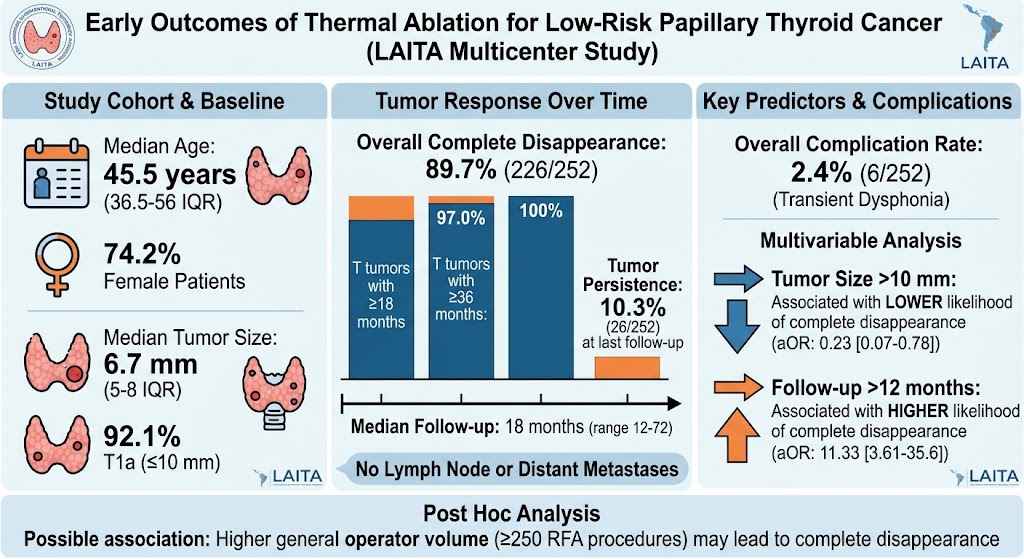
The median age of patients was 45.5 years with a strong female predominance (74.2%). Tumor median size was 6.7 mm; notably, 92.1% of tumors were T1a (≤10 mm). Over a median follow-up of 18 months (IQR 12-24 months, range 12-72 months), complete tumor disappearance was observed in 89.7% of cases (226/252). When stratified by follow-up duration, disappearance rates improved significantly: 97.0% for tumors followed ≥18 months and 100% for those ≥36 months, indicating persistent efficacy over time.
Tumor persistence was documented in 10.3% (26/252) with no evidence of lymph node or distant metastases, underscoring the low risk of disease progression within this timeframe. The overall complication rate was notably low at 2.4%, comprising exclusively transient dysphonia that resolved without long-term consequences.
Multivariable logistic regression identified tumor size >10 mm as independently associated with reduced odds of complete tumor disappearance (adjusted OR 0.23, 95% CI 0.07–0.78), whereas follow-up exceeding 12 months significantly increased likelihood of success (adjusted OR 11.33, 95% CI 3.61–35.6). Furthermore, a supplementary post hoc analysis suggested that operators with higher procedural volume (≥250 RFA procedures) achieved superior complete ablation rates, implicating expertise as a key factor.
Expert Commentary
These results confirm that ultrasound-guided RFA offers a minimally invasive, safe, and effective therapeutic option for low-risk T1a PTC patients in Latin America, with outcomes paralleling international data from Asian and European cohorts. The findings align with current American Thyroid Association (ATA) and European Thyroid Association (ETA) guidelines endorsing thermal ablation as an alternative to surgery or surveillance in selected cases. The low complication profile particularly benefits patients seeking to avoid surgery’s risks.
However, the study highlights important limitations in treating larger tumors (T1b, >10 mm), which demonstrated lower complete disappearance rates and require validation in prospective trials. Moreover, operator experience emerges as critical, advocating for centralized training and credentialing to optimize outcomes.
Some limitations warrant mention: the retrospective design and variable follow-up durations may bias long-term efficacy assessment. Additionally, lack of randomization and comparator arms (surgery or active surveillance) limit direct efficacy comparisons. Histopathologic confirmation post-ablation was also not routinely performed, although imaging follow-up was robust.
Conclusion
This multicenter Latin American study provides compelling evidence that radiofrequency ablation is an effective and safe minimally invasive alternative for T1a low-risk papillary thyroid cancers, with high rates of complete tumor disappearance and minimal adverse events. Tumors larger than 10 mm remain a therapeutic challenge, underscoring the need for carefully designed clinical trials before wider adoption in these cases. Operator experience positively impacts outcomes, underscoring the importance of training and volume standards. These findings support incorporation of thermal ablation into the therapeutic armamentarium for selected patients with low-risk PTC in Latin America, potentially reducing surgical morbidity while maintaining excellent oncologic control.
Funding and Clinical Trials Registration
The retrospective nature of the study did not specify dedicated funding. Future prospective and randomized clinical trials in this population are encouraged to firmly establish the role of thermal ablation in low-risk thyroid cancer management.
References
1. Dueñas JP, Buitrago-Gómez N, Rahal A, et al. Early Outcomes of Thermal Ablation for Low-Risk Papillary Thyroid Cancer: A Multicenter Study from Latin American Interventional Thyroidology Association (LAITA). Thyroid. 2026 Aug 6; [Epub ahead of print]. PMID: 42558025.
2. Haugen BR, et al. 2015 American Thyroid Association Management Guidelines for Adult Patients with Thyroid Nodules and Differentiated Thyroid Cancer. Thyroid. 2016 Jan;26(1):1-133.
3. Kim JH, Rhim H, Tae K, et al. Radiofrequency ablation for the treatment of low-risk papillary thyroid microcarcinoma: four-year follow-up results for 111 patients. Eur Radiol. 2020;30(5):3809-3816.
4. Papini E, et al. European Thyroid Association Guidelines for the Use of Minimally Invasive Techniques in the Thyroid: Focus on Radiofrequency Ablation. Eur Thyroid J. 2019 Sep;8(5):121-128.
5. Zhang M, et al. Long-term outcomes of thermal ablation for T1bN0M0 papillary thyroid carcinoma: a prospective cohort study. J Clin Endocrinol Metab. 2023;108(3):645-654.