Highlight
- A three-step triage approach successfully prioritized patients with inflammatory rheumatic and musculoskeletal diseases (iRMD) among rheumatology referrals.
- Telephone interviews followed by brief rheumatologist consultations reduced wait times for patients with confirmed iRMD compared to noninflammatory referrals.
- Despite good specificity and sensitivity, one-third of iRMD cases were initially missed, highlighting the indispensability of comprehensive assessments.
- Retrospective machine learning models achieved moderate accuracy, suggesting potential enhancements to the triage process.
Study Background
Inflammatory rheumatic and musculoskeletal diseases (iRMD) such as rheumatoid arthritis, psoriatic arthritis, and ankylosing spondylitis encompass a diverse group of disorders characterized by inflammation leading to joint damage, pain, and disability. Early and accurate diagnosis is critical to improving long-term outcomes through timely initiation of disease-modifying treatments. However, rheumatology services worldwide face overwhelming referral volumes with limited specialist availability, causing prolonged wait times and potential diagnostic delays. Efficient triage systems that distinguish patients likely to have iRMD from those with noninflammatory conditions are needed to prioritize resources and accelerate care for those in urgent need. Although referral guidelines and screening questionnaires exist, their performance in routine clinical settings varies. Integration of modern techniques such as machine learning (ML) holds promise for refining triage accuracy and workflow efficiency.Study Design
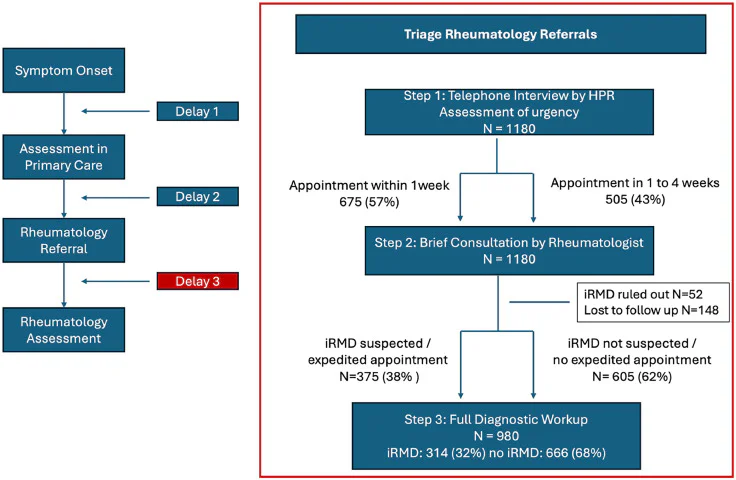
This prospective, single-center study conducted at a tertiary rheumatology center included 1180 consecutive patients referred for rheumatologic evaluation over approximately two years. The triage protocol comprised three sequential steps: 1. Telephone interview (Step 1): Conducted by trained personnel to collect clinical history and symptoms relevant to iRMD. 2. Brief rheumatologist consultation (Step 2): A 10-minute face-to-face evaluation within four weeks of the telephone screening. 3. Comprehensive inpatient assessment (Step 3): A detailed, multidisciplinary workup scheduled immediately, within four weeks, or later, based on prior steps. Researchers evaluated the diagnostic performance of steps 1 and 2 in identifying iRMD, defined based on clinical, laboratory, and imaging criteria at comprehensive assessment. Additionally, machine learning models using data from steps 1 and 2 were retrospectively developed and validated to estimate their predictive performance. Key endpoints included sensitivity, specificity, wait times, dropout rates, and area under the receiver operating characteristic curve (AUC-ROC) for ML models.Key Findings
Of the 1180 referred patients, 413 (35%) were suspected to have iRMD at initial triage, while 767 (65%) were not. Notably, only 52 patients (4.4%) were considered sufficiently unlikely to have iRMD to justify foregoing further evaluation. Hence, 1128 patients were scheduled for comprehensive assessment; among these, 148 (13.1%) dropped out before completion, and 980 completed the evaluation. Ultimately, iRMD was diagnosed in 314 (32%) of those assessed comprehensively, with 666 (68%) having noninflammatory musculoskeletal conditions. The diagnostic performance of the brief rheumatologist consultation (Step 2) yielded a sensitivity of 67.2%, correctly identifying 211 patients with iRMD, and a specificity of 75.4%, correctly recognizing 502 patients without inflammatory disease. This indicates that about one-third of iRMD cases were initially missed at this stage, emphasizing the need for the full diagnostic workup to capture all cases. Time intervals from the telephone interview to final comprehensive assessment were significantly shorter for patients ultimately diagnosed with iRMD compared to those with noninflammatory conditions (mean 33 vs 55 days), demonstrating the triage approach’s effectiveness in prioritizing urgency. Retrospective application of machine learning models yielded AUC-ROC values of 0.73 (95% CI: 0.65-0.80) for the telephone interview data (Step 1) and 0.78 (95% CI: 0.70-0.86) for the brief rheumatologist consultation data (Step 2). These moderate discriminative capabilities suggest ML-based triage could enhance sensitivity and specificity of initial assessments.Expert Commentary
The study by Redeker et al. provides pragmatic real-world evidence supporting a structured multi-step triage strategy to streamline rheumatology referrals. Prioritizing patients with higher likelihood of active inflammatory disease while safely excluding low-risk individuals is essential to optimize scarce specialist resources. The sensitivity of step 2 (67.2%) remains suboptimal, reflecting the clinical complexity of early inflammatory arthritis and overlapping presentations with other musculoskeletal disorders. This underscores that no triage shortcut can fully replace detailed diagnostic evaluation. Integration of machine learning approaches into initial screening represents an exciting advancement. Although the reported AUC-ROC values indicate only moderate accuracy, further refinement with larger datasets, incorporation of laboratory and imaging findings, and continuous model updating could improve predictive power. This aligns with the growing trend in rheumatology and medicine towards AI-assisted diagnostics. Limitations include a single-center design and some patient attrition prior to comprehensive evaluation. Generalizability to other practice settings and referral populations warrants validation. Additionally, cost-effectiveness and patient satisfaction metrics were not reported.Conclusion
This study validates a pragmatic triage protocol utilizing telephone interviews and brief rheumatologist consultations that effectively accelerates care for most patients with inflammatory rheumatic diseases while maintaining patient safety. Approximately one-third of iRMD cases are not identified initially, confirming that comprehensive assessment remains indispensable. Incorporation of machine learning offers potential to enhance triage precision and reduce diagnostic delay. Future research should focus on multicenter validation, integration of multimodal data, and implementation studies assessing impact on clinical outcomes. Optimized triage strategies are vital to meet increasing demand for rheumatology services and improve patient-centered care in inflammatory musculoskeletal diseases.Funding and ClinicalTrials.gov
Information on study funding and trial registration was not provided in the source material.References
1. Redeker I, Zacharopoulou M, Schmidt A, et al. Performance of a triage approach for identification of patients with inflammatory rheumatic and musculoskeletal diseases among rheumatology referrals. Ann Rheum Dis. 2026;85(11):2174-2182. PMID: 42701083. 2. Smolen JS, Aletaha D, McInnes IB. Rheumatoid arthritis. Lancet. 2016;388(10055):2023-2038. 3. McInnes IB, Schett G. The pathogenesis of rheumatoid arthritis. N Engl J Med. 2011;365(23):2205-2219. 4. van der Linden MP, le Cessie S, Raza K, et al. Long-term impact of delay in assessment of patients with early arthritis. Arthritis Rheum. 2010;62(12):3537-3546. 5. Tieu J, Parker C, Rowe IA, et al. Role of machine learning in clinical triage: Potential and challenges. Lancet Digit Health. 2020;2(7):e373-e375.Specialty calculators
For clinical reference; use professional judgment.