Highlights
- Subsolid nodules (SSNs), including nonsolid and part-solid ground-glass opacities (GGOs), demonstrate indolent behavior with excellent 5-year survival exceeding 98% for SSN-related mortality.
- Most nonsolid nodules remain stable over 5 years, supporting active surveillance as a safe management strategy for many patients.
- Part-solid nodules have a higher likelihood of progression and treatment, often requiring surgical or ablative interventions.
- Radiofrequency ablation (RFA), both percutaneous and transbronchial, emerges as a less invasive, effective alternative to surgery for selected patients with pulmonary GGNs.
- Secondary primary lung cancers are common in patients with SSNs, underlining the need for careful long-term surveillance beyond the index nodule.
Background
Subsolid pulmonary nodules (SSNs), characterized by nonsolid (pure ground-glass opacity) or part-solid components on computed tomography (CT), represent a distinct clinical entity within the lung adenocarcinoma spectrum. Increasingly detected through widespread CT lung cancer screening and incidental imaging, SSNs pose diagnostic and management challenges due to their heterogeneous natural history. While some progress to invasive adenocarcinoma, many exhibit indolent behavior amenable to surveillance rather than immediate intervention. Understanding the natural history, treatment outcomes, and survival patterns of SSNs is crucial to optimize clinical decision-making, minimize overtreatment, and improve patient prognosis.Key Content
Natural History of SSNs and GGOs
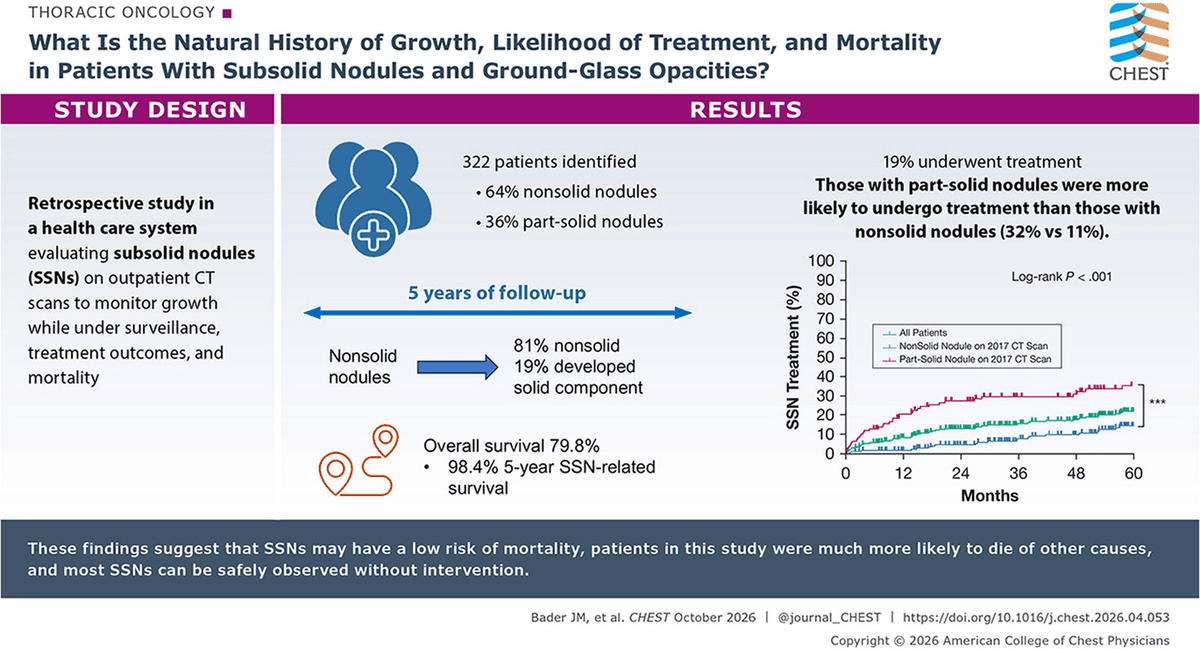
The landmark cohort study by Bader et al. (Chest 2026) analyzed 322 patients with SSNs identified from over 17,000 chest CT scans using natural language processing. Notably, 64% of nodules were nonsolid (pure GGOs), and 36% part-solid. Over a 5-year follow-up, 81% of nonsolid nodules remained stable, while 19% developed a new solid component, indicating progression risk particularly in part-solid lesions. Treatment was more common in part-solid nodules (32%) than pure nonsolid (11%), reflecting their greater malignant potential. Overall survival was 79.8%, but critically, 5-year SSN-related survival was excellent at 98.4%, with most mortality linked to secondary primary malignancies rather than the index SSN. This data supports conservative management for many SSNs, especially nonsolid types, with careful radiologic surveillance.Treatment Modalities and Outcomes
Treatment decisions hinge on nodule characteristics such as size, growth, and solid component appearance. Surgical resection, often sublobar, remains standard for resectable SSNs showing progression. However, minimally invasive alternatives are gaining traction. Several retrospective studies highlight the role of radiofrequency ablation (RFA) as a safe, effective treatment for pulmonary GGNs, especially in patients refusing surgery or with limited comorbidities. Bader et al. referenced studies demonstrating no local recurrences with RFA and shorter hospitalization and complication rates compared to thoracoscopic sublobar resection (Cardiovasc Intervent Radiol 2025; Afr Health Sci 2024). Furthermore, a multi-center clinical trial of a novel transbronchial RFA system (Respirology 2025) documented over 90% complete ablation at one year, with superior outcomes for GGNs compared to solid nodules. These findings position RFA as a promising, tissue-sparing treatment, preserving pulmonary function and minimizing morbidity. However, longer follow-up and randomized controlled trials are needed to establish definitive efficacy compared with surgery.Survival and Mortality Causes
The excellent SSN-related survival (98.4% at 5 years) underscores the indolent course of many SSNs. Importantly, patients with SSNs exhibit high rates of developing multiple lung nodules and secondary primary lung cancers, which contribute more substantially to mortality than the initial SSN lesion. This observation necessitates vigilant long-term surveillance protocols extending beyond the primary lesion. Comparative studies in inflammatory and interstitial lung diseases reveal ground-glass opacities as common radiologic findings yet with differing prognostic implications (Respir Med 2025). In systemic sclerosis-associated interstitial lung disease, ground-glass patterns respond variably to antifibrotic therapy, emphasizing the need for tailored management (Rheumatol Int 2024).Methodological Advances and Emerging Research
The application of natural language processing to large clinical imaging datasets, as employed by Bader et al., exemplifies advances in identifying SSNs at scale, enabling robust longitudinal studies. Additionally, integration of artificial intelligence and machine learning in CT image analysis holds promise for refined subtyping and prognostication of SSNs and GGOs (Crit Care 2024). The ongoing multicenter randomized controlled trial evaluating Yifei Sanjie Pill, a traditional Chinese medicine, for preventing progression in high-risk pulmonary nodules will further elucidate adjunctive pharmacologic strategies for SSN management (JMIR Res Protoc 2026).Expert Commentary
The growing prevalence of SSNs and GGOs on routine and screening CT scans demands a nuanced understanding to prevent overtreatment and optimize outcomes. The evidence consistently supports a conservative approach for pure nonsolid nodules, with intervention reserved for progression or appearance of solid components, reflecting invasive potentials. Radiofrequency ablation emerges as a less invasive, lung-sparing modality with favorable safety profiles and promising efficacy, particularly for patients unfit or unwilling to undergo surgery. Yet, current data remain predominantly retrospective; thus, prospective randomized trials are essential to confirm equivalence or superiority against surgery. The notable incidence of second primary lung cancers in SSN patients highlights the need for comprehensive surveillance strategies encompassing entire lung fields, rather than focusing solely on the index lesion. Integration of clinical, radiologic, and potentially molecular biomarkers may refine risk stratification and individualized treatment pathways. From a mechanistic standpoint, the progression from ground-glass opacity to invasive adenocarcinoma involves complex genomic alterations and stromal interactions. Future translational research delineating these pathways could reveal targets for chemopreventive or biologic therapies.Conclusion
Subsolid pulmonary nodules, comprising nonsolid and part-solid GGOs, represent a unique clinical challenge with generally favorable prognosis when managed judiciously. Evidence from large-scale retrospective cohorts confirms excellent 5-year survival with predominantly surveillance-based management. Part-solid nodules warrant closer follow-up and more frequent intervention due to higher progression risk. Minimally invasive treatments such as radiofrequency ablation show significant promise as alternatives to thoracoscopic surgery, offering lower complication rates and shorter hospital stays while maintaining excellent local control. The high prevalence of subsequent primary lung malignancies necessitates diligent long-term lung surveillance. Advances in imaging analytics and emerging therapies promise to refine management further. Future directions include prospective validation of ablative techniques, adjunctive pharmacotherapies to retard progression, and molecular profiling to guide personalized patient management.References
- Bader JM, Prince SR, de Santis W, et al. Natural History, Treatment, Survival, and Causes of Mortality in Patients With Subsolid and Ground-Glass Nodules. Chest. 2026 May 18;170(4):1326-1336. PMID: 42155700.
- Beyar-Katz O, et al. Radiofrequency Ablation Versus Thoracoscopic Sublobar Resection for the Treatment of Pulmonary Ground Glass Nodules: A Retrospective Observational Study. Cardiovasc Intervent Radiol. 2025 Apr;48(4):495-502. PMID: 39994026.
- Sun J, et al. Safety and efficacy of a novel transbronchial radiofrequency ablation system for lung tumours: One year follow-up from the first multi-centre large-scale clinical trial (BRONC-RFII). Respirology. 2025 Jan;30(1):51-61. PMID: 39197870.
- Zhang Y, et al. The effect of radio-frequency ablation in treating pulmonary ground glass nodule patients and its influence on pulmonary function. Afr Health Sci. 2024 Dec;24(4):250-257. PMID: 40190498.
- Wang N, et al. Clinical Study on the Prevention of High-Risk Pulmonary Nodule Progression With Yifei Sanjie Pill: Protocol for a Multicenter Randomized Controlled Trial. JMIR Res Protoc. 2026 Jul 15;15:e78534. PMID: 42456132.
- Keijsers RG, et al. CT Imaging Assessment of Response to Treatment in Allergic Bronchopulmonary Aspergillosis in Adults With Bronchial Asthma. Chest. 2024 Jun;165(6):1307-1318. PMID: 38387646.
- Rosas IO, et al. Tocilizumab plus Nintedanib for progressive interstitial lung disease in systemic sclerosis: a one-year observational study. Rheumatol Int. 2024 Oct;44(10):1959-1966. PMID: 39180531.