Highlight
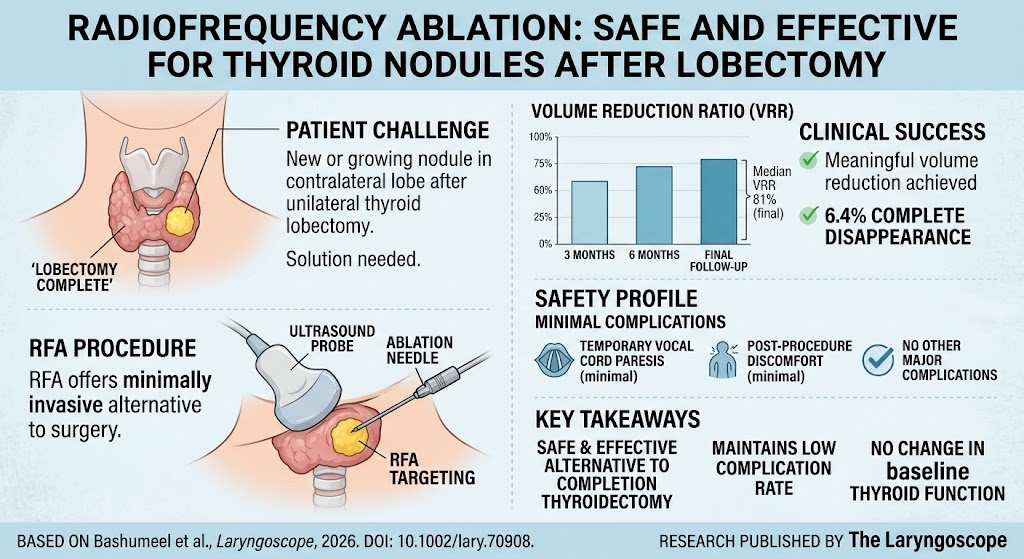
- Radiofrequency ablation (RFA) achieves substantial volume reduction of thyroid nodules in patients with prior lobectomy.
- RFA demonstrates a low complication rate, including minimal transient vocal cord paresis and discomfort.
- Post-procedure thyroid function remains stable, with no new cases of hypothyroidism or hyperthyroidism reported.
- RFA offers a minimally invasive alternative to completion thyroidectomy, reducing surgical risks.
Study Background
Thyroid nodules are commonly encountered in clinical practice, and patients who have undergone unilateral thyroid lobectomy are at risk for developing new symptomatic nodules or growth of preexisting nodules in the remaining thyroid lobe. Conventional management of these nodules often involves completion thyroidectomy, which carries surgical risks and potential complications such as hypothyroidism. Radiofrequency ablation (RFA) has emerged as a minimally invasive treatment modality that can reduce nodule volume and relieve symptoms without the need for surgery. Evaluating the safety and efficacy of RFA in post-lobectomy patients is important to determine its role as an alternative to completion thyroidectomy.
Study Design
This retrospective analysis included 47 patients with a history of thyroid lobectomy who underwent RFA for nodules in the contralateral lobe. The study population was stratified into three groups based on nodule type: 8 patients with a history of papillary thyroid carcinoma (PTC), 25 with hyperfunctioning nodules, and 14 with symptomatic benign nodules. RFA was performed by experienced operators under ultrasound guidance. Primary outcomes measured were volume reduction ratio (VRR) at 3 and 6 months and at the final follow-up. Secondary outcomes included post-procedural complications and the maintenance of thyroid function over time.
Key Findings
The median VRR at the final follow-up was 81.0%, with an interquartile range of 58% to 89%, indicating a clinically meaningful volume reduction of thyroid nodules after RFA in these patients. Complete disappearance of the nodule was achieved in 6.4% of patients, which, while modest, demonstrates the potential for full resolution in select cases. A small fraction (2.1%) of nodules showed progression during follow-up, signifying the need for ongoing surveillance.
Regarding safety, RFA was associated with minimal complications. Three patients experienced temporary vocal cord paresis, which resolved without long-term sequelae, and two reported transient discomfort or pain following the procedure. No severe adverse events such as hematoma, infection, or permanent nerve injury were observed.
Importantly, thyroid function tests revealed no deterioration from baseline in any patient post-RFA. There were no newly diagnosed cases of hypothyroidism or hyperthyroidism, suggesting that RFA preserves thyroid gland function effectively in the remaining lobe.
Expert Commentary
These findings accord with growing evidence supporting RFA as a safe and effective treatment for thyroid nodules, particularly in patients unsuitable or unwilling to undergo further surgery. The preservation of thyroid function is a significant advantage, as completion thyroidectomy often leads to hypothyroidism requiring lifelong hormone replacement. The low complication rate underscores the importance of operator experience in optimizing procedural outcomes.
Study limitations include its retrospective design and relatively small sample size, which may impact the generalizability of results. Furthermore, longer-term follow-up is necessary to establish the durability of nodule volume reduction and to monitor for late recurrences or growth.
Conclusion
Radiofrequency ablation offers a promising, minimally invasive alternative to completion thyroidectomy for treating residual thyroid nodules after lobectomy. It achieves significant volume reduction with a low risk profile and preserves thyroid function. Given these advantages, RFA should be considered in the multidisciplinary management of post-lobectomy thyroid nodules, particularly for patients at higher surgical risk or those desiring to avoid additional surgery. Future prospective studies with larger cohorts and extended follow-up are warranted to further validate these findings and to optimize patient selection criteria.
References
1. Bashumeel Y, Alsbei M, Tsakiris E, et al. Radiofrequency Ablation as a Safe and Effective Treatment for Thyroid Nodules After Lobectomy. The Laryngoscope. 2026 Sep 14; DOI: 10.1002/lary.42736038. PMID: 42736038.
2. Papini E, et al. Minimally invasive treatments for benign thyroid nodules: A systematic review. Endocrine. 2017;55(1):28-36.
3. Kim JH, et al. Efficacy and Safety of Radiofrequency Ablation for Thyroid Nodules: A Systematic Review and Meta-analysis. Thyroid. 2016;26(7):956-963.
4. Lee JH, et al. Radiofrequency ablation of benign thyroid nodules: Safety and imaging follow-up in 236 patients. Eur Radiol. 2017;27(1): 411-418.