Highlight
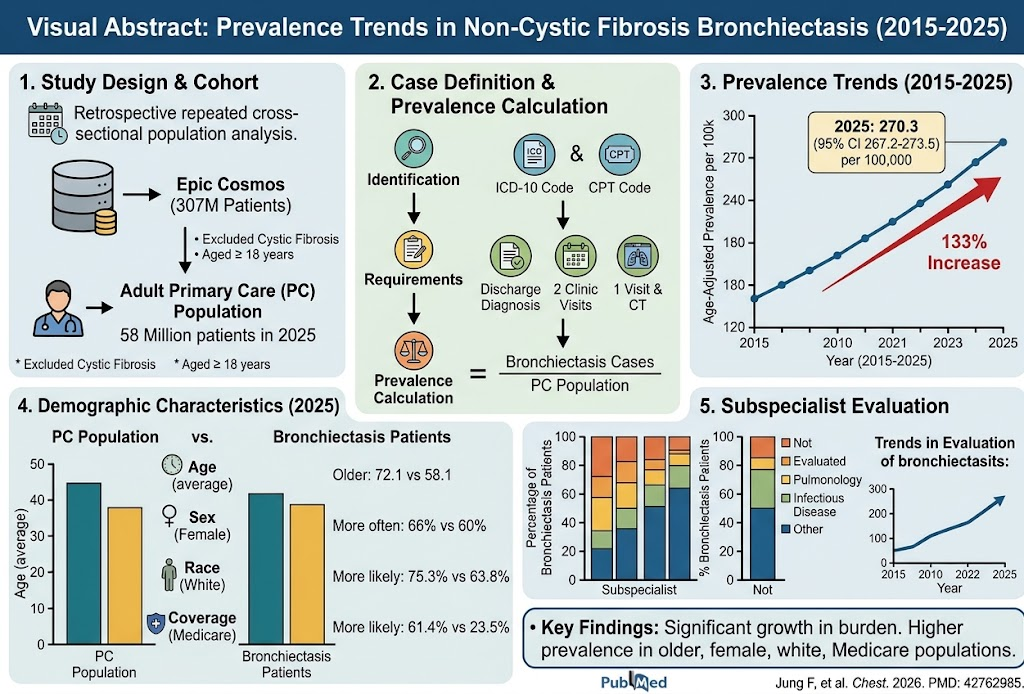
1. Non-cystic fibrosis bronchiectasis prevalence in US primary care rose markedly by 133% over 2015-2025.
2. The age-adjusted prevalence reached 270.3 per 100,000 patients in 2025.
3. Patients with bronchiectasis were more frequently older, female, white, and Medicare beneficiaries.
4. Study utilized a vast electronic health record database capturing over 307 million patients nationwide.
Study Background
Bronchiectasis, a chronic respiratory condition characterized by irreversible bronchial dilation and airway inflammation, has gained increasing clinical recognition in recent years. While cystic fibrosis bronchiectasis is well studied, limited contemporary data are available on the epidemiology of non-cystic fibrosis bronchiectasis in the United States population, especially within primary care settings. Understanding its prevalence trends and demographic distribution is critical for healthcare planning and optimizing disease management given its association with significant morbidity, frequent exacerbations, and healthcare utilization.
Study Design and Methods
This study employed a retrospective, repeated cross-sectional design to analyze trends in prevalence of non-cystic fibrosis bronchiectasis from 2015 through 2025. Data were sourced from the Epic Cosmos electronic health record (EHR) database, encompassing over 307 million de-identified patients across the United States.
The primary care (PC) cohort included adults aged 18 years and older who had at least one visit to internal medicine, family medicine, geriatrics, or gynecology providers annually. Bronchiectasis cases were identified through ICD-10 and CPT codes with strict criteria: a discharge diagnosis, two outpatient visits with bronchiectasis billing codes, or one visit with a billing diagnosis preceded by a chest CT scan, excluding any with cystic fibrosis diagnosis codes. Annual age-adjusted prevalence rates were calculated with 95% confidence intervals, supplemented by multivariable regression analyses to characterize demographic and insurance factors associated with bronchiectasis diagnosis.
Key Findings
In 2025, the primary care cohort comprised over 58 million adult patients, with 191,203 meeting the study definition for non-cystic fibrosis bronchiectasis, yielding an age-adjusted prevalence of 270.3 per 100,000 patients (95% CI, 267.2-273.5). This represented a striking 133% increase in prevalence compared with 2015.
Comparative demographic analysis revealed that bronchiectasis patients were substantially older (mean age 72.1 years vs. 58.1 years in the overall PC population), predominantly female (66% vs. 60%), and more often identified as white (75.3% vs. 63.8%). Conversely, Hispanic or Latino ethnicity was less frequent among bronchiectasis cases (5% vs. 9%). Insured status analysis showed a higher proportion of Medicare coverage in bronchiectasis patients (61.4% vs. 23.5%), consistent with older age demographics.
The increase in prevalence may reflect enhanced clinical recognition, increased use of diagnostic imaging (notably chest CT), aging population, or true rising disease burden. Notably, the stringent case definition incorporating diagnostic imaging ensures robustness but may affect sensitivity and under-ascertain milder or undiagnosed cases.
Expert Commentary
These findings underscore a rising clinical burden of non-cystic fibrosis bronchiectasis within US primary care, highlighting the need for increased provider awareness and resource allocation for management. The observed demographic trends align with prior literature suggesting bronchiectasis predominates in older adult women of white race/ethnicity.
However, limitations inherent in EHR-based retrospective analyses include potential coding inaccuracies, selection bias towards patients receiving care, and inability to capture disease severity or longitudinal outcomes fully. Additionally, reliance on ICD and CPT codes, despite rigorous criteria, may omit undocumented or subclinical cases. Future prospective population-based studies incorporating standardized diagnostic criteria and clinical phenotyping are warranted to validate these trends and explore underlying etiologies.
Conclusion
This large-scale EHR analysis reveals a substantial increase in the prevalence of non-cystic fibrosis bronchiectasis in US primary care over a recent decade, predominantly affecting older, white females with Medicare coverage. These data provide critical epidemiologic insight, informing clinicians, researchers, and policymakers on the expanding impact of bronchiectasis and the importance of targeted strategies for diagnosis and care delivery in this vulnerable population.
Funding and Disclosures
The original study did not report specific funding information. No conflicts of interest were disclosed within the source publication.
References
1. Chalmers JD, Aliberti S, Blasi F. Management of bronchiectasis in adults. Eur Respir J. 2015 Sep;47(3):672-91. doi: 10.1183/13993003.00692-2015.
2. Weycker D, Hansen GL, Seifer FD, et al. Epidemiology and burden of bronchiectasis. Adv Ther. 2017 May;34(7):2096-2107. doi: 10.1007/s12325-017-0540-5.
3. McShane PJ, Naureckas ET, Tino G, Strek ME. Executive Summary: An Official American Thoracic Society Clinical Practice Guideline: Diagnosis and Treatment of Idiopathic Bronchiectasis. Am J Respir Crit Care Med. 2018 Oct 15;198(6):608-613. doi: 10.1164/rccm.201803-0645ST.
4. King PT. The pathophysiology of bronchiectasis. Int J Chron Obstruct Pulmon Dis. 2009;4:411-9. doi: 10.2147/COPD.S4964.
5. Jung F, MacRae S. Non-Cystic Fibrosis Bronchiectasis in the United States: Prevalence Trends in a Large Electronic Health Record Population, 2015-2025. Chest. 2026 Sep 19. PMID: 42762985.