Highlights
- Prepare for Kidney Care trial demonstrates no significant QALY difference between preparing for responsive management versus renal dialysis in older, frail or multimorbid patients with kidney failure over 4.5 years.
- Responsive management is associated with significantly fewer dialysis access complications, an important consideration in patient morbidity.
- The trial’s pragmatic design and extensive multicenter UK recruitment enhance generalizability for clinical decision-making in elderly kidney failure cohorts.
- Complementary interventions addressing symptom control, physical function, and patient quality of life are critical adjuncts regardless of treatment modality.
Background
Chronic kidney disease (CKD) and kidney failure represent major healthcare burdens globally, with an increasing number of elderly patients characterized by complex multimorbidity and frailty. Ageing populations and advances prolonging survival have emphasized the need for evidence-based, patient-centered management strategies that balance life prolongation against functional status and quality of life (QoL). Dialysis initiation in elderly, vulnerable patients remains controversial due to uncertain survival benefits and potential burdens including hospitalizations and treatment complications. Conversely, conservative or responsive management—encompassing symptom control and supportive care without dialysis—has been employed but lacked high-quality comparative evidence against dialysis in this demographic. The Prepare for Kidney Care trial addresses this critical knowledge gap within the UK health context.Key Content
Prepare for Kidney Care Trial Overview
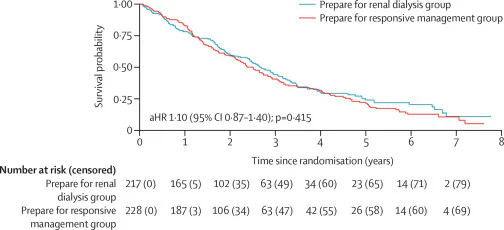
The Prepare for Kidney Care (PFKC) trial was a landmark, phase 3, pragmatic, open-label, superiority randomized controlled trial (RCT) conducted across 31 kidney centers in the UK (England, Wales, Scotland, Northern Ireland). Inclusion criteria targeted patients with kidney failure (eGFR <15 mL/min/1.73 m2), aged ≥80 years regardless of frailty, or aged 65-79 years with WHO performance status ≥3 or Davies comorbidity score ≥2—thus representing a frail or multimorbid elderly population for whom dialysis outcomes were uncertain. Participants (N=445) were randomized 1:1 to prepare for responsive management or to prepare for renal dialysis. Responsive management followed a protocolized, patient-centered approach focusing on slowing disease progression, active symptom management, and QoL preservation without dialysis or transplantation. The control arm involved standard preparation for renal dialysis. The primary endpoint was mean difference in quality-adjusted life years (QALYs) measured by EQ-5D-5L, capturing both survival duration and health-related QoL, analyzed by intention-to-treat over a mean follow-up of 4.5 years. Secondary safety outcomes included hospital admissions, dialysis access complications, deaths, and serious adverse events.Trial Findings and Interpretation
The trial found no statistically significant difference in mean QALYs between responsive management (1.354; 95% CI 1.201-1.508) and renal dialysis groups (1.472; 95% CI 1.288-1.655), adjusted mean difference −0.147 (95% CI −0.350 to 0.056; p=0.16). This suggests equivalence in combined length and health-related QoL outcomes. Adverse events, including hospital admissions and deaths, were comparable between groups, reinforcing safety parity. Importantly, dialysis access complications were significantly fewer in the responsive management group (adjusted incident rate ratio 0.41; 95% CI 0.19-0.88), highlighting reduced procedure-related morbidity. These outcomes support that in older, frail, or multimorbid patients, dialysis initiation does not confer superior QoL-adjusted survival compared with conservative management. This provides crucial data supporting shared decision-making incorporating patient preferences and clinical factors.Complementary and Supportive Care Trials: Exercise and Symptom Management
Emerging evidence emphasizes the role of adjunctive interventions to address frailty and functional decline in CKD and dialysis populations. For instance, nurse-led multicomponent exercise regimens in hemodialysis patients have demonstrated favorable, though not uniformly statistically significant, improvements in muscle strength and physical function, as well as QoL trends, indicating safety and feasibility (PMID: 42963345). Similarly, telehealth-supported home-based exercise programs for non-dialysis stage 4–5 CKD patients have shown significant enhancements in functional capacity, sarcopenia risk reduction, and patient-reported outcomes (PMID: 42669568). These interventions could be integral to responsive management paradigms.Additional Insights on Related Hemodialysis Management Strategies
Studies addressing other aspects of dialysis care are relevant to comprehensive management decisions: – Ferric citrate and sevelamer carbonate show comparable efficacy for hyperphosphatemia control in maintenance hemodialysis, with ferric citrate additionally improving iron parameters (PMID: 42675918). – Central venous catheter locking solutions (trisodium citrate vs. heparin) demonstrate similar safety and functionality profiles, informing dialysis access management (PMID: 41820022). – Novel adjuncts such as transcutaneous vagus nerve stimulation may enhance dialysis efficacy and symptom burden relief (PMID: 39754453). – Cognitive impairment treatment with thiamin and folic acid supplementation in maintenance hemodialysis patients improves cognitive scores without increasing adverse events (PMID: 42059045).Mechanistic and Biological Perspectives
Responsive management focuses on holistic symptom control, avoiding the physiological stresses and complications associated with dialysis initiation, such as vascular access-related infections and cardiovascular strain. The equivalence in QALYs suggests that in frail older adults, prolonging survival without dialysis but with effective symptom management can preserve meaningful QoL. Exercise interventions potentially modulate skeletal muscle fibrosis, capillarization, and satellite cell activity, mitigating sarcopenia and physical decline common in CKD, even prior to dialysis initiation. This underscores the need for integrated multimodal care.Expert Commentary
The Prepare for Kidney Care trial addresses a long-standing clinical dilemma with a robust, pragmatic RCT design and thorough follow-up. The lack of superiority of dialysis in this vulnerable cohort may influence clinical guidelines, supporting a more nuanced, individualized approach to renal replacement therapy decisions in aging populations with frailty or multimorbidity. Current CKD management guidelines (e.g., NICE, KDIGO) emphasize shared decision-making, integrating patient values, functional status, and prognosis. This trial provides high-grade evidence reinforcing that conservative management is a viable option without compromising quality-adjusted survival. Limitations include the open-label design and predominant UK-based population, which may affect generalizability in different healthcare settings. The relatively small number of eligible patients screened compared with those randomized reflects stringent inclusion criteria, appropriate for targeting the frail elderly demographic. Future research should explore stratified approaches incorporating biomarkers, frailty indices, and patient-reported outcomes to optimize modality selection. Integrative supportive interventions such as physical rehabilitation, nutritional support, and cognitive therapies warrant incorporation into care models.Conclusion
The Prepare for Kidney Care trial substantiates that among older adults with kidney failure and frailty or multimorbidity, preparing for responsive management yields comparable quality-adjusted life expectancy to preparation for renal dialysis over 4.5 years, with fewer dialysis access complications. This finding supports comprehensive, patient-centered decision-making that values quality of life and functional status. Supplementary studies demonstrate the importance of multimodal supportive care including exercise interventions and adjunctive therapies to enhance outcomes across CKD stages. Continued research should refine individualized approaches, integrating clinical, biological, and patient-reported factors to optimize outcomes.References
- Caskey FJ et al. Preparing for responsive management versus renal dialysis in older people living with kidney failure and frailty or multimorbidity in the UK (Prepare for Kidney Care): a two-arm, superiority, parallel-group, open-label, pragmatic, phase 3, individually randomised controlled trial. Lancet. 2026 Nov 4. PMID: 42982076.
- Szeto CC et al. Efficacy and safety of ferric citrate tablets in Chinese patients with hyperphosphatemia undergoing maintenance hemodialysis: a multicenter, randomized, open-label, active-controlled, phase III trial. Ren Fail. 2026 Dec;48(1):2534019. PMID: 42675918.
- Hunter AJ et al. Effects of a Nurse-Led Multicomponent Exercise Intervention for Haemodialysis Patients With Possible or Confirmed Sarcopenia: A Cluster Randomised Trial. Nurs Open. 2026 Nov;13(11):e70651. PMID: 42963345.
- Chen KK et al. Effects of a telehealth-supported home-based exercise program on functional capacity, sarcopenia risk, and patient-reported outcomes in non-dialysis stage 4-5 chronic kidney disease. J Nephrol. 2026 Oct;39(8):1668-1677. PMID: 42669568.
- Chua AT et al. A prospective, randomized, double-blind, placebo-controlled, multicenter study of thiamin plus folic acid in the treatment of cognitive impairment in patients undergoing maintenance hemodialysis. Ren Fail. 2026 Dec;48(1):2658981. PMID: 42059045.
- Wang J et al. Comparative efficacy of low-concentration trisodium citrate and low-concentration heparin for locking central venous hemodialysis catheters: a randomized controlled study. Ren Fail. 2026 Dec;48(1):2641842. PMID: 41820022.
- Nakamura Y et al. Effect of transcutaneous vagus nerve stimulation in hemodialysis patients: A randomized controlled trial. Ther Apher Dial. 2026 Oct;30(5):739-748. PMID: 39754453.
Specialty calculators
For clinical reference; use professional judgment.