Highlight
- Shotgun metagenomic sequencing of saliva reveals distinct microbial profiles across periodontal health and disease stages.
- Enrichment of key pathogenic bacteria such as Porphyromonas gingivalis and Treponema denticola is associated with advanced periodontal disease.
- Nonbacterial microorganisms including Candida and certain viruses also show differential abundance linked to periodontal status.
- A composite metagenomic classifier based on salivary taxa accurately identifies individuals with gingivitis and severe periodontitis, demonstrating potential as a non-invasive diagnostic tool.
Study Background
Periodontal disease is a prevalent chronic inflammatory condition affecting the supporting structures of teeth, leading to tissue destruction and tooth loss if untreated. Traditional diagnosis relies on clinical and radiographic evaluations, which often detect disease at advanced stages. The oral cavity hosts a complex microbiome with bacteria, fungi, and viruses playing roles in health and disease. Saliva reflects this microbial ecosystem and offers an accessible medium for microbial profiling. Understanding the microbial shifts associated with periodontal disease progression can facilitate earlier detection and targeted interventions, addressing a significant unmet clinical need in oral health management.Study Design
This cross-sectional investigation involved 204 adults (mean age 40.3 ± 7.6 years) enrolled in the SECRETO study (NCT01934725). Participants underwent comprehensive clinical and radiographic oral assessments, categorizing them into six periodontal classifications: periodontal health, localized gingivitis, generalized gingivitis, gingivitis with pockets, mild periodontitis (Stages I-II), and severe periodontitis (Stages III-IV). Unstimulated saliva samples were collected and subjected to shotgun metagenomic sequencing. Bioinformatics analyses evaluated microbial diversity, identified taxonomic compositions across bacterial, fungal, viral, and phage communities, and explored functional metabolic pathways. The study also developed composite classifiers to discriminate periodontal states based on microbiome features.Key Findings
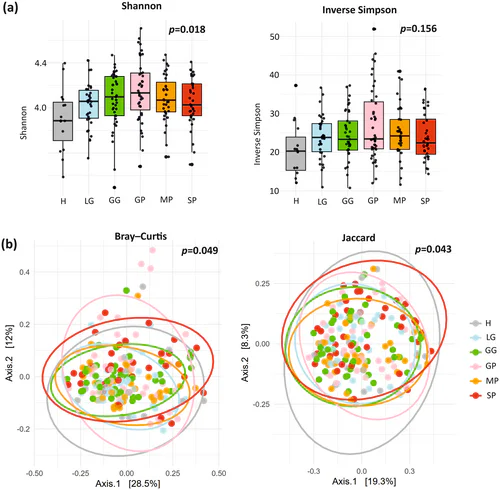
Analysis revealed significant differences in beta diversity metrics (Bray-Curtis and Jaccard indices) between healthy and disease states (p = 0.049 and p = 0.043 respectively), indicating microbial community shifts with disease progression. Pathogenic bacterial species including Porphyromonas gingivalis, Tannerella forsythia, Treponema denticola, Porphyromonas endodontalis, Fusobacterium nucleatum, and Parvimonas micra were significantly enriched in gingivitis with pockets and severe periodontitis groups. These taxa are well-established periodontal pathogens implicated in tissue destruction and inflammation. Beyond bacteria, fungal genus Candida, phage genus Moineauvirus, fungal genus Pyricularia, and viral genus Roseolovirus were prominently detected and differentially abundant in disease states, highlighting a multi-kingdom microbial shift during periodontal progression. Functional pathway analyses elucidated alterations in microbial metabolic capabilities aligned with disease severity, such as increased virulence factor pathways and shifts in biofilm-related processes. A metagenomic composite classifier constructed from these alterations effectively discriminated gingivitis with pockets (AUC = 0.90; 95% CI: 0.770-1.000) and severe periodontitis (AUC = 0.865; 95% CI: 0.762-0.968), demonstrating strong potential as a diagnostic biomarker tool.Expert Commentary
This study provides robust evidence that salivary microbiome alterations mirror periodontal disease states and progression. The use of shotgun metagenomics enables comprehensive detection beyond traditional bacterial targets to include fungi and viruses, shedding light on the complex microbial ecology in oral health and disease. However, as a cross-sectional study, causal relationships between microbiome changes and disease progression cannot be firmly established. Longitudinal studies are warranted to confirm the predictive value of identified biomarkers. Additionally, while saliva is a convenient diagnostic medium, factors such as diet, oral hygiene, and systemic health may influence microbial profiles and should be accounted for in future validations. These findings align with the growing recognition that periodontal disease is a polymicrobial and multi-kingdom dysbiosis-driven condition, supporting precision diagnostics and personalized periodontal care approaches.Conclusion
Shotgun metagenomic analysis of saliva reveals distinct taxonomic and functional microbial transitions closely associated with periodontal disease progression. The identification of specific bacterial, fungal, and viral signatures provides promising biomarkers for early detection and risk stratification. Future integration of multi-kingdom microbial profiling into clinical practice could enhance periodontal disease diagnosis, guide tailored therapies, and improve oral health outcomes.Funding and Clinical Trials Registration
This research was supported by the SECRETO study framework. The study is registered on ClinicalTrials.gov under identifier NCT01934725.References
1. Page RC, Eke PI. Case Definitions for Use in Population-Based Surveillance of Periodontitis. J Periodontol. 2007;78(7 Suppl):1387-1399. 2. Hajishengallis G. The inflammophilic character of the periodontitis-associated microbiota. Mol Oral Microbiol. 2014;29(6):248-257. 3. Paju S, Pussinen PJ, Suominen-Taipale L, et al. Periodontal infection and atherosclerosis: what evidence is needed for a causal association? J Clin Periodontol. 2009;36 Suppl 10:51-65. 4. Abusleme L, Dupuy AK, Dutzan N, et al. The subgingival microbiome in health and periodontitis and its relationship with community biomass and inflammation. ISME J. 2013;7(5):1016-1025. 5. Dewhirst FE, Chen T, Izard J, et al. The human oral microbiome. J Bacteriol. 2010;192(19):5002-5017. 6. Belstrøm D. The salivary microbiota in health and disease. J Oral Microbiol. 2020;12(1):1723975. 7. Manzoor M, Leskelä J, Könönen E, et al. Shotgun Metagenomic Analysis Reveals Taxonomic and Functional Transitions in the Salivary Microbiome During Periodontal Disease Progression. J Clin Periodontol. 2026 Aug 9;53(11):1650-1662. doi:10.1111/jcpe.13578.Specialty calculators
For clinical reference; use professional judgment.