Highlight
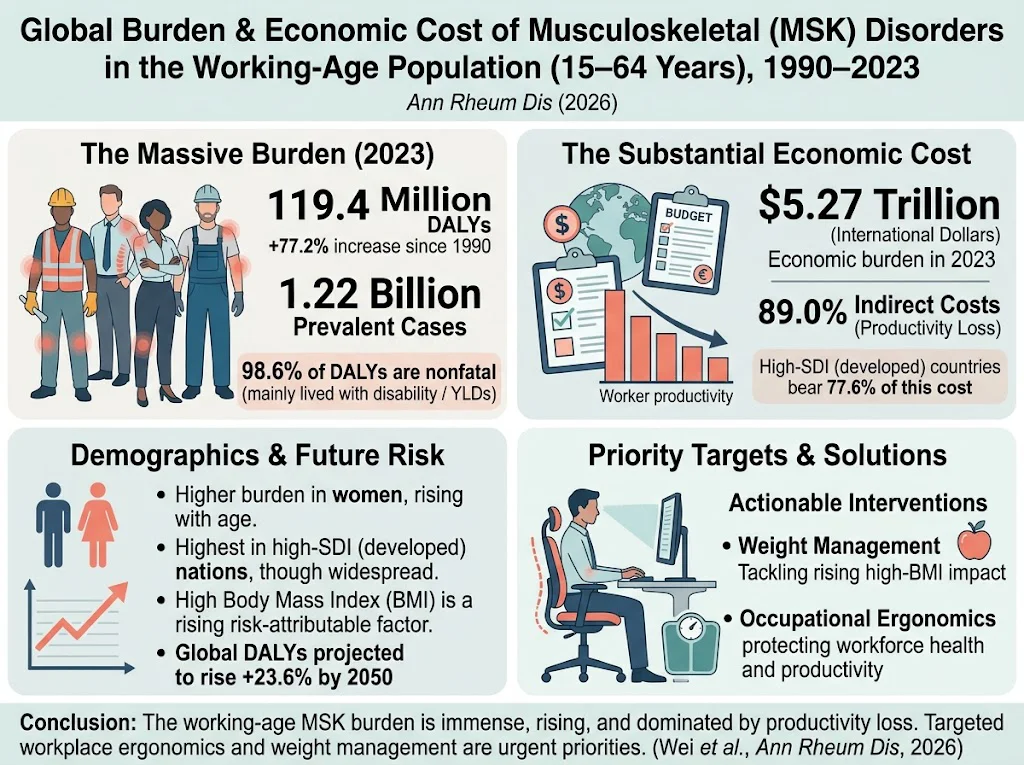
This comprehensive analysis reveals that musculoskeletal (MSK) disorders continue to be the foremost cause of disability among the global working-age population, with nearly 120 million disability-adjusted life years (DALYs) lost in 2023, representing a 77% increase since 1990. The economic impact is profound, totaling over 5 trillion international dollars, with the vast majority attributable to productivity loss and concentrated in high-socio-demographic index (SDI) countries. Alarmingly, the burden is projected to escalate by approximately 24% by 2050, underscoring an urgent need for targeted prevention strategies focusing on weight management and occupational ergonomics.
Study Background
Musculoskeletal disorders encompass a broad range of conditions affecting bones, joints, muscles, and connective tissues, such as osteoarthritis, rheumatoid arthritis, low back pain, and neck pain. These conditions are among the leading causes of disability worldwide, profoundly impacting individuals’ quality of life and societal productivity. Despite extensive research, the aggregated burden and economic cost borne specifically by the working-age population (15–64 years), the demographic segment critical for economic growth, have not been fully characterized. This knowledge gap limits effective policy-making and resource allocation, especially as MSK disorders increasingly contribute to long-term work disability.
Study Design
This study undertook a secondary analysis using data from the Global Burden of Disease (GBD) Study 2023, spanning 204 countries and territories. The analysis focused on individuals aged 15 to 64 to quantify prevalence, incidence, years lived with disability (YLDs), and DALYs attributable to MSK disorders. Key metrics were stratified across sex, age groups, and the Socio-demographic Index (SDI), a composite measure reflecting income, education, and fertility rates. The study further explored trends over 33 years (1990–2023), the burden’s distribution inequalities, risk factors (notably high body mass index), and projected the future global impact through 2050. A cross-national economic model calculated direct medical costs alongside indirect costs primarily from productivity losses.
Key Findings
In 2023, MSK disorders accounted for approximately 119.4 million DALYs globally among working-age individuals, marking a substantial increase of 77.2% from 1990. Nearly all of these DALYs (98.6%) relate to nonfatal disability rather than mortality, emphasizing the chronic, disabling nature of MSK conditions. The burden was higher in women and increased with age within the 15–64 range. Geographically, high-SDI countries experienced the greatest burden and economic costs, with a significant positive correlation (r = 0.59) between SDI and DALY rates; however, differences across SDI quintiles were somewhat modest, indicating MSK disorders’ widespread impact regardless of development status.
Prevalence reached an unprecedented 1.22 billion cases globally, highlighting the massive population affected. The economic cost was estimated at 5.27 trillion international dollars, with indirect costs from productivity loss comprising 89.0%, and high-SDI countries bearing 77.6% of this financial burden. Rising high body mass index (BMI) attributable fractions indicate obesity as a growing modifiable risk factor contributing to these disorders.
Projections suggest a global DALY increase of 23.6% by 2050, with incremental changes in age-standardized rates of less than 6% across all SDI strata, suggesting population aging and growth are key drivers rather than worsening individual risk. This projection underscores persistent and escalating challenges for healthcare and occupational systems worldwide.
Expert Commentary
This extensive and robust analysis emphasizes the escalating global public health challenge posed by MSK disorders among working-age adults. The dominance of indirect economic costs due to lost productivity underscores the importance of interdisciplinary approaches integrating clinical care, workplace ergonomics, and public health initiatives. Current international rheumatology and orthopedics guidelines advocate early diagnosis, weight management, physical activity, and ergonomic interventions; however, tailored policies addressing low- and middle-income countries are urgently needed to prevent widening disparities.
While the study’s strong points include comprehensive global data and economic modeling, limitations inherent in GBD data—such as reliance on heterogeneous data sources and potential underreporting—must be acknowledged. Despite modest variation across SDI quintiles, differential access to healthcare and social support may affect real-world impacts. Future research should focus on longitudinal cohort studies to clarify causality and effectiveness of preventive strategies.
Conclusion
Musculoskeletal disorders represent a mounting global burden predominantly affecting the working-age population, with significant health and economic repercussions worldwide, especially in developed and rapidly industrializing regions. The substantial indirect costs highlight lost workforce productivity as a critical factor. Priorities must include comprehensive weight management programs and improved occupational ergonomics to mitigate risk and preserve workforce health. Concerted efforts involving policymakers, healthcare providers, employers, and individuals are essential to address this growing public health crisis effectively and equitably.
Funding and ClinicalTrials.gov
This analysis was conducted using publicly available data from the Global Burden of Disease Study 2023. No new clinical trials were conducted for this study. Funding sources for the original GBD study included various global health organizations; specific funding information can be referenced in the original publication.
References
- Wei Z, Ji X, Lin D, et al. Global burden and economic cost of musculoskeletal disorders in the working-age population, 1990-2023. Ann Rheum Dis. 2026; PMID: 42982720.
- Global Burden of Disease Collaborative Network. Global Burden of Disease Study 2023 Results. Seattle, United States: Institute for Health Metrics and Evaluation (IHME), 2024.
- Smith E, Hoy DG, Cross M, et al. The global burden of other musculoskeletal disorders: estimates from the Global Burden of Disease 2010 study. Ann Rheum Dis. 2014;73(8):1462-9.
- World Health Organization. Musculoskeletal conditions. https://www.who.int/news-room/fact-sheets/detail/musculoskeletal-conditions. Accessed June 2024.
Specialty calculators
For clinical reference; use professional judgment.